Schloss Rosenbichl: A Historic Castle Residence in Austria
Site at a Glance
- Rating
- 4.7
- Popularity
- Very Low
- Country
- Austria
- Primary era
- Medieval
- Eras represented
- Medieval, Early Modern, Modern
- Civilizations
- Holy Roman Empire
- Site type
- Domestic
- Remains
- Castle
On this page8 sections
History
Medieval Estate and Early Development
The documented predecessors of Schloss Rosenbichl in Austria reach back to 1268, when a farm called Puehlaren occupied the site. By the fifteenth century, the settlement and estate were known as Minzenbach. The Gradenegger family held the property in the fourteenth century and granted it to the Kulmer family, whose members and descendants retained the Rosenbichl estate until 1676.
The Kulmer Residence
From 1535, the Kulmer family built a “new house” from components of earlier buildings. This work created a noble residence and established the name Rosenbichl for both the estate and the locality. In 1566, Freiherr Ernst Wilhelm von Kulmer, a baron, enlarged the residence with additional structures. The building’s later character developed through repeated alterations to this earlier complex.
Monastic, Industrial, and Charitable Ownership
In 1676, the Kulmers sold the residence and its associated lands to Bishop Johann von Sulzbach. Franz Andrä von Aschau acquired it in 1681, and in 1685 the property passed to Johann Stieff von Cräntzen, provost of Kraig. A provost was the senior official of certain religious institutions. Stieff von Cräntzen bequeathed Rosenbichl to St. Georgen am Längsee monastery.
Count Maximilian Thaddäus von Egger, an iron industrialist, acquired the estate in 1786 along with other holdings formerly associated with the monastery. After Carinthia’s iron industry declined and the Egger family experienced financial difficulties, Rosenbichl was sold to the Alpine Montangesellschaft, an Austrian mining and metallurgical company, in 1873.
In 1889, the lawyer Franz Prettner of Sankt Veit an der Glan acquired the property and bequeathed it to the Elisabethinen convent in Klagenfurt. The Elisabethinen are a Catholic religious order associated with nursing and care for the sick. Rosenbichl subsequently became a convent branch and a convalescent home for Elisabethinen sisters working in nursing. A fundamental renovation in 1935 added another storey and altered the buildings. Since October 2012, Schloss Rosenbichl has been privately owned.
Remains
Castle Complex
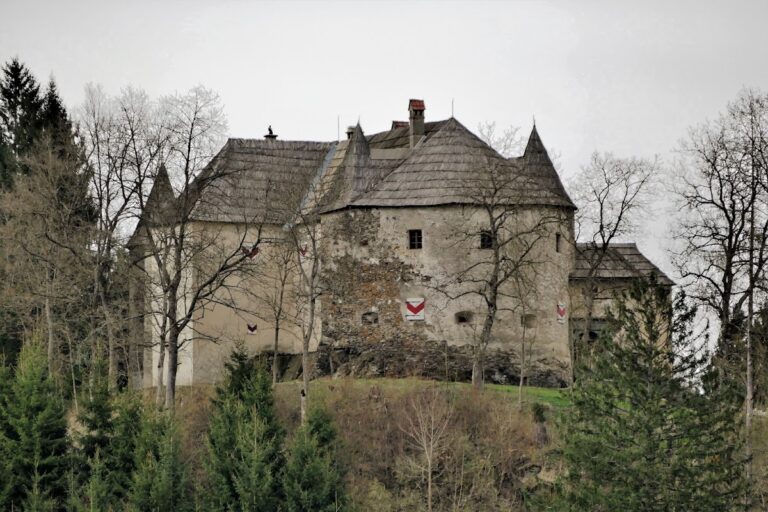
Schloss Rosenbichl stands near Pulst in the municipality of Liebenfels, on a slope of the Buchberg northeast of the village. The complex developed over several earlier buildings. Its Romanesque core reflects a medieval architectural tradition characterized by substantial masonry and rounded arches, while the present structure is a three-storey late Gothic castle. It has a rectangular plan with two wings set at right angles around a small, walled courtyard.
Entrance and Agricultural Buildings
Access to the castle is provided by a simple stone gate. A drawbridge formerly stood in front of the entrance. Agricultural outbuildings were added east of the main building at a later date, extending the complex beyond the principal residence.
Altered Interior and Exterior
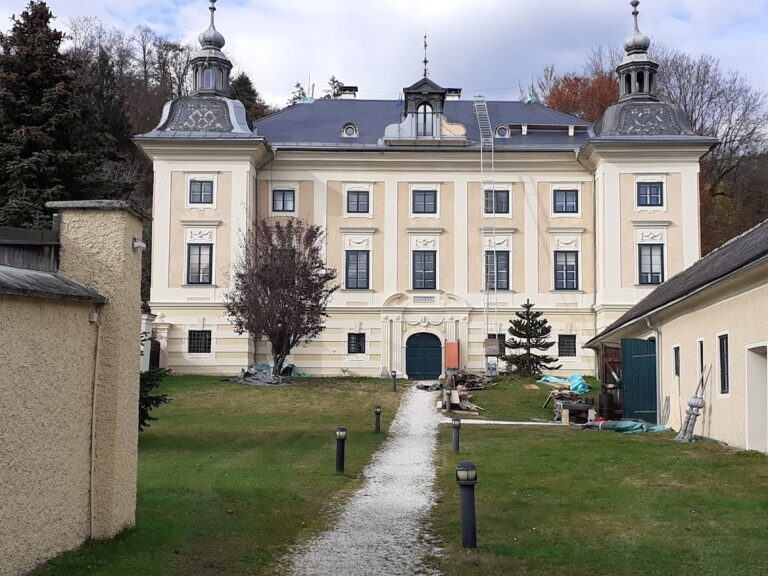
The additional storey and other changes made in 1935 adversely altered the proportions of the buildings and obscured the character of the former small Renaissance country residence of the Carinthian lesser nobility. The interior is furnished in a modern style and retains little of its former historic equipment, partly as a result of repeated alterations and changes of use.