Schloss Thorn: A Medieval Castle and Wine Estate in Germany


Site at a Glance
- Rating
- 4.5
- Popularity
- Very Low
- Country
- Germany
- Primary era
- Early Modern
- External website
- Open
- Eras represented
- Medieval, Early Modern, Modern
- Civilizations
- French, Holy Roman Empire
- Site type
- Domestic
- Remains
- Manor House
On this page10 sections
History
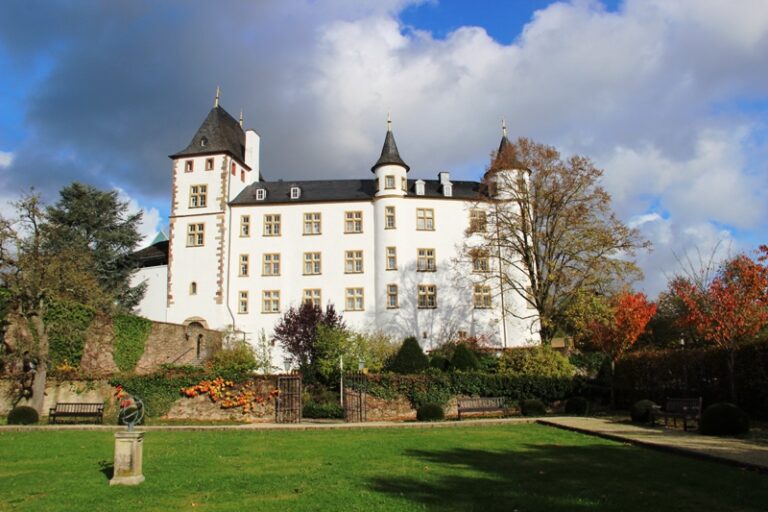
Schloss Thorn is a former medieval castle in Germany, built in the thirteenth century and later transformed into a stately home incorporating medieval, Renaissance, Baroque, and Empire-period elements. It stands in the locality of Schloss Thorn within the municipality of Palzem, overlooking the Moselle valley and the Saargau. The estate is described as the oldest castle wine estate on the Moselle.
Roman and Medieval Origins
About 2,000 years ago, the Romans built a guard tower on a projecting rock above a ford across the Moselle. Its purpose was to protect and observe this crossing. The name Thorn derives from the Latin turris, meaning “tower.”
A medieval castle was constructed on the site in the thirteenth century. By the end of the fifteenth century, it had fallen into disrepair. In 1536, a new owner rebuilt the complex, retaining two towers and part of the surrounding ring wall.
Noble Ownership and the Stately Estate
From the Middle Ages onward, Thorn belonged to several noble families. The lords of Rollingen, hereditary marshals of Luxembourg, and the lords of Bübingen were followed by the lords of Musiel, a family of Lorraine nobility. Laurant von Musiel represented the family at Thorn and maintained a recognized museum collection there that included Gallic coins.
Ownership later passed through Marie von Musiel, her marriage to Henri de la Fontaine, and their daughter Marie-Amélie de Fontaine, known as Mia. Mia’s daughter Marita and her husband, Bertram Baron von Hobe-Gelting, subsequently held the estate. Schloss Thorn remains in the von Hobe-Gelting family, whose barons are its current owners.
In 1800, a new manor house changed the character of the complex, turning it into a stately-home estate. The former defensive works were reshaped as garden terraces. This transformation added an Empire-style phase, an early nineteenth-century style associated with the Napoleonic era and its aftermath, to the site’s earlier architectural layers.
War Damage and Continuing Estate Use
A round tower was destroyed during the bombardment of 1945. Schloss Thorn remains in residential use, while wine continues to be produced from the vineyards surrounding the estate. The family has owned these vineyards since 1534, maintaining the estate’s agricultural connection across centuries of architectural change.
Remains
Castle Layout and Later Building Group
Schloss Thorn occupies a height overlooking the approach to the Moselle valley and the Saargau. The site is cut off by the Moselle and the Kreuzweiler Bach, forming the southwestern corner of Landkreis Trier-Saarburg. It lies across the river from the Luxembourg town of Remich.
The present building group developed from the remains of a probably rectangular medieval castle defended by round corner towers. The 1536 rebuilding preserved two towers and part of the ring wall. Extensions from the sixteenth and seventeenth centuries, together with the manor house erected in 1800, now bring medieval, Renaissance, Baroque, and Empire-period fabric into one complex. The former defensive installations survive in altered form as garden terraces.
Gate Tower
The surviving rectangular tower was formerly an inhabitable residential tower. It now serves as the gate tower and forms one of the clearest surviving elements of the medieval castle.
Southeastern Round Tower
A second surviving round tower once stood at the southeastern corner of the castle. It was destroyed during the bombardment of 1945, while the remaining castle fabric continues to express the complex’s earlier defensive arrangement.
Wine-Production Features
Tree Wine Press
Schloss Thorn preserves Europe’s only preserved tree wine press. The press remains in regular use and reflects the long-standing relationship between the castle estate and the surrounding vineyards.
Nearby sites