Schloss Bübingen: A Ruined Renaissance Castle in Germany


Site at a Glance
- Rating
- 3.9
- Popularity
- Low
- Country
- Germany
- Primary era
- Early Modern
- External website
- Open
- Eras represented
- Medieval, Early Modern
- Civilizations
- Duchy of Lorraine, Holy Roman Empire
- Site type
- Military
- Remains
- Castle
On this page7 sections
History
Schloss Bübingen is a ruined castle in Germany that developed from a Frankish manorial estate into a fortified residence and later a Renaissance castle. The estate formed in the Moselle region after the Franks displaced Roman power there, and it eventually lay within the Lordship of Nennig.
The Lordship of Nennig
Until 1769, territorial sovereignty in Nennig was jointly exercised by the Elector of Trier, the Duke of Lorraine, and the Duke of Luxembourg. The Elector of Trier was the prince-archbishop who ruled the Electorate of Trier and also held the electoral office of choosing the German king. Schloss Bübingen served as the seat of a Luxembourg lordship, while nearby Schloss Berg was the seat of a Lorraine lordship. The inhabitants of Nennig and its districts, including Nennig, Wies, Berg, and Bübingen, were therefore subject to different rulers within the same wider territory.
From manor to castle
Between 1330 and 1340, Gobel von Remich, the Luxembourg land provost, converted the Bübingen manor into a moated castle. A land provost was a senior territorial official who administered an area for its ruler. Together with nearby Schloss Thorn, the castle was intended to secure the Moselle crossing at Remich.
The complex later developed into a Renaissance castle, combining the residential and representational purposes of a palace with Renaissance architectural forms. French troops under Marshal Créquy, a senior French military commander, completely destroyed the castle in 1668.
Rebuilding and wartime destruction
Schloss Bübingen was rebuilt during the second half of the eighteenth century. In 1940, ownership passed to the Saarburg district, after which the building served as a teacher-training institution for women.
During the heavy fighting around the Orscholzriegel in late 1944 and early 1945, German defenders used the castle as an observation post. The Orscholzriegel was the defensive position around which German and American forces fought during that period. In January or February 1945, the American 94th Infantry Division attacked Schloss Bübingen. American forces blew up part of the castle wall to eliminate a German machine-gun position inside. Defenders in the upper floors were captured or shot, while troops in the cellar were killed by explosive charges thrown into it. Schloss Bübingen has remained a ruin since 1945.
The castle archive
In 1939, the staff physician Dr. Harms discovered the castle archive in the attic and transferred it to the Landesmuseum in Trier, saving it from destruction. The historical archive remained housed at the castle until 1954 and is now kept at the Saarbrücken State Archives.
Remains
Rebuilt castle form
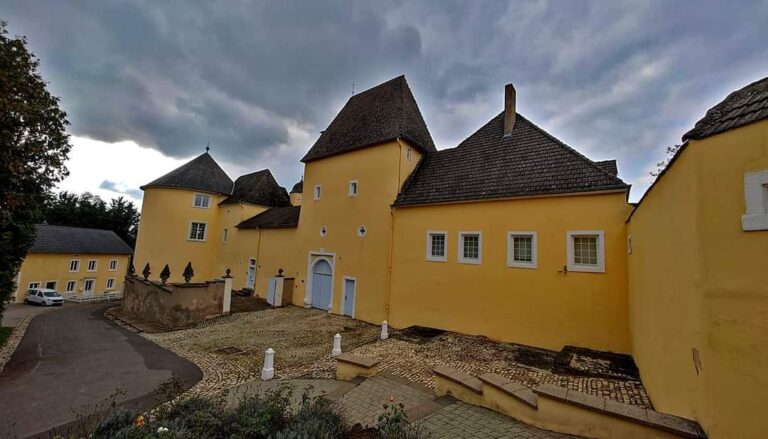
The surviving ruin represents the eighteenth-century rebuilding of the earlier castle complex. The rebuilt structure was a three-storey, nine-axis castle with a Baroque roof hood, a hood-shaped roof structure associated with the elaborate, monumental forms of Baroque architecture. Its principal façade measured 35 metres in length and contained two central projections, each two axes wide.
The castle chapel occupied the ground floor of the northeast tower. The building’s present condition results from the destruction of 1945, when an explosion specifically breached part of the castle wall. The remains therefore preserve elements of a residence whose form had changed from manorial estate to moated castle, Renaissance palace, and eighteenth-century rebuilt castle.
Nearby sites