Wintrange Castle: A Renaissance Estate in Luxembourg


Site at a Glance
- Rating
- 4.3
- Popularity
- Very Low
- Country
- Luxembourg
- Primary era
- Early Modern
- Eras represented
- Early Modern
- Civilizations
- Duchy of Luxembourg, Holy Roman Empire, Spanish
- Site type
- Domestic
- Remains
- Castle
On this page9 sections
History
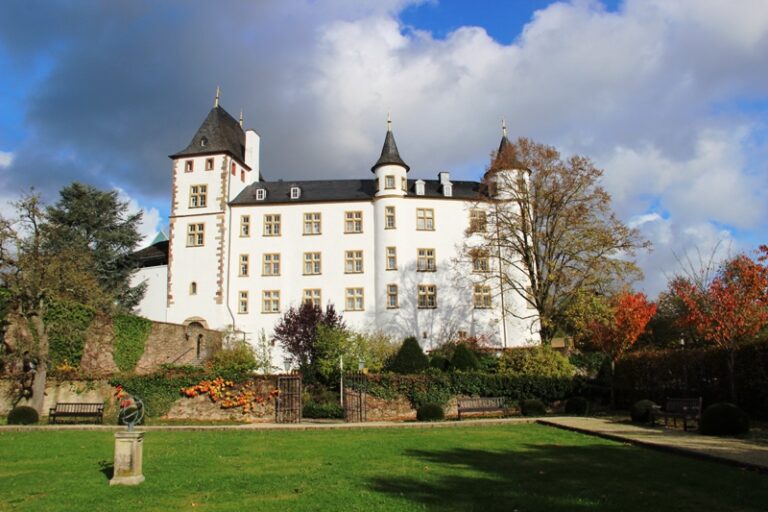
Wintrange Castle is a Renaissance-style castle in Luxembourg, built in 1610 by Alexandre de Musset, a nobleman from Foetz. The Renaissance was a European period that revived classical forms, symmetry, and ordered proportions, while castles of the period continued to combine residential and defensive purposes. The name Wintrange appears in written records from AD 987, and the surrounding area had already been inhabited for several millennia.
Early landscape and construction
Roman remains, including excavated villa remains, are found in the surrounding area. The Romans were the first to cultivate vineyards in the fertile river valley, an agricultural tradition that also shaped the later estate. When the castle was built, its grounds were much larger than they are today and were worked by servants. The estate included vineyards, waterways, and its own well system.
Wartime defenses and ownership
During the Thirty Years’ War, a major European conflict fought from 1618 to 1648, additional defensive works were added to the castle. These included a gunport protecting the main entrance. Over time, the estate passed through 18 family ownerships. Gisbert de Witt, one of its owners, cultivated the park as an orchard.
Industrialist Nick Schlesser bought the castle in 1938 after encountering it while hunting in the surrounding forests. The building suffered heavy damage during the Second World War. German soldiers were stationed there first, followed by American soldiers. Nick Schlesser’s descendants later restored the property, with his grandson Philippe Schlesser associated with the careful restoration. The castle remains privately owned.
Heritage protection
On 6 July 2016, Wintrange Castle was added to the list of national monuments of the municipality of Schengen. A national monument is a site receiving formal legal protection because of its historical or cultural importance.
Remains
Wintrange Castle stands in the centre of Wintrange in the Moselle valley, within an approximately 1.5-hectare private park. The Renaissance main building has four towers and has changed little over roughly four centuries. The estate also retains interconnected service buildings, cultivated grounds, water infrastructure, and garden structures that reflect its development as a noble residence and working estate.
Castle and service buildings
Renaissance main building
The main building contains approximately 550 square metres of living space distributed across three floors and an attic. The ground floor measures about 200 square metres, the first floor about 150 square metres, and the second floor about 130 square metres, while the attic covers about 140 square metres. Altogether, the building contains 21 rooms, including 10 bedrooms. Its four-tower form preserves the combination of domestic accommodation and defensive character established when the castle was built.
Stable extension and later additions
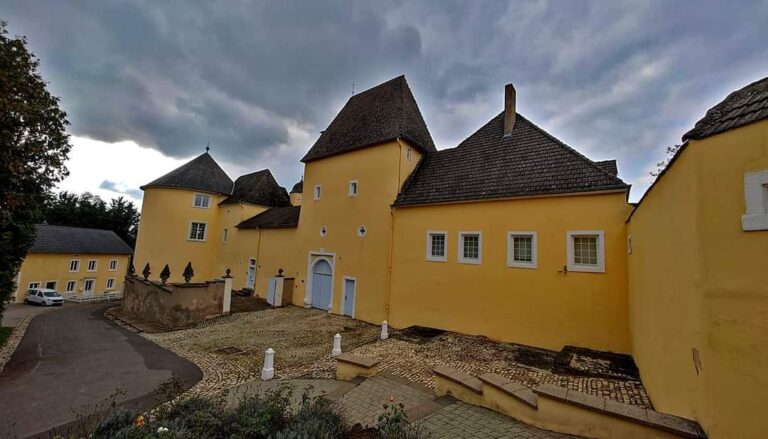
An interconnected barn extension dating from the eighteenth century includes a fifth tower. It was used mainly as a horse stable. Another extension provides approximately 140 square metres and allows for additional floors. Together, these additions show how the estate’s buildings expanded beyond the original castle.
Park and cultivated estate
The walled park contains more than 240 different trees and retains the estate’s historical well system, waterways, and vineyards. Its grounds include an orangerie, a garden building historically designed to protect citrus and other sensitive plants during colder seasons. The orangerie has two separate floors, while two cellars are located in the courtyard; another greenhouse also survives within the grounds. The estate adjoins the Haff Remich bird sanctuary and a national park containing lakes and ponds extending toward the Moselle River.