Schloss Stockern: A Renaissance Castle in Austria
Site at a Glance
- Popularity
- Low
- Country
- Austria
- Primary era
- Early Modern
- Eras represented
- Medieval, Early Modern
- Civilizations
- Duchy of Austria, Habsburg, Holy Roman Empire
- Site type
- Domestic
- Remains
- Castle
On this page7 sections
History
Schloss Stockern is a castle in Austria on the site of a defensive stronghold first recorded in the early 13th century. Alterations commissioned in 1576 gave it a Renaissance character, drawing on the European revival of classical forms. The castle later became associated with the writer and peace activist Bertha von Suttner.
The Stockhorner stronghold
The stronghold belonged to the Stockhorners, a noble family from Lower Austria. Its earliest known representative, Rudolfus de Stocharan, appears in records from 1137–1139. The family divided into two branches: an older line descended from Heinrich Stockhorner, who died in 1335, and a younger one descended from his brother Konrad, who died after 1296. The younger branch took its name from Schloss Starrein, moved to Germany in the 17th century, and continues there today.
Ernst Stockhorner, who died shortly after 1365 and held lands at Stockern, Radingdorf, and Puchberg, served as ducal court marshal. His son, also named Ernst, held the same honorary office and died around 1400.
Destruction and rebuilding
In 1474, Baron Stephan von Eytzing captured and largely destroyed the castle. The attack followed the decision of Ortolf and Ernst Stockhorner of Stockern to join the nobility’s opposition to Frederick III, Holy Roman Emperor from 1452 to 1493.
Hans von Wullerstorf received permission to rebuild the damaged fortress in 1484, but did not proceed. It was later reconstructed as a fortified residence, either under Ulrich von Haselbach, who took control of the lordship in 1507, or during the tenure of his successor.
Later ownership and Bertha von Suttner
A 1772 painting by Martin Johann Schmidt, an Austrian painter of the Baroque, a later European artistic style, depicts Saint Florian rescuing the burning castle. Florian was an early Christian martyr traditionally invoked for protection against fire. The painting does not establish when the blaze took place.
The castle later passed to the lords of Engelshofen. In 1870, Pauline von Engelshofen, daughter and heiress of Adolf, Imperial Knight von Engelshofen, married Baron Richard Gundaccar von Suttner. The estate and castle then passed to the Suttner family, which still owns them.
In 1889, Bertha von Suttner wrote Lay Down Your Arms! at the castle. She received the Nobel Peace Prize in 1905. Schloss Stockern is now part of an agricultural operation.
Remains
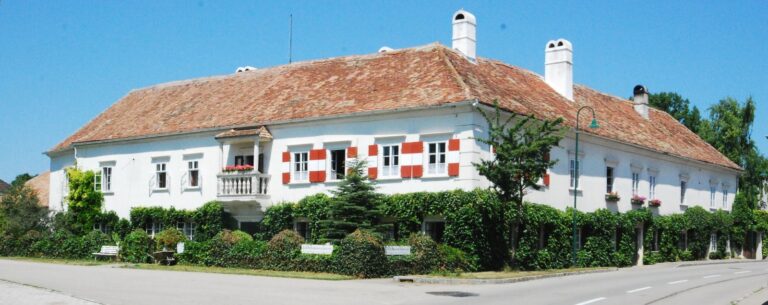
Castle and manor farm
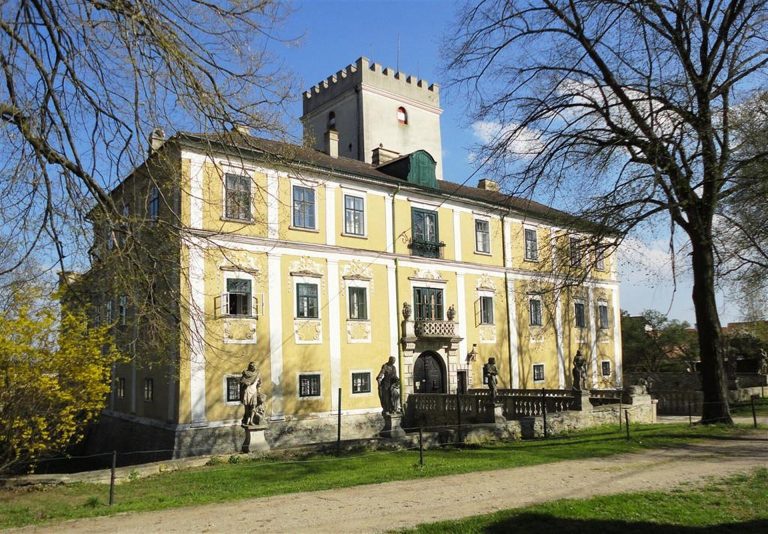
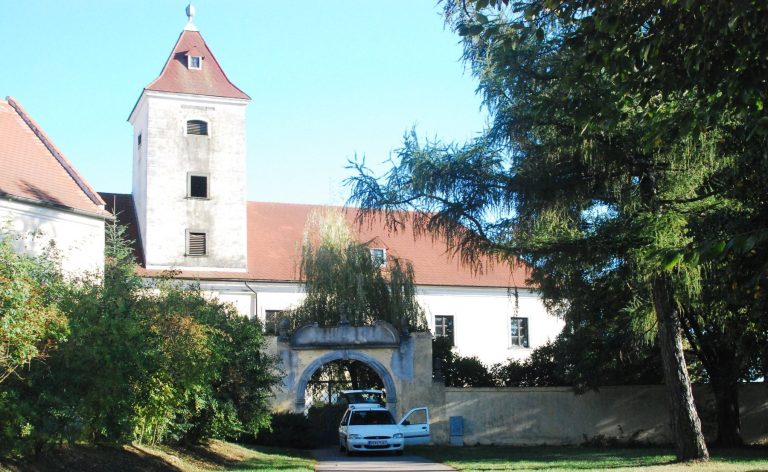
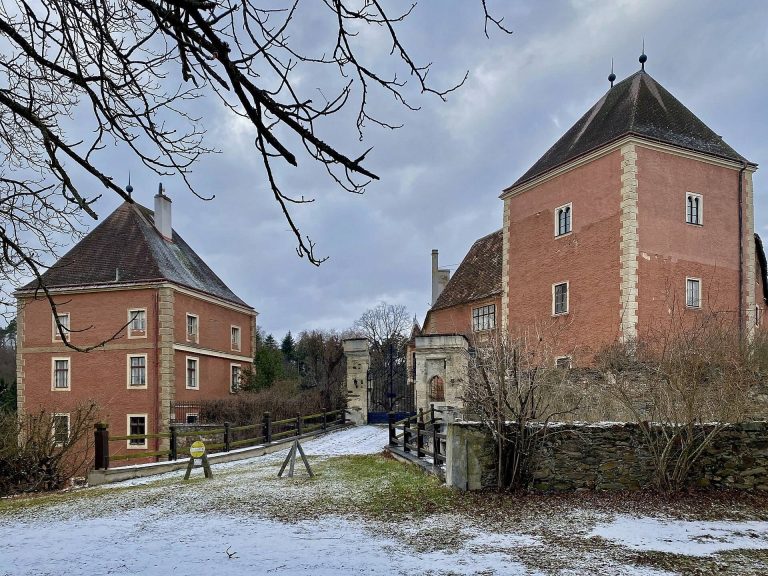
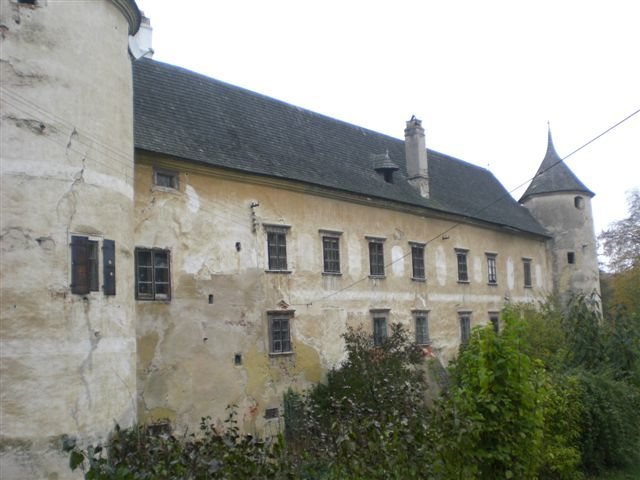
The two-storey castle combines a rectangular courtyard plan with round towers at all four corners. It stands within a park alongside a manor farm. Old beam and stucco ceilings, as well as furniture and oil paintings from the 17th and 18th centuries, may survive in the interior.
Park
The park’s well-preserved landscaped grounds are in the late-Baroque style. They rank among Lower Austria’s more notable historic gardens.