Burg Kühnring: Ancestral Castle of the Kuenringer in Austria


Site at a Glance
- Rating
- 5
- Popularity
- Very Low
- Country
- Austria
- Primary era
- Medieval
- Eras represented
- Medieval, Early Modern
- Civilizations
- Holy Roman Empire
- Site type
- Military
- Remains
- Castle
On this page7 sections
History
Burg Kühnring is a medieval castle in Austria, built by the Kuenringer, a noble dynasty associated with Lower Austria, during the first half of the twelfth century. It served as the family’s ancestral seat and as a residence of ministerial nobility, the medieval class of service nobles who held estates, offices, or military duties for higher-ranking lords.
Chapel and Kuenringer Foundation
The site’s earlier history began in the late eleventh century, when Azzo von Gobatsburg, an ancestor of Hadmar I, built a chapel there. Bishop Altmann of Passau consecrated the building, which later became the castle chapel. After the chapel had been established, Hadmar I built the castle during the first half of the twelfth century.
Burg Kühnring remained connected with the Kuenringer family into the thirteenth century, when it was recorded as belonging to Eufemia von Kuenring-Pottendorf. The castle formed part of the family’s position within the medieval social and political order of the region.
Conflict and Destruction in the Fifteenth Century
The castle became involved in regional warfare around 1460. Georg von Kuenring, serving as land marshal, a senior official with military and administrative responsibilities, fought the troops of Gamareth Fronauer. Based at Orth an der Donau, Fronauer was waging war against Emperor Friedrich III, the fifteenth-century Holy Roman Emperor.
After the castle had stood neglected for many years, Johann Götzesdorfer, one of Fronauer’s most determined supporters, occupied it. He spent the winter there with about 1,000 former mercenaries and used the castle as a base for plundering the surrounding region.
Wolfgang Kadawer, the administrator of Eggenburg, eventually expelled Götzesdorfer and destroyed Burg Kühnring. In 1463, Friedrich III granted Kadawer the right to hold and use the village of Kühnring. This grant indicates that the castle had already been destroyed and left deserted by that time.
The exact method of destruction is uncertain. The damage was severe enough to displace and rotate sections of wall several metres thick through 90 degrees, while the adjacent former castle chapel survived unharmed. One hypothesis proposes that holes were drilled into the walls, wooden beams were inserted, and the beams were soaked with water until the walls burst.
Conversion of the Chapel
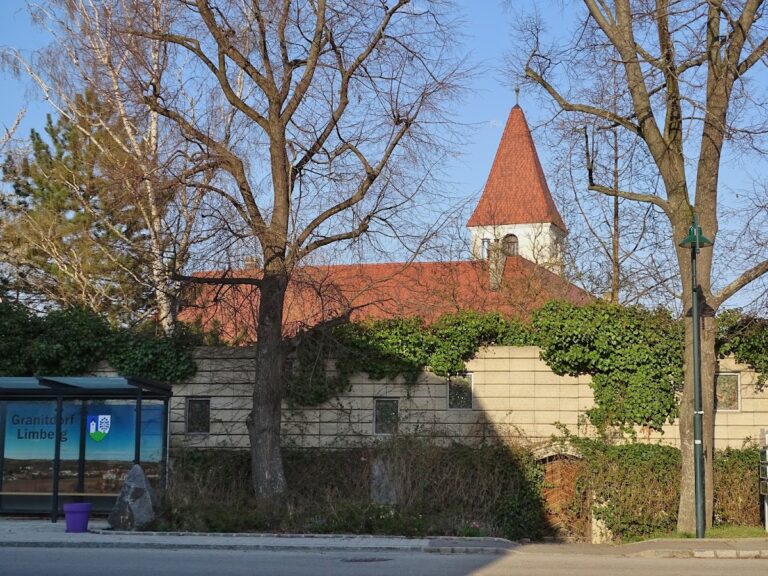
After the castle’s destruction, its chapel was converted into a parish church. The building was remodeled several times, including alterations that substantially changed its form. Further remodeling in 1660 gave the church its present appearance, preserving the religious building beside the ruined castle site.
Remains
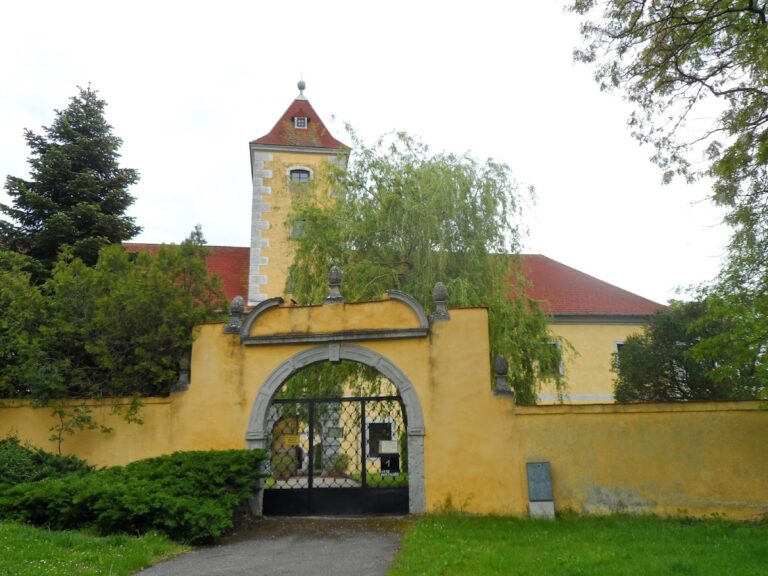
The former castle stood on the site now occupied by Kühnring parish church. The surviving complex is represented by several substantial wall sections and part of the castle moat, a defensive ditch surrounding or protecting a fortified site. These remains preserve the position of the medieval fortification beside the later parish church.
Castle Walls and Moat
Large fragments of the castle walls survive, including sections several metres thick. Their present arrangement reflects the violence of the fifteenth-century destruction: some wall sections were displaced and turned through 90 degrees. One surviving remnant contains a channel made for wooden anchors, a feature connected with the construction of the heavy masonry.
Part of the castle moat also remains as one of the surviving elements of the fortified complex. Together with the displaced wall fragments, it conveys the scale and physical impact of the destruction that ended Burg Kühnring’s use as a castle.
Former Castle Chapel
The former castle chapel stands immediately beside the castle remains and survives as Kühnring parish church. Unlike the castle walls, it was not damaged during the destruction. Its present form results from repeated remodeling after the castle disappeared, especially the work carried out in 1660.