Nístějka: A Gothic Castle Ruin in Czechia


Site at a Glance
- Rating
- 4.2
- Popularity
- Low
- Country
- Czechia
- Primary era
- Medieval
- Eras represented
- Medieval
- Civilizations
- Holy Roman Empire, Kingdom of Bohemia
- Site type
- Military
- Remains
- Castle
On this page7 sections
History
Nístějka is a Gothic castle ruin in Czechia, near Vysoké nad Jizerou, built by medieval Bohemian nobility in the first half of the fourteenth century. It probably guarded a land route through the Jizera valley. No written record survives from the castle’s beginnings, but Heník of Valdštejn, who was styled after Nístějka in 1369, is considered its probable builder. That year also provides the first written mention of the castle.
The Valdštejn and Vartenberk Lords
The castle’s ownership is difficult to reconstruct because the Valdštejn family had numerous branches and few written records survive. Hynek of Valdštejn was styled after Nístějka in 1399, followed by Jindřich of Valdštejn in 1406. In 1407, however, Nístějka was the seat of Jindřich of Vartenberk, who had acquired Valdštejn in 1404. These families were noble houses of medieval Bohemia.
The Lords of Jenštejn and the Castle’s End
By 1422, Nístějka was held by the lords of Jenštejn, first Václav of Jenštejn and later Mikuláš of Jenštejn. Mikuláš died in 1459, after which the castle’s history becomes unclear. Archaeological research led by Jaroslav Kavan of the North Bohemian Museum in Liberec in 1958 helped clarify its final phase. Eight archaeological layers, particularly in the palace area, indicate that a fire probably destroyed the castle during the second half of the fifteenth century. The palace’s storeys collapsed in the blaze. The possibility that this fire caused Mikuláš of Jenštejn’s sudden death remains speculative.
A record from 1492 describes Racek Cukr of Tamfeld as the hereditary lord of Navarov and the Nístějka estate, but refers to the estate rather than to a castle. This suggests that Nístějka may already have ceased to stand. In 1519, it was recorded as deserted. The ruins are protected as a cultural monument and lie within the Nístějka nature monument, a legally protected area designated for important natural features.
Remains
The Fortified Spur
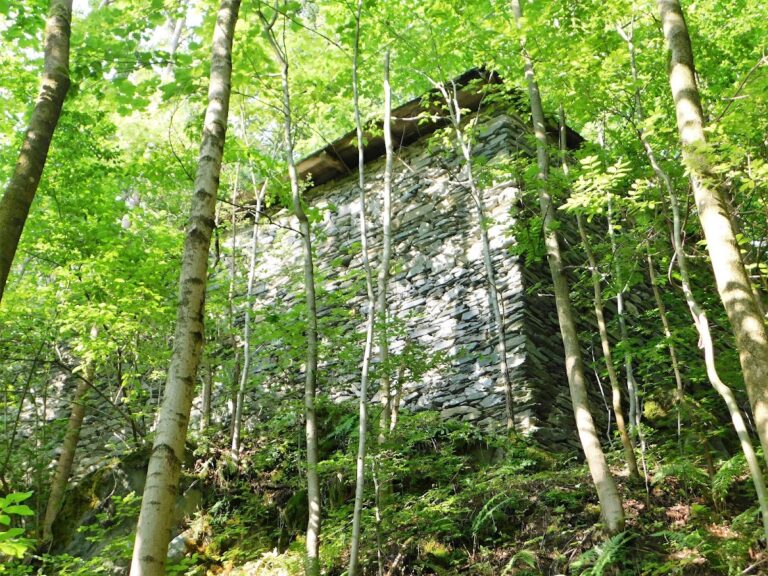
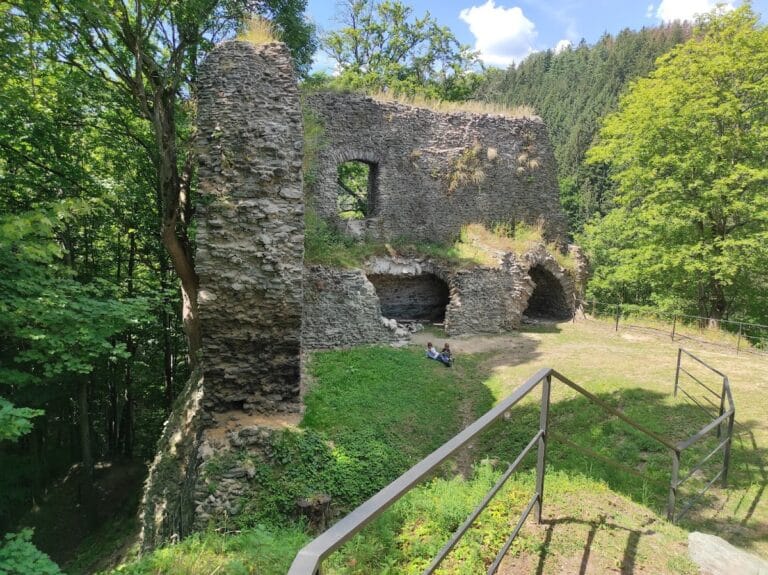
Nístějka occupied a narrow rocky spur above the meeting of the Jizera River and Farský Stream, opposite road I/14. A neck ditch, a defensive trench cut across the narrow land connection of a fortified spur, protected the approach. A small fragment of the front wall survives above the ditch.
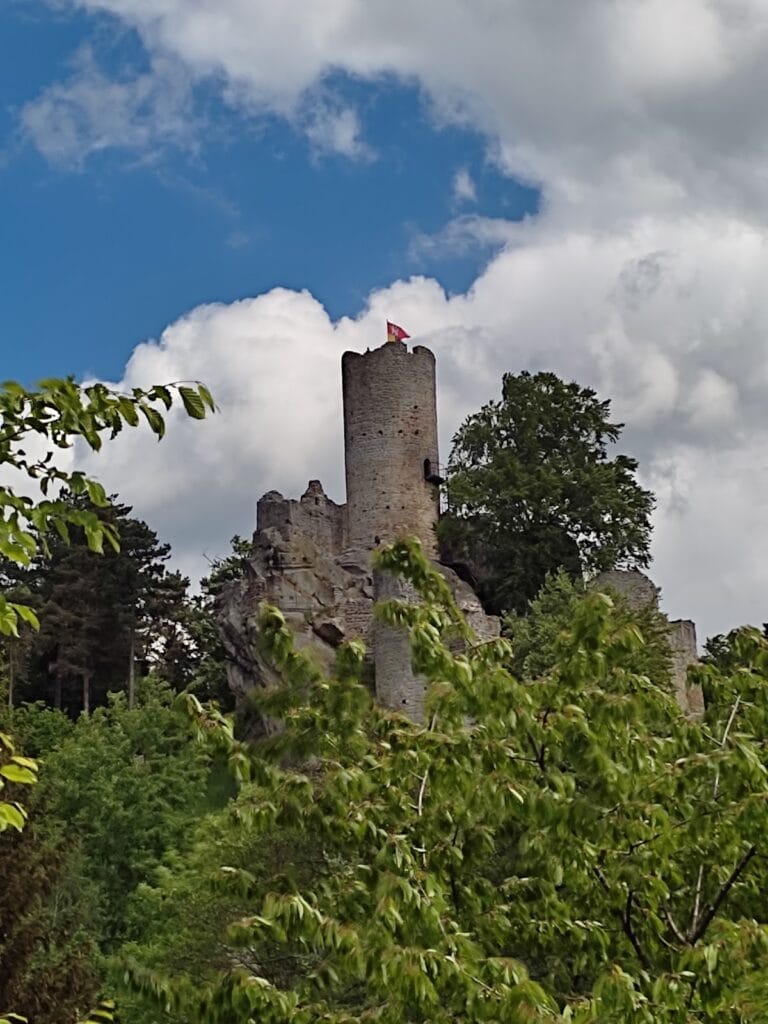
The highest point of the castle was occupied by a round bergfried, a fortified tower intended mainly as a strong defensive element rather than a permanent residence. Behind it probably stood wooden buildings of uncertain form. Minor terrain remains and traces of rock cut for construction mark this part of the layout.
The Castle Core
Entry into the castle core crossed another narrow ditch cut through the rock. A transverse wall survives in a small fragment and blocked a possible passage along the rock. Beyond the ditch lay a small, irregular courtyard. The courtyard gave access to the sunken ground floor of the palace and to a bottle-shaped hollow cut into the rock, which may have been used as a cistern or for storing grain.
The Palace
A rectangular palace dominated the castle core. It was divided into two rooms and had two pillars. The building probably rose two or three storeys. Its interior rooms had flat ceilings, while the higher levels were arranged as a single room. Tiled stoves, heating installations faced with decorated ceramic tiles, warmed the palace and added interior decoration.
Excavation in the palace area revealed eight archaeological layers. Among the finds were decorated stove tiles and small iron objects, especially nails and staples. The collapsed palace storeys preserve the physical evidence of the probable fire that brought the castle’s existence to an end.
Nearby sites