Puchhof Castle: An Abbey Manor and Agricultural Estate in Bavaria
Site at a Glance
- Popularity
- Medium
- Country
- Germany
- Primary era
- Early Modern
- Eras represented
- Medieval, Early Modern
- Civilizations
- Duchy of Bavaria, Electorate of Bavaria, Holy Roman Empire
- Site type
- Domestic
- Remains
- Castle
On this page14 sections
History
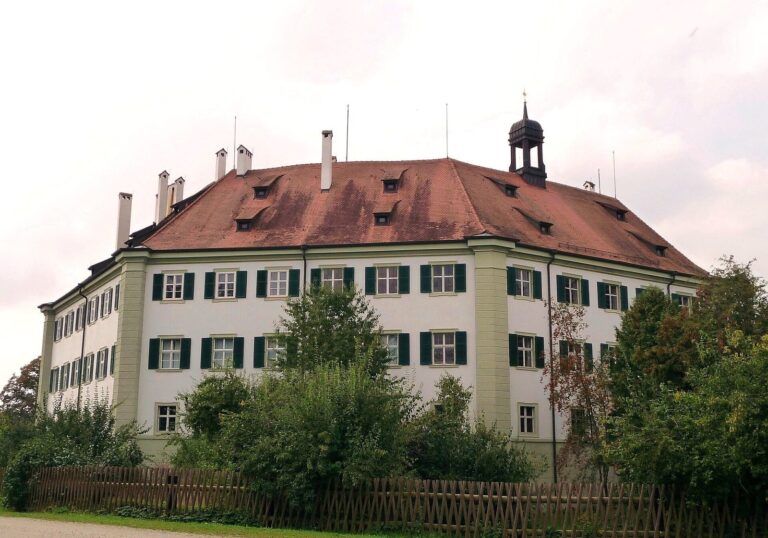
Puchhof Castle, also known as the Old Castle of Puchhof, is a former abbey manor in Aholfing, Bavaria, Germany. Its architectural history includes a late-twelfth-century Romanesque chapel, while the main castle was commissioned after 1768 and rebuilt in stone in 1798. For centuries, the estate was connected to Prüfening Abbey, a Benedictine monastery near Regensburg.
Medieval tenure and abbey jurisdiction
Puchhof belonged to Prüfening Abbey from the twelfth century. On 9 July 1140, Otto of Regensburg transferred it to Abbot Erbo in exchange for an estate and a mill at Mangolding. The transfer document stated that Otto’s family had held Puchhof for three generations as a fief, land held from a superior under feudal obligations, from the Babenbergs, a ruling dynasty. The Lords of Bogen held lay oversight, or bailiwick rights, over the property.
After Albert IV of Bogen died in 1242, Puchhof passed to the Wittelsbachs, the dynasty that ruled Bavaria. In 1282, Duke Henry of Bavaria granted Karolus de Straubing a manor and castle at Rain, along with bailiwick rights over Puchhof. Karolus’s family later became known as the Rainer von Rain. In 1311, following the Ottonian Handfeste, a legal charter, Prüfening Abbey gained lower-court jurisdiction. Puchhof thereby became a Hofmark, a landed estate with local judicial rights. In 1328, Albrecht von Rain and his wife Elspet sold their fiefs, oversight, judicial authority, and right to collect dues at Puchhof to Cunrat Nothaft. In 1448, the estate was settled as a life estate, granting its holders use of the property and its income for their lifetimes, for Friedrich Vinnder, Lower Bavaria’s revenue administrator, his wife, and their son.
Abbey estate and rebuilding
The Thirty Years’ War, a major European conflict fought from 1618 to 1648, devastated Puchhof. Abbot Placidus Bacheder commissioned the monk Romanus Schneidt to rebuild it, initially with a wooden building. Schneidt later became abbot, as did Bernhard Degl, who succeeded him at Puchhof. After the estate recovered economically, it was reconstructed in stone.
A 1695 agreement between the Prince-Bishopric of Regensburg and Prüfening Abbey provided for the constable from Niedermotzing to be called to Puchhof for official duties. Around 1710, the abbey’s right to brew and serve beer on its estates brought it into conflict with Count Josef von Leiblfing, owner of Schloss Rain. The dispute lasted nearly a century. Its partial resolution allowed the abbey to continue serving beer, while Rain’s subjects could be punished for drinking there.
Abbot Petrus Gerl commissioned the castle after 1768. Secularization, the transfer of church property to secular authorities or owners, ended Prüfening Abbey’s tenure. After 1803, Puchhof’s Hofmark came under the Straubing district court. Following attempted sales, the government managed the estate through tenants. Ritter von Reindl, a director of the Royal Court of Appeal, was recorded as its tenant in 1822 and later acquired it.
Private ownership and agricultural development
Regensburg wine wholesaler Friedrich Fikentscher bought Puchhof and other former estate properties in 1839. Agricultural activity expanded with modern equipment, and a dairy, cheese factory, and sugar factory had been established by 1844. Carl Lang acquired Puchhof in 1870 and made it an entailed estate, one whose succession was legally restricted. Between 1880 and 1886, drainage, irrigation, and power works supported further development. His son, Karl Friedrich, was a friend of Ludwig III, king of Bavaria from 1913 to 1918, and served in the Bavarian Reichsrat, the kingdom’s upper chamber. He was ennobled as von Lang-Puchhof.
Thyssen ownership and postwar recovery
Fritz Thyssen acquired the entire estate in 1937. That October, his daughter Anita moved to Puchhof with her husband, Gabor Ödon Count Zichy zu Zich and Vásonykeö, and their son Fritz August. The west wing was remodeled to suit the family. Fritz and his wife, Amélie Thyssen, sought to operate Puchhof as a model agricultural estate, and the distillery was redesigned between 1937 and 1939.
In 1939, the Nazi regime forced Fritz Thyssen to leave Germany. He and Amélie were captured in France, and he spent the rest of the war in concentration camps. That year the Prussian government took possession of Puchhof, then sold it to Philipp F. Reemtsma on 1 April 1940. After the regime collapsed, American authorities leased the estate to Hugo Nickel. Puchhof was returned to Fritz Thyssen on 15 October 1949, but the castle remained under American control until 1 July 1952. Thyssen had died in exile in Buenos Aires. Amélie returned and rebuilt the agricultural operation, expanding its facilities and housing; a retirement home followed in 1955–56.
In August 1960, Chancellor Konrad Adenauer presented Amélie Thyssen with the Grand Cross with Star and Sash of the Order of Merit of the Federal Republic of Germany at Puchhof. She died there on 25 August 1965. Her daughter Anita inherited the estate and put the farm up for sale in 1966.
Maffei ownership and continuing use
Guido Ritter und Edler von Maffei acquired the estate and castle in June 1966. In 1996, Liselotte von Maffei moved her distillery from Gut Freiham to Puchhof; for a time, it was Bavaria’s second-largest distillery. Guido died on 19 June 1999 and was buried in the chapel. Liselotte continued the distillery, and the castle remains part of an agricultural estate.
Remains
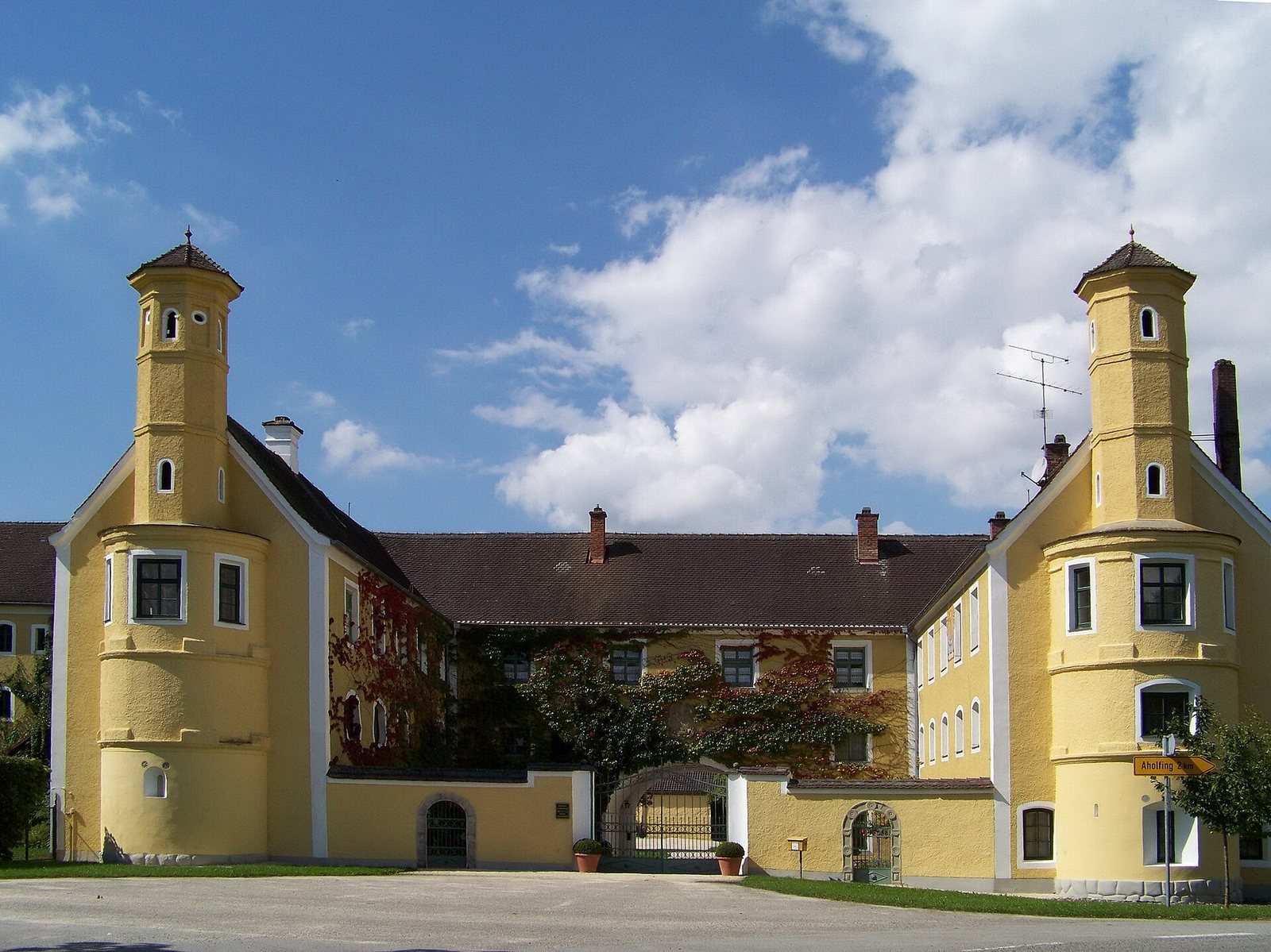
The castle is a three-storey complex arranged in four wings around a main courtyard. A masonry wall closes off the street-facing side. The long wing extends two window-width sections beyond each side wing at either end, giving the building a balanced outline.
Castle complex
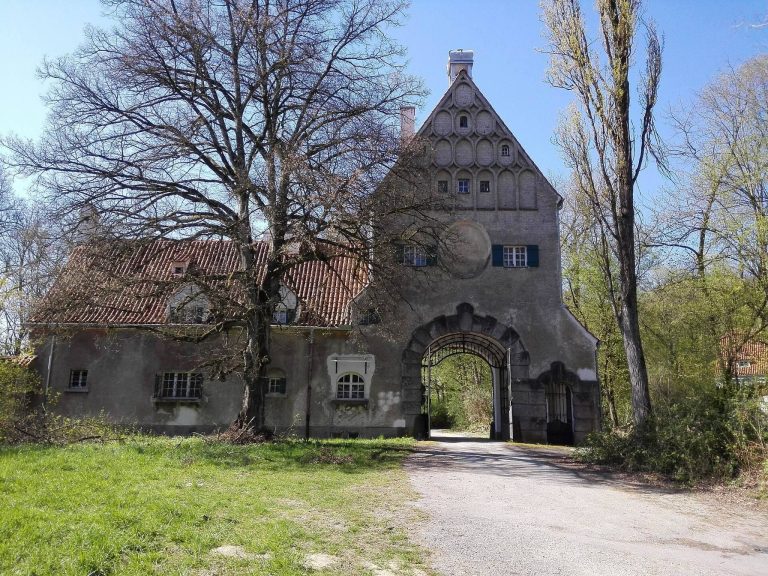
At the gable ends of the side wings, projections extend through all three storeys. Above them rise three-storey polygonal turrets with spire-shaped roofs, linked by a low, curved wall. A round-arched entrance leads from the forecourt into the main courtyard, with Abbot Petrus Gerl’s coat of arms set above the opening. Father Andreas Schleinkofer served as architect and master builder. The second wing was designed to match the chapel wing for symmetry.
Castle chapel
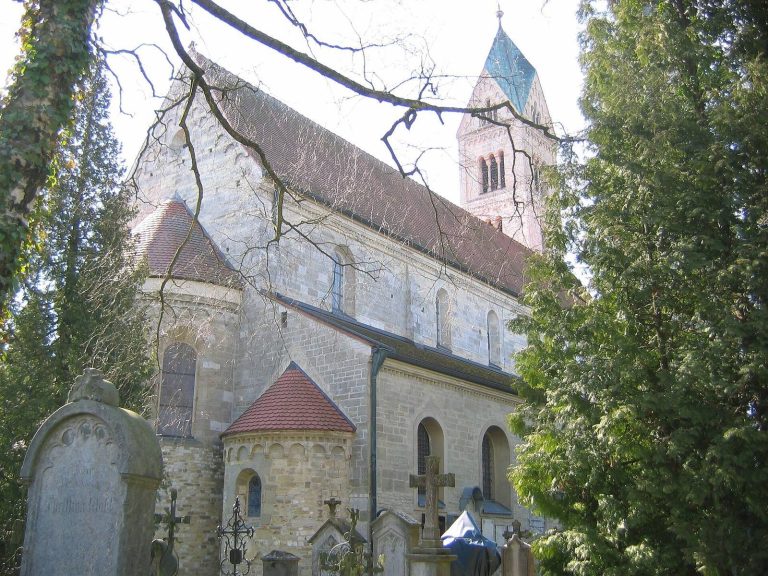
The chapel occupies the lower level of the south wing. Its rectangular interior measures 12.4 by 6 metres and accommodates 80 people. Five window divisions are marked by pilasters, shallow projections resembling columns; the windows were given Baroque forms in 1768. The chapel’s mirror ceiling, a broad flat panel within a shaped frame, was made by Otto Gebhard and depicts the patron saints of Prüfening Abbey.
The chapel’s stone structure retains its original form, although its interior has been altered several times. A Gothic altar was made around 1450. During the castle’s rebuilding, the chapel had a main altar dedicated to Saint Otto and two side altars dedicated to Saint Peter and Saint Benedict. The altars were removed when the chapel ceased to be consecrated for worship. Two statues may have been placed in the church at Obermotzing.
Park and estate features
Park and burial crypt
The castle park originally covered 50 hectares and contained native and foreign trees and shrubs. Widening the Laber created an artificial lake within the grounds. After Carl Lang died in Munich on 7 April 1916, his wife had a burial crypt built for him in the park. His body was transferred there in 1923, but repeated flooding led to the removal of his coffin to Steinach cemetery in 1966, after which the crypt was demolished.
Agricultural and industrial features
Estate features include drainage and irrigation works, a power canal and electric power station, a distillery, agricultural buildings, and workers’ accommodation. A retirement home was built in 1955–56. These facilities reflect Puchhof’s continued use as a working agricultural estate.
New Castle
The estate also includes the associated New Castle of Puchhof, built under Carl Lang.
Archaeological remains
Medieval and early-modern structural traces and finds lie below ground in the castle area. They include remains around the chapel and evidence of earlier buildings.