Schloss Prielau: A Former Prince-Bishop’s Hunting Lodge in Austria


Site at a Glance
- Rating
- 4.6
- Popularity
- Low
- Country
- Austria
- Primary era
- Early Modern
- External website
- Open
- Eras represented
- Early Modern
- Civilizations
- Holy Roman Empire
- Site type
- Domestic
- Remains
- Castle
On this page10 sections
History
Schloss Prielau is a former prince-bishop’s hunting lodge in Austria, located at Prielau near Zell am See. Its history begins in the fifteenth century, while the rebuilding carried out between 1560 and 1565 gave the residence the general form that survives today.
Fifteenth- and sixteenth-century estate
The property was first mentioned in 1425 in connection with Christian Glaser zu Prielau. By 1466 it belonged to Polykarp von Hunt, whose family was then among the leading families of the Pinzgau. Hans Christoph Perner von Rettenwörth rebuilt and substantially remodeled the residence between 1560 and 1565.
In 1577 Schloss Prielau was owned by Caspar Panicher zu Wolckersdorff, an estate provost in Fusch and district judge in Zell am See. After his death or departure, ownership passed to his daughter Anna and her husband, Christoph von Hirschau. In 1590 the property came to Dietrich Kuen-Belasy, Baron of Chiemsee, and remained with the Kuen-Belasy family until 1722.
Chiemsee ownership and secularization
In 1722 the Diocese of Chiemsee acquired the castle. A prince-bishop was both a bishop and a territorial ruler, so the diocese combined religious authority with secular administration. This arrangement ended when the Diocese of Chiemsee was secularized in 1803.
The last prince-bishop to use Schloss Prielau was Sigmund Christoph von Waldburg-Zeil-Trauchburg. His coat of arms remains above the entrance to the west tower. The castle was auctioned in 1811 and acquired by Anton Neumayer.
The Hofmannsthal family and Nazi expropriation
Gertrude, known as Gerty, von Hofmannsthal, the widow of the Austrian writer Hugo von Hofmannsthal, bought Schloss Prielau in 1932 and began restoring it. Hugo von Hofmannsthal was a writer, librettist, and dramatist. Gerty lived at the property with her son Raimund and his wife Elisabeth.
During the Nazi period, the family faced expropriation because of its Jewish heritage. Gerty attempted to transfer the castle to her daughter Christiane and Christiane’s husband, the scholar Heinrich Zimmer, so that they could sell it to the family friend Gustav Kapsreiter. Although the proposed donation was initially approved, it was ultimately rejected and the family was expropriated.
The Gestapo, the secret state police of Nazi Germany, confiscated the castle in 1940, forcing the Hofmannsthal family to emigrate to England. In 1942 it became the direct property of the Reich. The following year, the Reichsgau of Salzburg, the Nazi administrative territory that included Salzburg after Austria’s annexation, transferred it to the Austrian sculptor Josef Thorak, who received major state patronage under the Nazi regime.
Restitution and later use
The Hofmannsthal family regained Schloss Prielau through restitution in 1947. Restitution was the postwar return of property confiscated or expropriated under Nazi rule to former owners or their heirs, although the family did not permanently move back into the castle.
The Porsche family acquired Schloss Prielau in 1987. Restoration work prepared the building for a new use as a small hotel with a restaurant, guest rooms, and suites. The castle remains in use in that form. The Republic of Austria has protected it as a monument since 1993, under register number 35435, while the chapel has separate protection under number 61264.
Remains
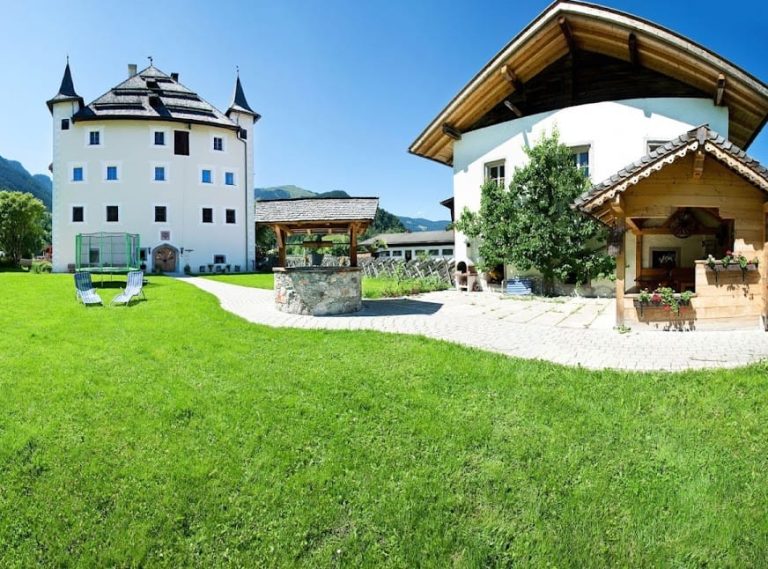
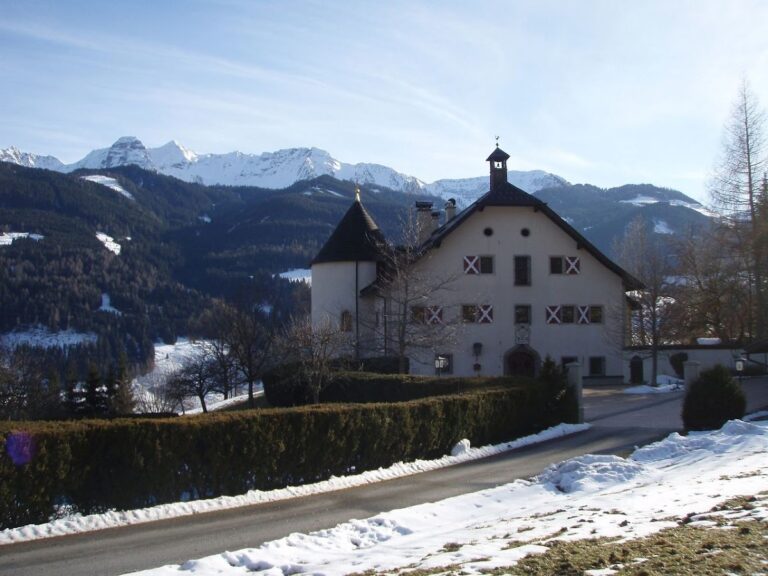
Schloss Prielau stands at the northern end of Lake Zell in Maishofen, surrounded by a large park that extends toward the lake. The large residence has three floors beneath a hipped roof, formerly covered with wooden shingles. A small turret rises from the roof, and square towers occupy the centers of the two principal facades.
Buildings
Main residence
The building has the form established by the sixteenth-century rebuilding. The west tower preserves the coat of arms of Sigmund Christoph von Waldburg-Zeil-Trauchburg above its entrance. Furnishings associated with the Kuen-Belasy barons and the bishops of Chiemsee have been retained. On the first floor, the former reception rooms are richly decorated and have coffered ceilings.
Holy Trinity Chapel
A slightly detached Baroque chapel dedicated to the Holy Trinity dates from 1730. Baroque architecture and decoration are characterized by elaborate ornament, dramatic forms, and richly treated interiors. The chapel contains an image of the Holy Trinity regarded as miraculous, together with numerous old votive images. Votive images are devotional offerings connected with prayer, thanksgiving, or hoped-for healing, and those preserved here reflect the chapel’s importance as a pilgrimage destination.
Park and estate
The estate includes the park, a red-deer farm, and a private beach on the northern shore of Lake Zell. It also contains a golf course, a helicopter landing area, and a wellness area with a sauna, steam bath, and massage facilities. The building’s present hotel and restaurant use incorporates guest rooms and suites within the historic estate.