Vladičanski dvor in Novi Sad: Episcopal Palace of the Eparchy of Bačka



Site at a Glance
- Rating
- 4.7
- Popularity
- Low
- Country
- Serbia
- Primary era
- Modern
- External website
- Open
- Eras represented
- Modern
- Civilizations
- Habsburg, Hungarian
- Site type
- Religious
- Remains
- Palace
On this page8 sections
History
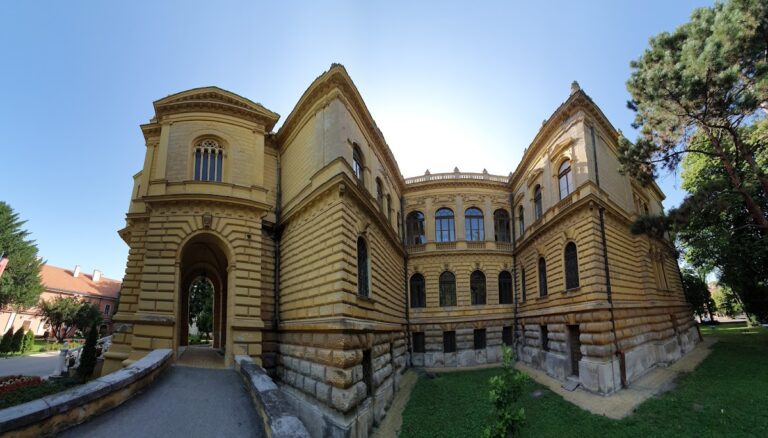
Vladičanski dvor is an episcopal palace in Novi Sad, Serbia, built for the Serbian Orthodox Eparchy of Bačka between 1899 and 1901 in a historicist design combining Byzantine, Eastern, and Serbian medieval forms. It remains the seat and residence of the Bishop of Bačka and is recognized as a cultural heritage site of exceptional importance.
The first episcopal palace
Novi Sad’s first episcopal palace was built in 1741 by Visarion Pavlović, bishop of the Eparchy of Bačka, beside the newly constructed Saint George Cathedral. Its main facade faced a marshy branch of the Danube, toward the area now occupied by the Fish Market.
The building was destroyed during the bombardment of Novi Sad in June 1849. The attack came from Petrovaradin Fortress amid the political upheavals of the 1848–49 revolution and the Serbian uprising. In a later memoir, the city chronicler Mihajlo Polit-Desančić recalled the frogs, noise, poor air, and limited sunlight around the old palace, suggesting that its destruction was not widely mourned.
Construction of the present palace
Plans for a replacement began in 1849, but the new residence was not completed until the end of the century. Vladimir Nikolić finished the design in 1899. Ferenz Raichl officially signed it after public accusations that Patriarch Georgije Branković had favored his godson Nikolić. Construction followed from 1899 to 1901.
Bishop Mitrofan Šević marked the completion of the palace in 1901 with a ceremony attended by Patriarch Georgije Branković, the Austro-Hungarian representative Pavle Peter, and Ilarion Ruvarac, a Serbian Orthodox cleric and historian.
Ecclesiastical and civic role
The palace has continued to serve as the seat and residence of the Bishop of Bačka, a bishop who administers this territorial diocese of the Serbian Orthodox Church. Its current occupant is Bishop Irinej Bulović, who is also a professor at the Faculty of Orthodox Theology in Belgrade.
In 1919, after Banat, Bačka, and Baranja were united with the Kingdom of Serbia in the formation of Yugoslavia, Prince Regent Aleksandar Karađorđević addressed the population from the palace balcony. The building was placed on Serbia’s list of protected cultural monuments in 2007 and is also classified as a cultural heritage site of exceptional importance.
Remains
Plan and exterior
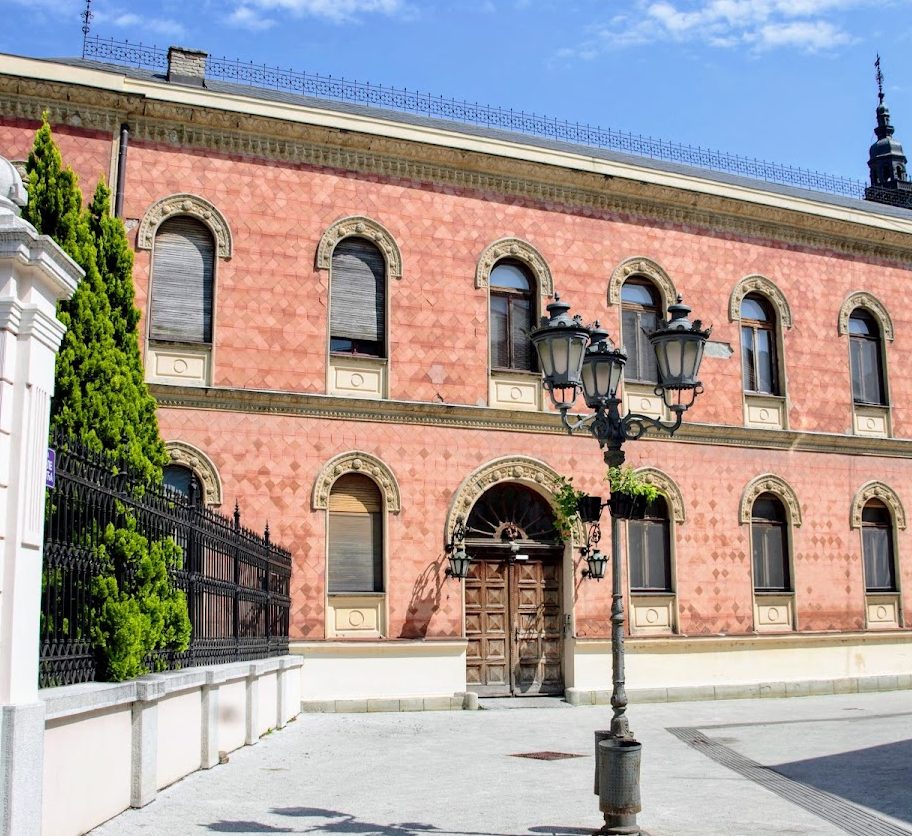
The palace stands at the end of Zmaj Jovina Street, where Zmaj Jovina, Dunavska, and Nikola Pašić streets meet. Its position forms the visual conclusion of Zmaj Jovina Street. The building has an elongated plan shaped like the Cyrillic letter P, an arrangement interpreted as a symbol of the Serbian Orthodox Church. The left wing is slightly shorter because the palace stands immediately beside Saint George Cathedral.
A ground floor and one upper storey are arranged around a closed central courtyard. Red brick covers the exterior, whose design combines eclecticism, neo-Romanticism, Serbo-Byzantine Revival, Byzantine and Eastern decorative forms, and motifs derived from Serbian medieval monasteries. The architectural approach reflects theories associated with Theophil Hansen, whose Vienna professors’ circle included Nikolić and whose teaching influenced the younger architect.
The facade contains bifora windows, divided into two openings, and trifora windows, divided into three. The bifora forms recall those of Studenica Monastery. Slender paired windows surround a central projecting section, whose upper part is finished with decorated semicircular pediments. Pseudo-Moorish decorative forms by the sculptor Julijo Anika add further ornament to the facade.
The roof is low and partly concealed behind a balustrade. Three eparchial coats of arms, the heraldic emblems of the Eparchy of Bačka, are incorporated into the building. One appears on the front facade, another on the side facing the churchyard, and the third in the courtyard.
Interior and ecclesiastical furnishings
The entrance hall contains a staircase with a wrought-iron railing, while almost all rooms have rich stucco decoration. The palace preserves a collection of 16 painted portraits, heritage property since 1949, together with faience stoves, antique furniture, and other works of art.
Vladimir Predojević painted scenes from the New Testament as frescoes in the dining room. The chapel contains an iconostasis, the screen separating the sanctuary from the main worship space in an Eastern Christian church, made by Vladimir Kuročkin and painted by the Russian artist Andreï Avtchnev.
Monument to Jovan Jovanović Zmaj
A monument to the poet Jovan Jovanović Zmaj was erected in front of the palace in 1984. It marks the location of the central celebrations of the Zmaj Children’s Games, a continuing cultural event associated with the poet. The life-size sculpture represents Zmaj during his customary daily walk along the street.
The monument replaced a former pink-marble cross, which was moved to the grounds of Saint George Cathedral.
Nearby sites