Schloss Ritzen: A Medieval Castle and Local-History Museum in Austria


Site at a Glance
- Rating
- 4.3
- Popularity
- Low
- Country
- Austria
- Primary era
- Medieval
- External website
- Open
- Eras represented
- Medieval, Early Modern
- Civilizations
- Holy Roman Empire
- Site type
- Military
- Remains
- Castle
On this page11 sections
History
From Grub to Schloss Ritzen
Schloss Ritzen is a former castle complex and local-history museum in Saalfelden am Steinernen Meer, Austria. It developed from an early medieval stronghold, and its earliest surviving documentary reference dates to 1339, when Konrad Grafenberger transferred the estate, then called Grub, to his son Alex. The property included a late-medieval defensive tower known as the Tower of Grub.
The estate changed hands several times. It passed to the Wispeck family, then to Schönberger, a citizen of Reichenhall, and later to the Ramseider dynasty, which died out in the late sixteenth century. Their heirs sold the property to the Gastein mining entrepreneurs Hans and Christoph Weitmoser. After Christoph’s death in 1603, his heirs sold the castle in 1604 to the Lords of Ritz, whose name the site has retained.
Later ownership and decline
The sons of the Lords of Ritz amassed great wealth but eventually lost it through an exceptionally expensive lifestyle. During the eighteenth century, ownership was associated with the Paurnfeind von Eyss and von Waltenhofen families, followed by a recorded transfer to the barons of Motzl in 1762.
In 1787, the property entered agricultural, or “peasant,” ownership. The complex subsequently deteriorated and became uninhabitable. It remained with the Rohrmoser family until 1937. Centuries of additions, demolitions, and connecting structures altered the original arrangement. Part of the palace was demolished in 1812, while a major fire in 1892 destroyed much of the estate and caused further damage.
Preservation and museum use
The municipality of Saalfelden acquired the surviving remains in 1964. Public ownership allowed the historic fabric that remained to be preserved, and the castle was restored and renovated. Since 1968, it has housed the Saalfelden local-history museum, one of the oldest regional museums in the Pinzgau, the historical region of northern Salzburg in which Saalfelden lies.
The museum preserves collections connected with Saalfelden and its surrounding region. Historical and ethnographic objects are presented alongside modern multimedia displays and a major collection of nativity scenes. Schloss Ritzen has been protected as a monument by the Republic of Austria since 1993 under designation number 61131.
Remains
Surviving castle structures
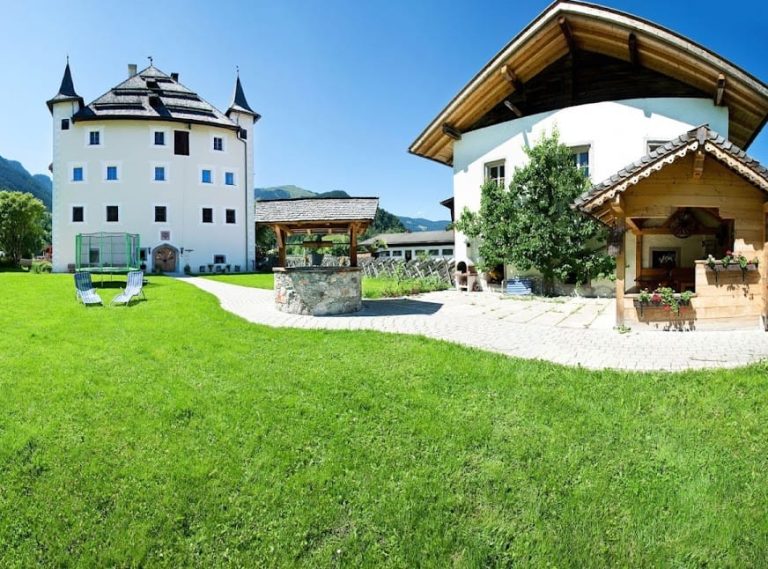
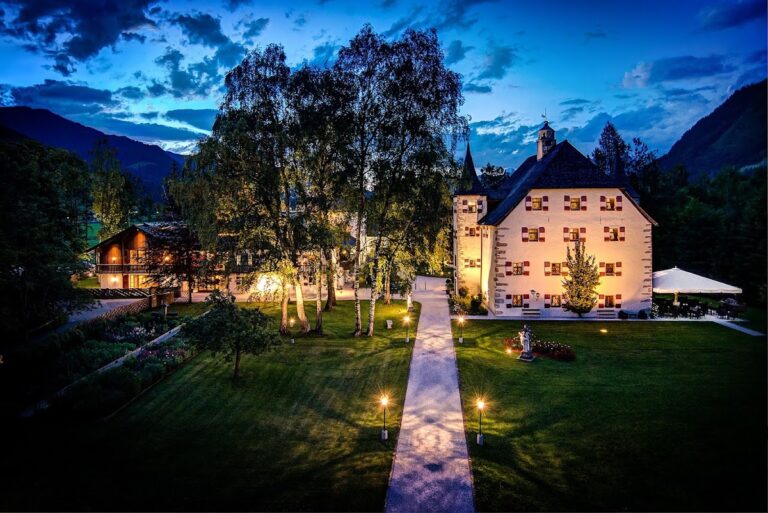
Schloss Ritzen stands on a level hill in southern Saalfelden, a short distance from the small bathing lake Ritzensee. The former castle plan was horseshoe-shaped, but the surviving complex now has a rectangular form. Only a side wing of the historic castle remains as the present building.
Historic side wing
The surviving wing has three storeys. Its main facade contains five small windows on each storey. The entrance portal has stone jambs and a lowered round arch, with the date 1593 carved into it. A small wooden turret rises from the front section of the roof, while finely formed late-Gothic vaults survive inside. Late Gothic describes the later phase of Gothic architecture, known in part for elaborate vaulting and increasingly complex forms.
Medieval defensive enclosure
The medieval defensive enclosure probably had four round towers. One of these towers survives as part of the remaining castle fabric, preserving a physical element of the site’s earlier fortified arrangement.
Museum collections
The museum occupies approximately 1,200 square metres in 22 display rooms. Its regional historical and ethnographic collections explain the history of Saalfelden and the surrounding Pinzgau, while the nativity displays preserve a strongly local artistic tradition.
The Biberg deer
Among the displayed objects is the Biberg deer, a bronze figure representing Cernunnos, a Celtic antlered deity associated with animals and the natural world. The figure has a human form with deer antlers. In the religious interpretation attached to it, the deer was the key to paradise and an animal that saved the souls of the dead, allowing them to enter paradise.
Nativity scenes by Xandi Schläffer
A major part of the nativity collection consists of works by the Saalfelden nativity maker Xandi Schläffer, who died on 18 November 1984. His scenes reproduce local farmhouses with stone roofs, passages decorated with wooden paneling, and the open stable at Bethlehem. Other works show complete Pinzgau nativity villages or place the Steinernes Meer panorama behind the scene, giving the collection a distinct regional character.