Schloss Pläswitz: A Ruined Renaissance and Baroque Palace in Poland


Site at a Glance
- Rating
- 4.4
- Popularity
- Very Low
- Country
- Poland
- Primary era
- Early Modern
- Eras represented
- Early Modern, Modern
- Civilizations
- German, Habsburg, Holy Roman Empire
- Site type
- Domestic
- Remains
- Elite Residence
On this page10 sections
History
Medieval origins
Schloss Pläswitz is a ruined palace in Poland, located in Pielaszkowice. The locality was established in the twelfth century by Peter Wlast, a locator, the person responsible for organizing a medieval settlement under a territorial lord. In 1375, Landeshauptmann Thimo VII von Colditz, a high regional official, received lordship over the locality.
Renaissance palace and noble ownership
A Renaissance palace was constructed in the 1570s under Hans von Mühlheim. The Renaissance was a European architectural period that revived interest in classical forms. After 1659, the property belonged to the von Rechenberg family. From 1700, the von Nostitz family remodeled the palace in the early Baroque style, a period associated with more dynamic and elaborate architectural forms.
Through marriage, the estate later passed to the noble von Buddenbrock family, represented by Dietrich von Buddenbrock. The family developed a distinct Pläswitz line and made the estate a fideicommiss, an inheritable arrangement intended to keep landed property within the family and prevent its division or sale. The best-known landowner was the later General Johann von Buddenbrock. Other family members held political and administrative posts, including Karl Freiherr von Buddenbrock, who served as president of a chamber, and Maximilian Freiherr von Buddenbrock, a government councillor and Prussian chamberlain. Karl jun. Freiherr von Buddenbrock became the next holder of the family estate.
The armistice and the estate’s later fate
In 1813, the palace hosted the conclusion of the Armistice of Pläswitz between Napoleon on one side and Prussia and Russia on the other. The von Buddenbrock family retained ownership until 1945, when it was expropriated. Erich Freiherr von Buddenbrock was the last estate lord. The final recorded survey, made in 1937, measured the estate at 558 hectares.
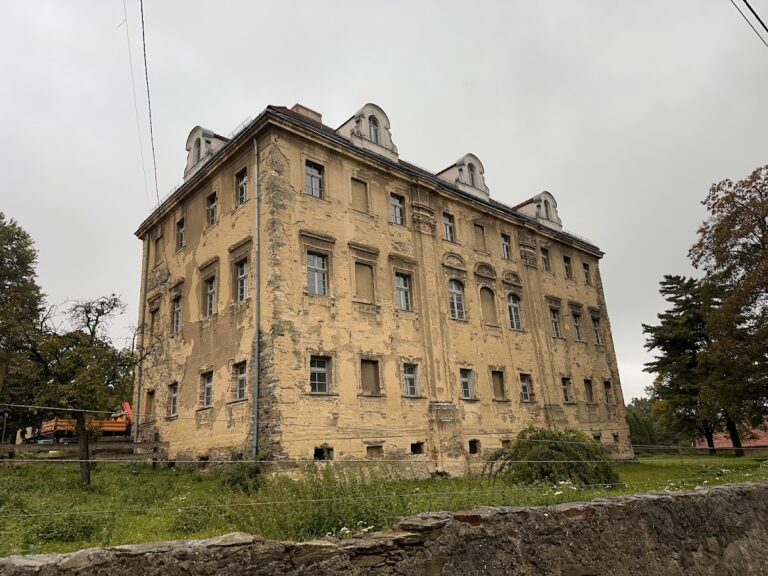
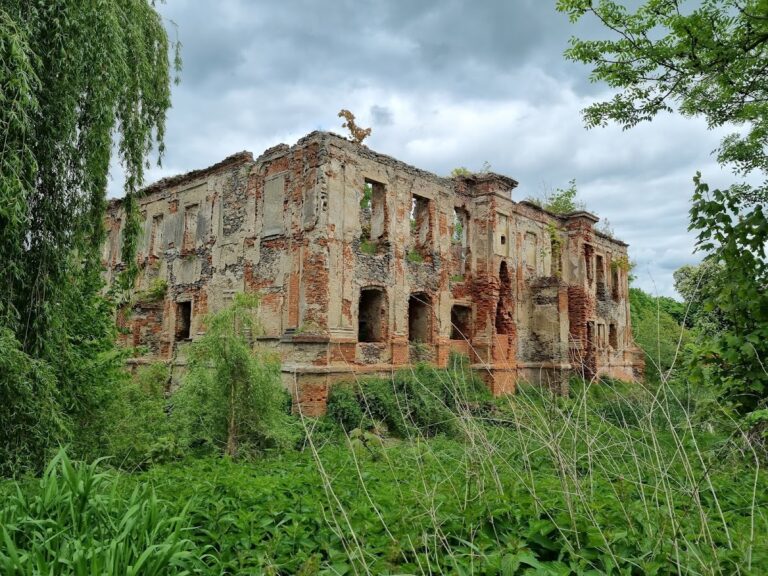
A fire devastated the palace in 1948. The complex later became a ruin, while its park grew over. Heritage registrations were made in 1977 and 2002.
Remains
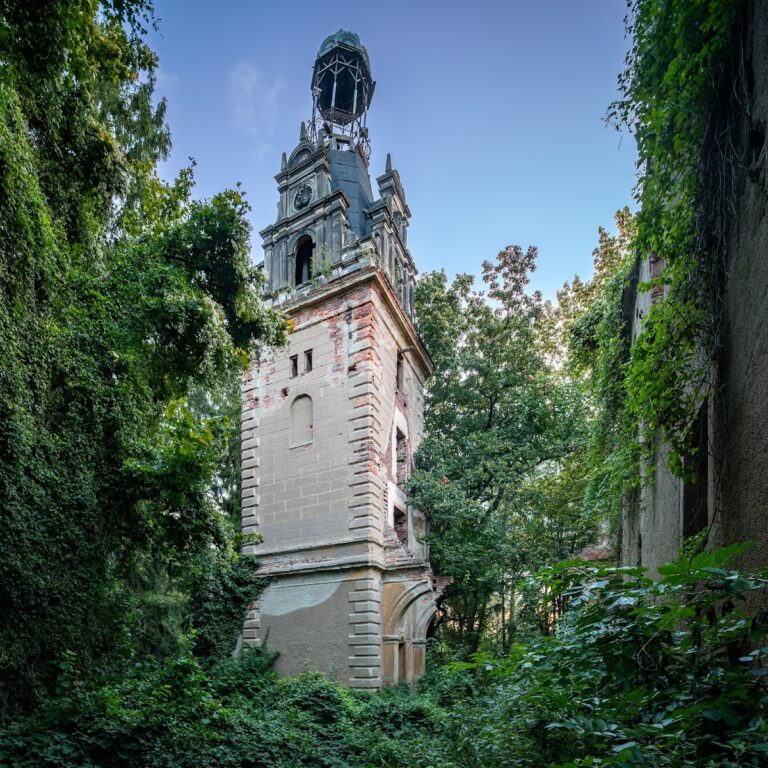
The surviving complex combines the ruined palace with a landscaped park, water features, residential and agricultural buildings, a garden pavilion, and a granary. Its architectural history is reflected in the palace’s Renaissance plan and later Baroque alterations, together with additions made during the eighteenth, nineteenth, and early twentieth centuries.
Palace structure
Renaissance and Baroque palace
The palace retains the principal elements of its Renaissance design, including a central tower, a projecting bastion, and a moat. During the Buddenbrock period, the building was altered with features that included a mansard roof and the characteristic red exterior paint associated with the estate. The fire of 1948 left the palace in ruinous condition. The ruins were documented in 2012.
Park and supporting buildings
Park and fishponds
The palace park contains fishponds dating from the third quarter of the eighteenth century. It was altered during the second half of the nineteenth century and is now overgrown.
Annexes and estate buildings
A residential annex was added in the mid-eighteenth century. A combined residential and agricultural annex dates from the second half of the nineteenth century, as does a wooden garden pavilion. The complex also includes a granary built at the beginning of the twentieth century.
Nearby sites