Corpus Christi Church in Łażany: A Historic Gothic Filial Church in Poland


Site at a Glance
- Rating
- 4.8
- Popularity
- Very Low
- Country
- Poland
- Primary era
- Medieval
- Eras represented
- Medieval, Early Modern, Modern
- Civilizations
- Holy Roman Empire
- Site type
- Religious
- Remains
- Fortified Church
On this page11 sections
History
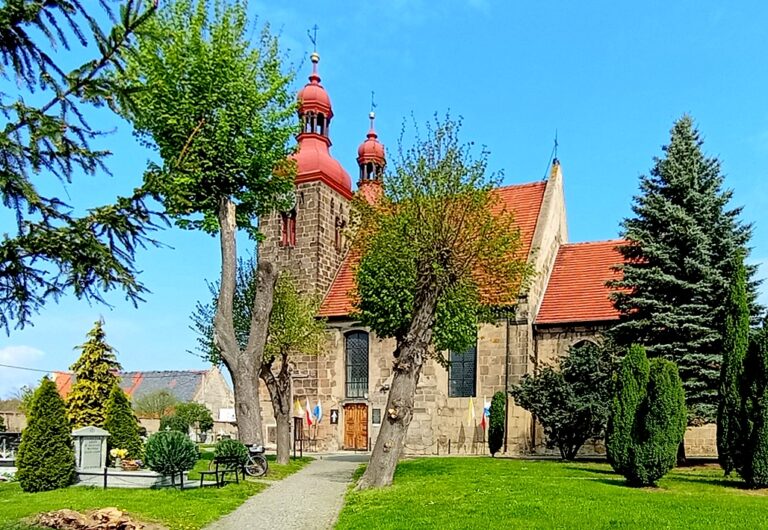
Corpus Christi church in Łażany is a historic Roman Catholic filial church in Poland, established around 1300 and first recorded around 1335. Its Gothic character reflects a medieval European architectural style known for pointed arches, vaulted spaces, and strongly vertical forms. The church is dedicated to Corpus Christi, the Catholic feast focused on the Eucharist, and belongs to the Parish of the Sacred Heart of Jesus in Żarów.
Medieval foundation and Protestant period
The church formed part of the religious life of Łażany from the beginning of the fourteenth century. Between 1553 and 1564, it was taken over by Protestants. An enlargement followed in 1569, when a burial place was also constructed for the husband of Formosa von Niemitz. A foundation plaque from that year remains associated with the work.
Rebuilding and later modernization
After the church was destroyed by fire, it was rebuilt in 1641. Further modernizations took place in 1843, 1857, 1913, 1978, and 2014. The latest renovation renewed the facade, laid a new walkway, and added a granite surround around the church. The work received support from the Friendly Village Association of Łażany, the Polska Miedź Foundation in Lubin, and parishioners.
The church stands in the center of Łażany, in Świdnica County, Lower Silesian Voivodeship. It was entered in the historic-monument register under number A/1826/1682 on 12 May 1966.
Remains
The surviving church is an oriented, single-nave Gothic building, aligned broadly from west to east with the chancel toward the east. It is built of fieldstone and brick and retains a west tower, a rectangular chancel, a southern sacristy, and tile-covered roofs. The former cemetery enclosure also survives in part, preserving the historic setting of the building and its funerary memorials.
Church building
The nave has a ceiling installed in 1978. The chancel is covered by an elliptical barrel vault, a continuous curved ceiling shaped like the length of half a cylinder, while the sacristy has a wooden ceiling. The tower adjoins the church on the west and has a pointed-arch portal and a hipped roof. Gabled, tile-covered roofs protect the nave and chancel. The main entrance is set in the southern nave wall, with the 1569 foundation plaque and a sundial positioned above the doorway.
Cemetery enclosure and mausoleum remains
Stone wall and fence
The church formerly stood within a cemetery enclosed by a surviving stone wall with a defensive character and traces of loopholes. Part of the boundary is formed by a wrought-metal fence with an entrance gate facing the former von Seidlitz palace.
Von Burghauss mausoleum
Small recognizable fragments of the former von Burghauss mausoleum remain near the gate leading toward the palace. The mausoleum was approximately 8 metres high and measured 5 by 5 metres.
Funerary memorials
Interior slabs
Interior funerary slabs commemorate Hans von Mühlheim, who died in 1494, and Rosy von Mühlheim, his second wife, who died in 1495. Other slabs commemorate Jorge von Mühlheim, also called von Buschke, who died in 1549, and Christoph von Mühlheim, who lived from 1528 to 1550. Christoph was the father of Siegmund von Mühlheim and the husband of Formosa von Niemitz.
Exterior memorials
An exterior slab commemorates Sigmund von Mühlheim, who lived from 1552 to 1594, and bears the coats of arms of the Mühlheim, Niemitz, Peterswald, and Zedlitz families. Another memorial commemorates Anna von Peterswald, born in 1528 and identified as Christoph von Mühlheim’s wife, with the arms of her parents, Hans von Peterswald and Anna von Czettritz.
An exterior memorial also commemorates Otto Siegmund von Nostitz auf Lahsena, who lived from 1662 to 1703. His epitaph, a memorial monument or inscription for a deceased person, has an elaborate compositional program. Other epitaphs commemorate Otto Siegmund Nostitz, Sigmund Mülheim, and Anna Peterswald.