Schloss Planegg: Former Moated Castle and Hofmark Seat in Germany


Site at a Glance
- Rating
- 4.2
- Popularity
- Very Low
- Country
- Germany
- Primary era
- Early Modern
- Eras represented
- Medieval, Early Modern, Modern
- Civilizations
- Duchy of Bavaria, Electorate of Bavaria, German, Holy Roman Empire
- Site type
- Domestic
- Remains
- Castle
On this page11 sections
History
Schloss Planegg is a former moated castle in Germany that probably received its fortifications between 1415 and 1420 before developing into a Baroque residence. It was the seat of the lords of the Hofmark Planegg, a landed jurisdiction whose holder exercised local administrative and lower judicial rights, and remains in the possession of the von Hirsch family, the last family to hold the lordship.
Formation of the Hofmark
Planegg was first recorded in 1409, when Duke Wilhelm III of Bavaria acquired additional properties and united them with the existing estate. He raised the estate to a Hofmark and granted it in 1425 to his son, Konrad von Egenhofen.
After the death of the last male Egenhofen descendant in 1472, Planegg passed through marriage to Christoph Lung. The Lung family, originally known as Dietoch and from the area around Rottenburg an der Laaber, then held the estate for several generations.
Changing noble ownership
Planegg belonged to Karl von Villinger of the baronial Villinger von Schönenberg family for three years after 1613. In 1616, Hans Georg von Hörwarth the Elder acquired the estate and became lord of Planegg. The castle complex was substantially enlarged in 1617, when the Chapel of St. Magdalene was also documented.
Heavy debts led Johann Josef Anton Franz von Hörwarth to sell Planegg in 1732 to Johann Baptist von Ruffini, also called Rufin or Ruffin. A native of South Tyrol, Ruffini already owned the neighboring Hofmark of Krailling. The Ruffini family retained Planegg until the early nineteenth century.
Planegg was then sold together with the Hofmarken of Seeholzen, Krailling, and Frohnloh to the Bavarian Minister of the Interior, Count Friedrich Karl von Thürheim. Several years later, Thürheim sold the property to the Bavarian court banker Jakob von Hirsch. An enlargement in 1737 gave Schloss Planegg its present Baroque appearance.
Destruction and protection
During Kristallnacht, the Nazi-organized pogrom against Jews and Jewish property on 9 and 10 November 1938, SS men in civilian clothing set fire to the castle of the Jewish-background lord Rudolf von Hirsch. They threatened members of the volunteer fire brigade with firearms to prevent them from extinguishing the blaze, and several rooms burned out.
Schloss Planegg is entered in the Bavarian monument register as a protected architectural monument. The Bavarian archaeological register also covers underground medieval and early-modern remains in the area of the castle and its predecessor buildings, including the vanished Baroque garden complex.
Remains
Castle complex
Main castle and chapel
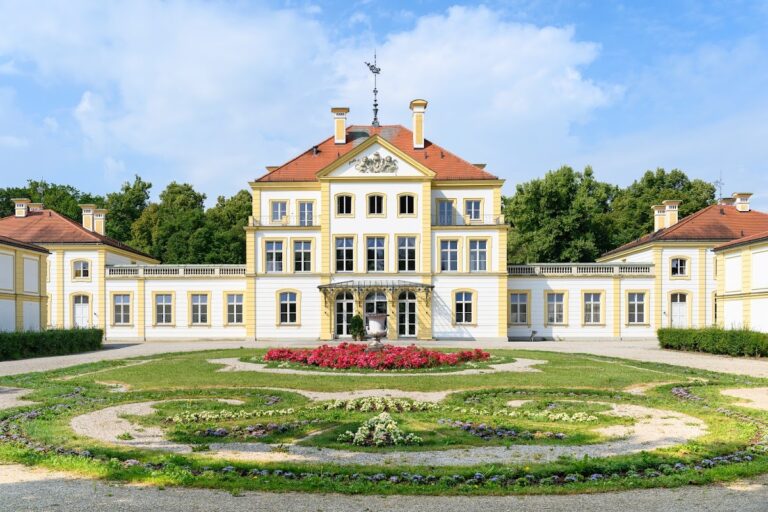
The castle is a former moated complex whose buildings were enlarged in the seventeenth century and given their present Baroque appearance in 1737. The Chapel of St. Magdalene belongs to the 1617 phase of the complex. The moat reflects the castle’s earlier defensive character, while the later alterations shaped it as a residence.
Tower
An engraving by Michael Wening, a Bavarian artist and topographical engraver, from around 1701 shows Schloss Planegg as a multi-sectioned building with an onion-domed tower. The core of the tower is probably medieval. Its present form is Rococo, a lighter architectural style known for delicate decoration and curved forms, and the tower is regarded as a symbol of Planegg.
On the north side, a wooden tower was replaced in 1818 by a new tower designed by the Bavarian architect Gabriel von Seidl. That replacement tower no longer exists.
Park and brewery
Castle park
The Würm River flows through the castle park. The grounds were originally laid out in the French style and were largely transformed into an English landscape park after 1800. The park is not publicly accessible. The vanished Baroque garden complex forms part of the underground archaeological remains associated with Schloss Planegg and its predecessor buildings.
Former castle brewery
A former castle brewery adjoins the park. Brewing had taken place on the site since the sixteenth century, while the brewery building is also dated to 1835. Jakob von Hirsch renewed the established brewery in 1850.
The brewery changed owners and names several times. It was called Brauerei Josef von Hirsch in 1886, Freiherrlich von Hirschsche Bierbrauerei in 1908, Schloßbrauerei Planegg Emil Freiherr von Hirsch in 1922, Schloßbrauerei Planegg AG in 1928, and Pschorrbräu AG Abteilung Schloßbrauerei Planegg in 1931. It was later leased to the Paulaner brewery. The former brewery building now serves as a library magazine.