St. Quirin in Aubing: A Roman Catholic Parish Church in Germany


Site at a Glance
- Rating
- 4.5
- Popularity
- Very Low
- Country
- Germany
- Primary era
- Medieval
- External website
- Open
- Eras represented
- Medieval, Early Modern, Modern
- Civilizations
- Duchy of Bavaria, German, Holy Roman Empire
- Site type
- Religious
- Remains
- Church
On this page12 sections
History
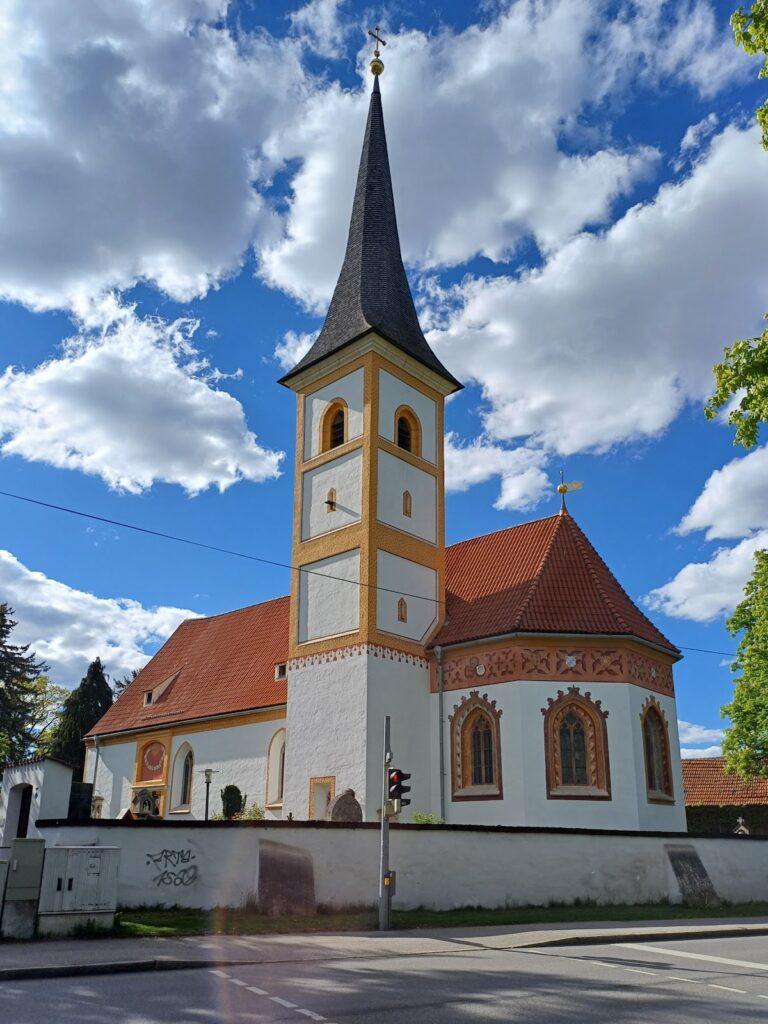
St. Quirin in Aubing is a Roman Catholic parish church in Munich, Germany, whose Romanesque tower was built at the end of the thirteenth century. Dedicated to Saint Quirin, a Christian martyr venerated as a saint, it was Aubing’s original parish church and served a historic parish that also included Pasing, Laim, Untermenzing, Obermenzing, and Allach. The tower is the oldest surviving building in Aubing, and dendrochronology, the dating of timber through its annual growth rings, places the felling of wood for its bell chamber in the winter of 1283–1284.
Medieval rebuilding
An earlier nave, probably made of wood, was destroyed by fire during the Bavarian War in 1422. The parish priests of Aubing then organized the rebuilding of the church in the Late Gothic style. The completed church was consecrated in 1489 by Ulrich of Salona, an auxiliary bishop who served under and represented Sixtus of Tannberg, Bishop of Freising.
The consecration date became clear only after renovation work in the 1960s uncovered equipment associated with the ceremony. Among the finds were Ulrich’s seal impression and a partly legible document. Its final digit was initially read as zero, producing the date 1480 and prompting a five-hundredth-anniversary celebration in 1980. Ultraviolet examination later showed that the digit was nine. The 1489 date also fits Ulrich’s appointment as auxiliary bishop in 1484 and the felling of roof timbers in the winter of 1484–1485.
Early modern changes
The interior was painted in two major campaigns. The first took place between 1580 and 1594, while the second began in 1668. In that year Martin Reiter, Aubing’s parish priest from December 1632 until his death on 28 September 1669, commissioned the Baroque high altar. His grave slab remains in the choir, and the grave slab of his stepfather was found in the tower.
Repairs took place in 1724 and 1787. Further Baroque alterations to the choir interior began in 1740, when the fresco on the choir vault was painted. The cemetery beside the church continued in use until 1911. Its enlargement in 1863 led to the relocation of the main entrance from the south side to the west; the former entrance was blocked.
Expansion and later work
In 1879, the “community”, whether the parish or the municipality, approved 2,600 marks for an organ and 1,500 marks for a tower clock. A northern aisle designed by Michael Kurz was considered in 1913, but after the First World War the plan was abandoned in favor of building a church in Neuaubing. St. Quirin nevertheless became too small again as the parish grew. Kurz’s plans were subsequently used to extend the nave westward by a fifth bay, a structural division of the nave, in 1936–1937.
Three new bells were consecrated in 1997 for the seven-hundredth anniversary of the tower, and the bell chamber was thoroughly renovated. The same twentieth-century renovation work also brought the medieval consecration equipment to light, adding important evidence for the church’s Late Gothic rebuilding and consecration.
Remains
St. Quirin consists of a rectangular nave hall with a narrower choir projecting to the east. The Romanesque tower contains the historic bell chamber, while the nave preserves elements from the Late Gothic rebuilding and the later westward extension. Two two-storey additions stand beside the choir, each with an upper floor covered by a cross vault whose ribs resemble those used elsewhere in the church.
Church layout and painted surfaces
The nave was originally shorter, with its western facade aligned with the tower. The extension of 1936–1937 added a fifth bay and placed the present western entrance beyond the earlier frontage. This entrance has a vestibule. The former southern entrance was blocked in 1863 and converted into a chapel window. Frescoes from the first interior painting campaign survive in the main nave, where they frame the windows beside the side altars. The choir vault carries the fresco painted in 1740.
Furnishings and musical instruments
Shrine of Saint Ursula
The Shrine of Saint Ursula, dated 1499, is the church’s most important furnishing. It stands in the western extension beneath the gallery and was originally the central section of an altarpiece whose side wings have been lost. The shrine probably entered St. Quirin during the nineteenth century, as it does not appear in earlier inventories.
Saint Ursula is shown slightly larger than her four companions. Each of the five crowned figures holds a martyr’s palm. The rear of the shrine bears a painted Man of Sorrows, an image of Christ displaying the wounds of the Passion, together with the Instruments of the Passion, objects associated with his suffering and crucifixion. Incised lettering from the sixteenth century accompanies an inscription dated 1591, which names Georg Manser of Maisach and gives the motto “With God’s work, everything is possible.”
Choir-arch cross
A cross on the choir arch, with a figure of Christ, dates from about 1530.
Organ
The present organ was built in 1965 by Julius Zwirner of Munich, incorporating material from an earlier instrument made around 1880 by Johann Georg Beer. It is an electric slider-chest organ with 15 stops distributed across two manuals and a pedal. Its couplers are II/I, I/P, and II/P, and it has one adjustable combination, a tutti control, and a piano pedal.
Bells
The tower holds five bells. The oldest was cast in 1516, while another dates from the immediate postwar period and is made of Euphon alloy. Three further bells were added in 1997. All five hang from wooden yokes within a wooden bell frame. Apart from the otherwise undecorated Mary bell, which has only a shoulder frieze, each bell carries an image of its associated saint on its front. Their pitches are E1, A1, B1, D2, and E2. The third bell sounds the quarter-hour and the Angelus, while the first gives the hourly strike.
Medieval consecration equipment
The renovation of the 1960s uncovered a group of medieval objects connected with the church’s consecration. The collection includes Ulrich’s seal impression, a glass bottle containing the consecration document, a pouch surrounding the bottle, a small box probably used for chrism, an Ulrich cross, and several bones whose significance remains uncertain.