St. Nikolaus (Neuried bei München): A Historic Catholic Parish Church
Site at a Glance
- Rating
- 3.8
- Popularity
- Very Low
- Country
- Germany
- Primary era
- Medieval
- External website
- Open
- Eras represented
- Medieval, Modern
- Civilizations
- Duchy of Bavaria, German, Holy Roman Empire
- Site type
- Religious
- Remains
- Church
On this page15 sections
History
St. Nikolaus (Neuried bei München) is an old Catholic parish church in Germany, built during the second half of the fifteenth century on the site of a Romanesque predecessor. Its surviving medieval fabric, Late Gothic choir, and later furnishings reflect the changing religious and architectural history of the parish.
Medieval predecessors and rebuilding
The earlier church was dedicated to Mary and dated from the late thirteenth century. Its lower tower section and parts of its nave walls remain incorporated into the present building. During the second half of the fifteenth century, the church was rebuilt, and in 1484 the tower’s upper storey and the Late Gothic choir were completed. The date survives on the inside of the chancel arch.
The rebuilding created a church whose medieval core continued to serve the community through later alterations. A 1589 epitaph inside the choir commemorates the Spitzweck family, who held the Boschetsried, also called Poschetsried, sheep farm and Schwaige, a rural estate associated with livestock farming and dairying. Fürstenried Palace was later built on the site of that estate.
Early modern changes
The Gothic church was altered several times during the seventeenth and eighteenth centuries. The nave was probably heightened around 1752, and the dedication to Saint Nicholas of Myra is documented from the middle of the eighteenth century. Nicholas was a fourth-century Christian bishop traditionally associated with generosity and care for vulnerable people.
The church also preserves a memory of the great local fire of 1811. A votive painting inside the building depicts a farmer whose farm was spared, expressing remembrance and thanksgiving after the disaster.
Modern alterations and parish use
An extension was added in 1956. It provided a sacristy on the ground floor and a parish sitting room above it. During restoration in the 1970s, the west gallery was renewed, the nave’s barrel vault and its Baroque frescoes were replaced by a flat wooden ceiling, and a Baroque pulpit dating from around 1700 was removed.
A new parish church, also dedicated to Saint Nicholas, was built in the 2000s and consecrated in 2008. Since that time, the older building has served as a subsidiary church, meaning a church that supports the main parish church.
Remains
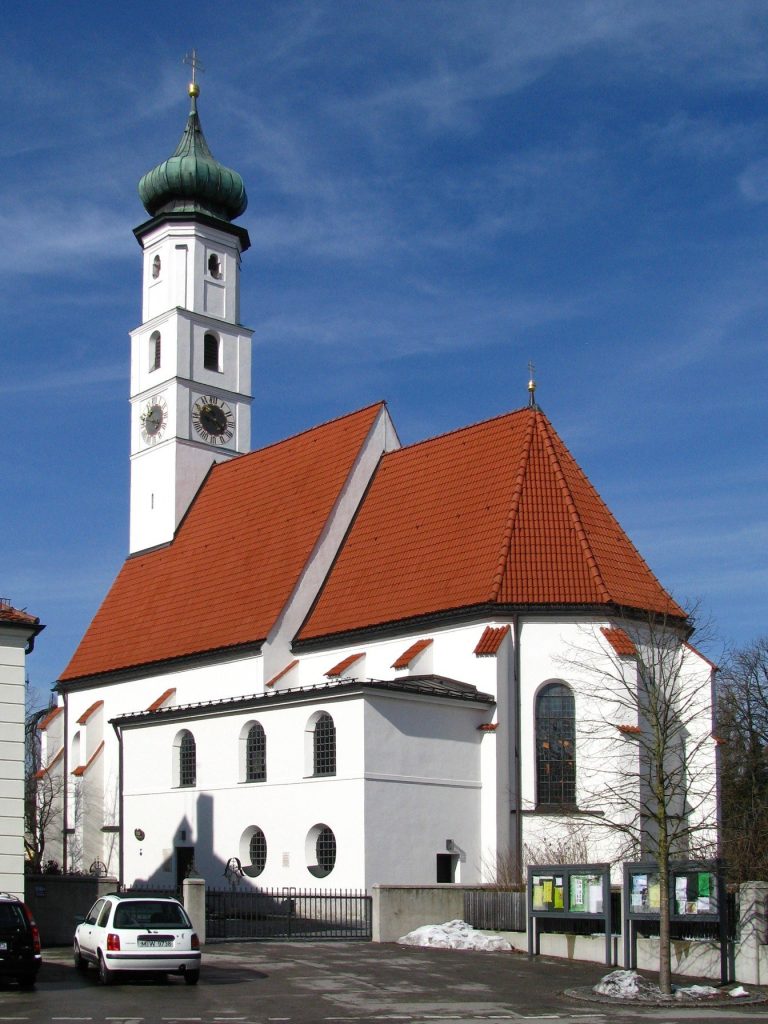
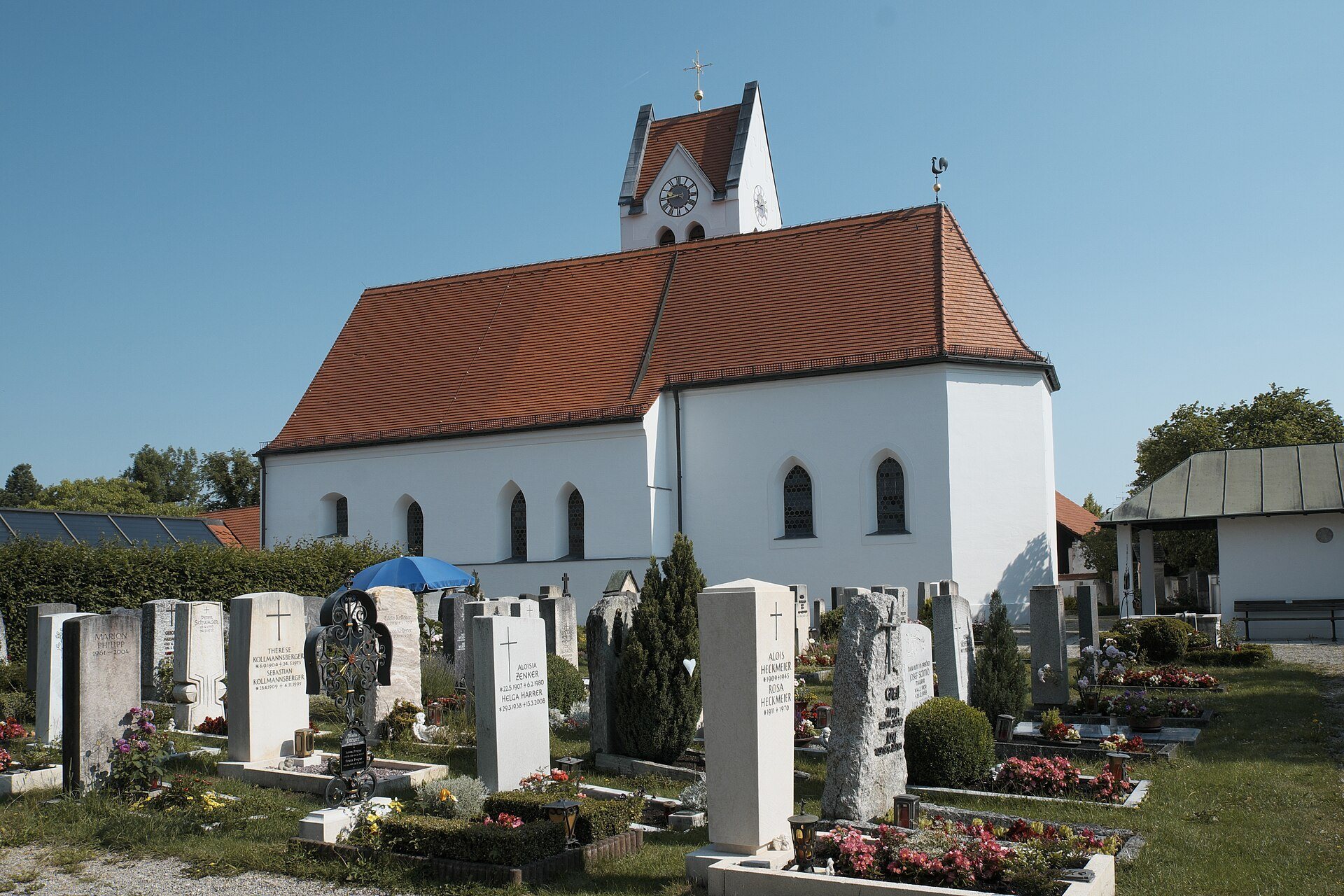
St. Nikolaus is a hall church with a strongly recessed choir closed on five sides. The medieval tower stands at the northern angle of the choir, while the surviving lower tower section and portions of the nave walls belong to the earlier church. The interior combines Late Gothic construction with later ceilings, altars, sculptures, paintings, and memorials.
Medieval structure
Hall church and choir
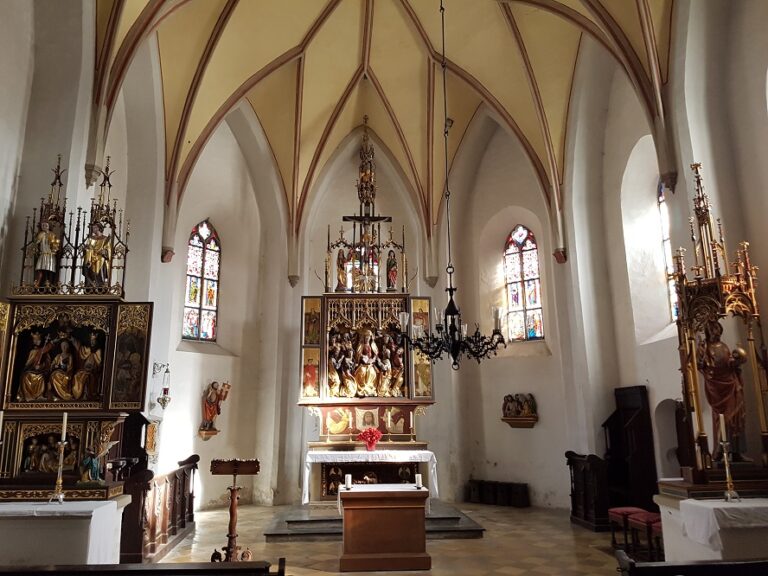
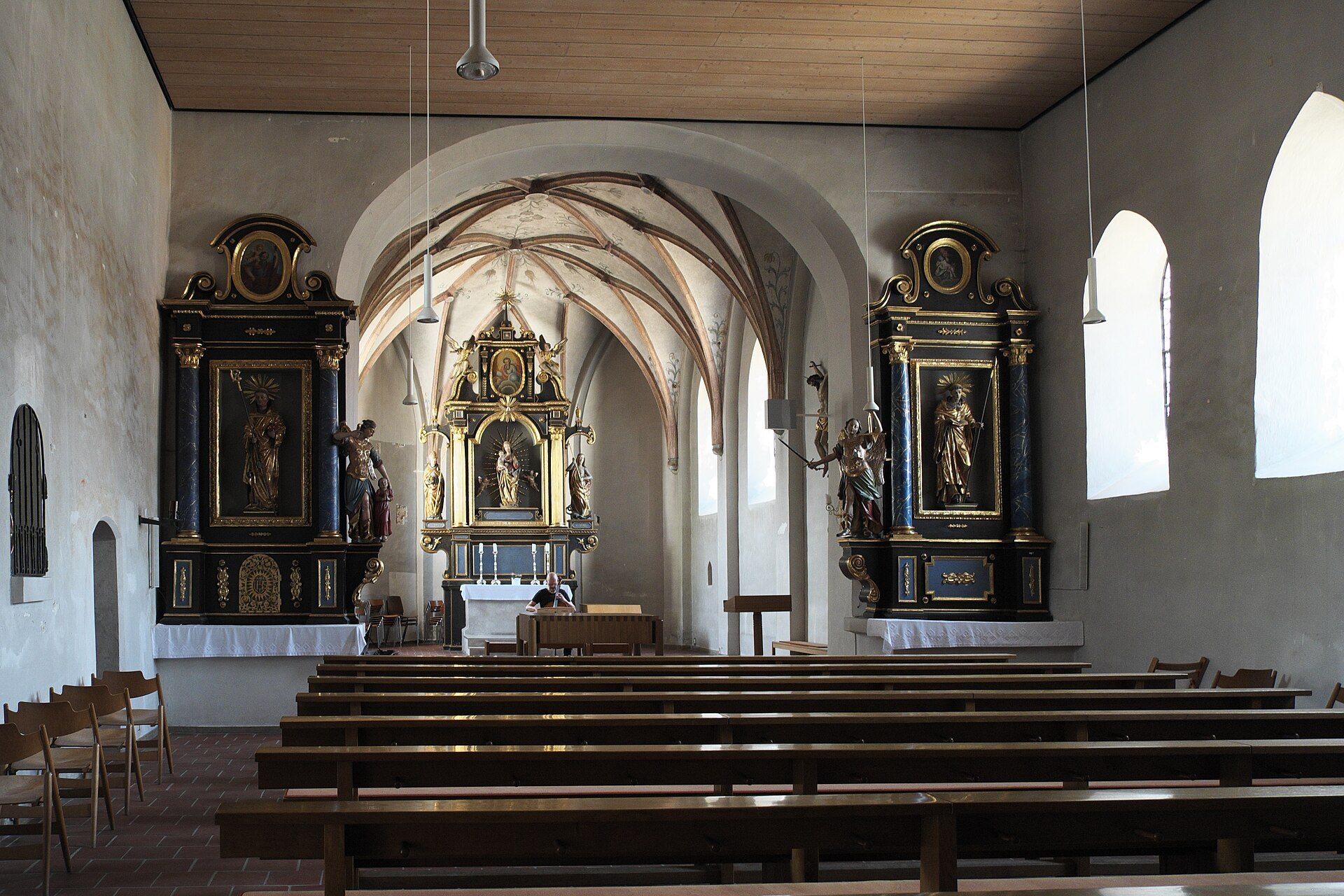
The nave forms a single hall, now covered by the flat wooden ceiling installed during the restoration of the 1970s. The choir is set noticeably farther back from the nave and terminates on five sides. Its walls are articulated by wall piers and shield arches, which span between wall supports and help organize the vaulted interior.
A net-rib vault covers the choir. Its intersecting ribs create a network of patterns and rest on consoles carved with heads. Floral paintings on the vault were uncovered again in 1955. Decorated bosses mark the intersections of the ribs, including one with a relief of the Madonna, while other bosses represent saints.
North tower
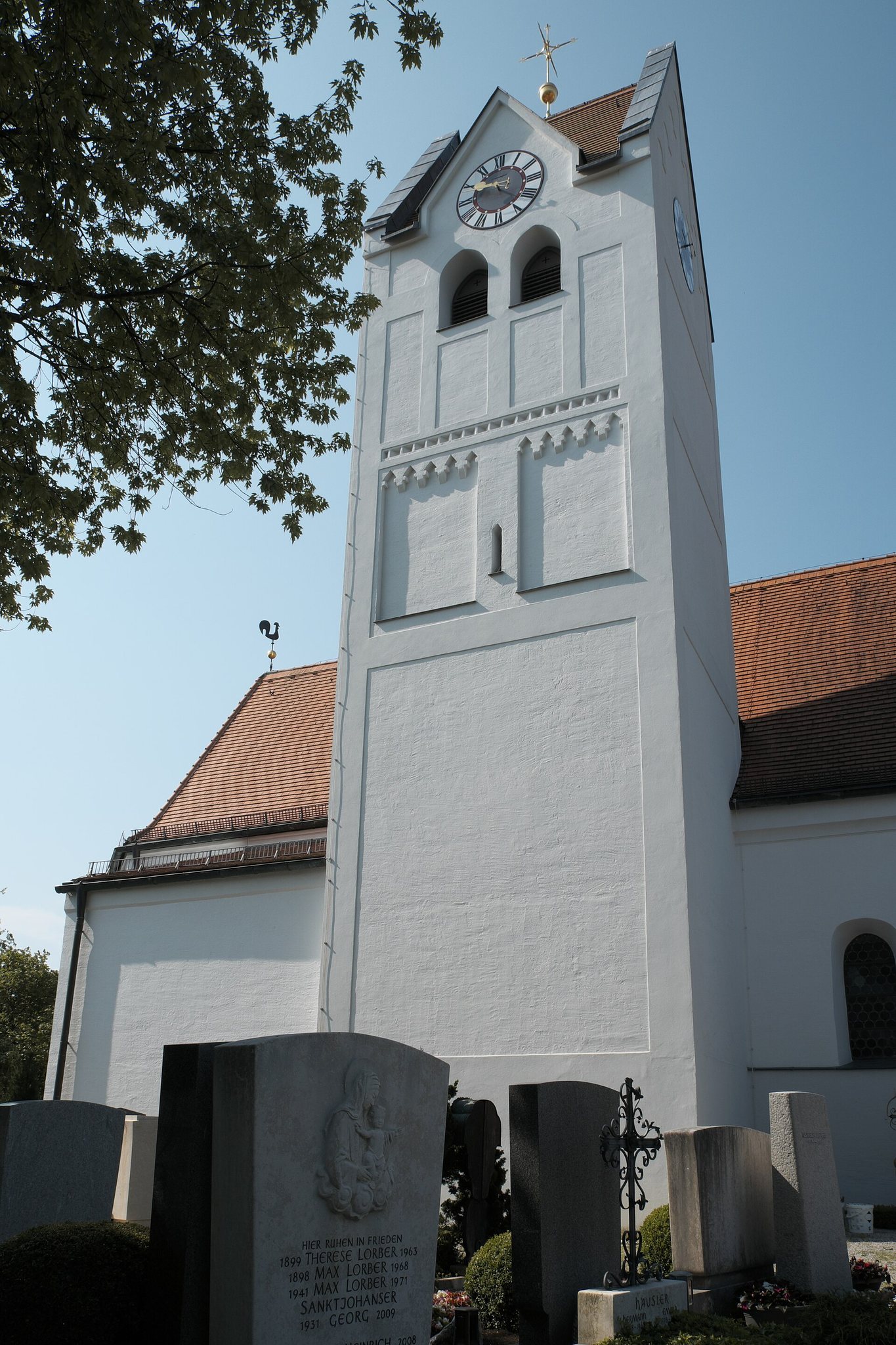
The tower rises beside the northern side of the choir and is covered by a gabled roof. Blind panels divide its exterior surfaces. In the upper storey, the panels are framed by a tooth frieze and a pointed-arch frieze bearing crosses. Two pointed-arch sound openings lie below the clock. The north and south stepped gables were added in 1890, and the lower part of the tower belongs to the late thirteenth-century predecessor.
Altars and devotional sculpture
High altar
The high altar was made around 1650. Its central carved Madonna and Child date from around 1500. Mary and the infant Jesus stand on a crescent moon and are surrounded by a halo of rays. Saint Nicholas appears on the left side of the altar, while Saint George stands on the right. George was a Christian martyr traditionally portrayed as a dragon-slayer.
Side altars
The two side altars probably date from around 1708. The central figure on the left altar is Saint Leonard, made around 1520. Leonard was especially associated with livestock and prisoners. Beside him stands the Archangel Raphael protecting Tobias, a group made in the middle of the eighteenth century. Raphael is traditionally connected with healing and with guiding Tobias.
The figures on the right altar, the Archangel Michael and Benedict of Nursia, were also made in the mid-eighteenth century. Michael was traditionally regarded as a defender against evil, while Benedict was a sixth-century religious founder whose Rule became foundational for Western monasticism.
Other sculptures
A crucifix and a depiction of the Sorrowful Madonna in the choir date from the first half of the eighteenth century. Against the northern nave wall stands a painted wooden sculpture of Pope Sylvester I from the late fifteenth century. Sylvester was bishop of Rome from 314 to 335.
The northern side of the nave also contains a sculpture group of Saint Anne with the Virgin and Child, made around 1520 and housed in a niche. The image shows Anne together with her daughter Mary and the infant Jesus.
Memorial and organ
Spitzweck epitaph
The choir contains the Spitzweck family’s 1589 epitaph, a commemorative monument for the family. Its panel painting is set within an elaborately carved frame. The Good Shepherd appears in the main scene, while God the Father is shown above the clouds holding a globe in his left hand. Members of the family are portrayed in the lower part of the panel.
Organ
The present organ was newly built by Christoph Kaps in 1992. It has 15 stops, two manuals, and a pedal.