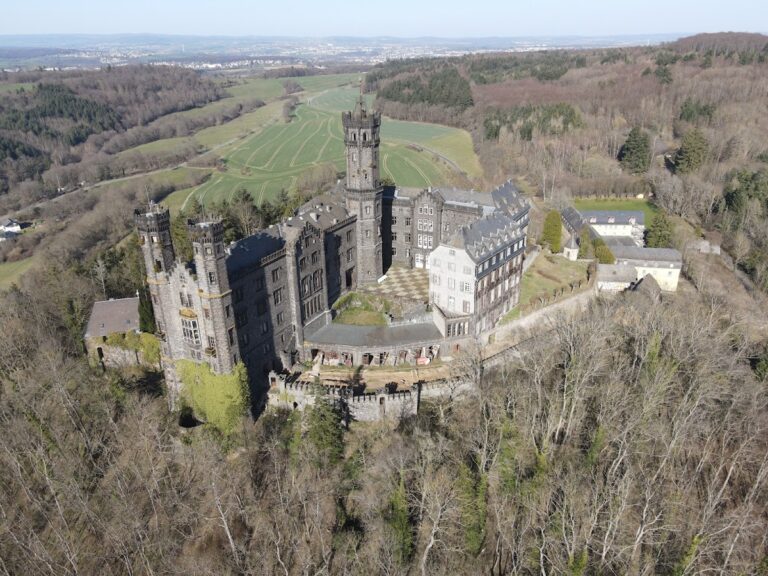
Schloss Oranienstein: A Nassau-Orange Palace and Bundeswehr Site in Germany


Site at a Glance
- Rating
- 4.4
- Popularity
- Low
- Country
- Germany
- Primary era
- Early Modern
- External website
- Open
- Eras represented
- Medieval, Early Modern, Modern
- Civilizations
- Holy Roman Empire
- Site type
- Domestic
- Remains
- Palace
On this page11 sections
History
Schloss Oranienstein is a palace in Diez, Germany, built by the Nassau-Orange dynasty between 1672 and 1681 on the remains of the former Dierstein Benedictine convent. It was intended as a widow’s residence for Countess Albertine Agnes of Nassau-Orange and remained connected with the Counts and Princes of Nassau-Dietz until 1815. The dynasty, also known as Orange-Nassau, produced the Dutch stadtholders and later the Dutch monarchs.
Foundation under Albertine Agnes
Albertine Agnes began the project while serving as regent for her underage son, Henry Casimir II. Her government in Nassau-Dietz also introduced several religious, social, and medical measures. She prohibited local drinking gatherings, banned the torture and burning of people accused of witchcraft, encouraged regular church attendance, and arranged for a doctor and a free pharmacy.
Oranienstein was one of four German castles named after the House of Orange. The others were Oranienburg, Oranienbaum, and Oranienhof near Bad Kreuznach. Oranienhof no longer survives. The palace at Diez therefore formed part of a wider group of residences associated with the Nassau-Orange family.
Baroque transformation
Albertine Agnes’s daughter-in-law, Henriette Amalia, commissioned the first major rebuilding of the complex. Carried out between 1704 and 1709 according to plans prepared by Daniel Marot, the work transformed the earlier residence into a Baroque palace. Baroque architecture favored dynamic compositions, rich ornament, and theatrical spatial effects. The palace chapel was inaugurated in 1716, completing an important part of the new complex.
In 1743, the union of the Ottonian branches of the House of Nassau and the reorganization of the territory caused Oranienstein to lose its position as a residential palace in favor of the residence at Dillenburg. The Ottonian lines were Nassau ruling branches descended from the medieval count Otto. The palace later regained a political role when William V of Orange used it as a residence during his exile from 1801 until 1806.
William V commissioned the German landscape architect Friedrich Ludwig von Sckell to design the palace gardens. In December 1801, William V and his son William Frederick issued the Letters of Oranienstein from the castle to fifteen former regents sympathetic to the House of Orange. They urged these figures to return to political participation. William V and William Frederick also recognized the Batavian Republic and renounced their stadtholder rights and claims in the Netherlands in exchange for compensation demanded by Napoleon Bonaparte. A stadtholder was a senior political office in the Dutch Republic, combining functions broadly comparable to those of a provincial governor and military leader.
From Nassau residence to Prussian military school
In 1806, Oranienstein passed to the Grand Duchy of Berg. Napoleon confiscated it in 1811 and ordered its furnishings to be sold at auction. After the Congress of Vienna, the palace became part of the newly created Duchy of Nassau. Prussia annexed the duchy in 1866 after Nassau supported defeated Austria in the German War, a conflict that helped determine Prussian dominance in the German states.
A proposal to establish a psychiatric institution at the palace was abandoned after protests from the Dutch royal family. Instead, a Prussian cadet school opened there in 1867. Barracks were added between 1874 and 1876, and further administrative buildings followed from 1900 to 1907. These additions changed the complex from a dynastic residence into a larger military site.
Twentieth-century changes
The cadet school was dissolved after the First World War, and French troops occupied the palace during the French occupation of the Rhineland. Renovation and reopening accompanied Diez’s six-hundredth anniversary in 1929, when the Nassau Local History Museum was installed at Oranienstein. A vine nursery also operated on the grounds during the interwar period, while an instruction school for labor-service leaders occupied the palace in 1932.
From 1934 to 1945, Oranienstein housed a National Political Education Institute. The Nassau Museum was removed in 1940. After the Second World War, France again confiscated the palace and its ancillary buildings. Responsibility passed to the newly established state of Rhineland-Palatinate in 1947, but the state could not meet the substantial cost of repairing wartime and postwar damage.
Restoration and Bundeswehr use
The Je Maintiendrai Nassau Foundation, established in Delft in 1957, supported the maintenance of buildings associated with the House of Nassau-Orange. A memorandum prepared by the Diez Museum and Historical Society helped persuade Minister-President Peter Altmeier and Defense Minister Franz Josef Strauss to arrange the transfer of Oranienstein to the Bundeswehr, the armed forces of the Federal Republic of Germany. Extensive renovation and restoration followed, including work on the palace’s stucco decoration and ceiling paintings. The palace was formally handed over to the Bundeswehr on 23 May 1962, when the Orange-Nassau Museum also opened.
Military use had already begun in the postwar period. The staff of Quartermaster Battalion 907 arrived on 27 February 1958, and the unit became Material Battalion 310 in 1959 before moving completely to Freiherr-vom-Stein Barracks in Diez in 1960. The staff returned as Supply Battalion 310 from August 1996 until the battalion was dissolved in 2002, with parts contributing to Logistics Regiment 46. Supply Battalion 156 moved its staff to Oranienstein on 1 April 1959 under Panzer Brigade 15, while the rest of the unit moved to Alsberg Barracks in Rennerod in 1969. The battalion was dissolved in 1972, followed by its successor units in 1993 and 1994.
Panzer Artillery Regiment 5 moved to the palace in 1960 and was renamed Artillery Regiment 5. It remained until the end of 1979, then merged with the Artillery Training Regiment at Idar-Oberstein on 1 January 1980. The staff of the 5th Panzer Division arrived on 1 May 1962 and remained until 1 April 1994. The division itself was dissolved on 30 September 2001. During the 1980s, an Air Force liaison command and the division’s mobilization-preparation group were also based there.
Other Cold War functions included the presence or storage of Military Police Company 5, Front Intelligence Platoon 5, Reserve Hospital Group 7406, and the military court of the 5th Panzer Division. Military Recruitment and Replacement Battalion 852, Replacement Battalion 52, and Leader Reserve II for III Corps were also based or stored at the site as equipment units. A mobilization depot stored equipment and material intended for rapid activation during a military emergency.
Further changes followed German military reorganizations after reunification. Panzer Brigade 34 used the palace from 1 April 1994 until its dissolution on 15 March 2002, while Support Command 4 was based there from 16 May 1994 until 31 March 1997. Transport Battalion 370 established its headquarters at Oranienstein after moving to Diez and Montabaur in 1993, then dissolved in 2003 and became part of Logistics Regiment 46. Hospital Regiment 74 remained from its formation in 1993 until 2007, and Mixed Hospital Regiment 13 stored equipment there from its formation in 1996 until 2007.
The Front Intelligence Training Company occupied the castle from 1999 until it was absorbed into the Bundeswehr Field Intelligence Center in 2002. The center was dissolved in 2008. Parts of the Hessen State Command’s Limburg district liaison organization were housed at Oranienstein from 2007 to 2013. Medical Command II was established there on 1 October 2001, formally inaugurated in April 2002, and dissolved on 31 December 2012. Regional Medical Support Command succeeded it on 1 January 2013 and continues to have its headquarters at Oranienstein.
The first-half-of-the-1990s renovation was completed in 1994. Since 1 April 2012, the Bundeswehr clothing company has operated its Diez service station at the site. Oranienstein also contains a military telecommunications installation and has held medical-supply equipment for Medical Area 41/3 since 1972. Recognized as a cultural monument in Rhineland-Palatinate, the palace remains both a functioning Bundeswehr site and a monument associated with Nassau-Orange history.
Remains
Palace complex
Schloss Oranienstein stands on a limestone rock at Diez an der Lahn. Its original construction incorporated parts of the Romanesque convent buildings of Dierstein. Romanesque architecture is characterized by massive masonry and rounded forms. The Baroque rebuilding produced a largely surviving five-winged palace containing 318 rooms. The form of the complex preserves the scale of Henriette Amalia’s transformation while retaining elements from the earlier religious foundation.
Palace chapel
The Baroque chapel occupies the first floor of the southeast cross wing and was inaugurated in 1716. Eugenio Castelli and Antonio Gentone created its elaborate stucco decoration. The ceiling painting depicts the miracle of Pentecost. It was long attributed to Jan van Dyk, but the painter was in fact Carlo Lodovico Castelli, the brother of the stucco artist.
The organ stands above the pulpit on a small gallery. Eduard Wagenbach built the present instrument in 1967 within a Baroque case. It has twenty-five stops on two manuals and pedal, electropneumatic action, and a free-standing console at floor level to the left of the altar. Its controls include two free combinations, a register swell, tutti, cancel, reed-off, and crescendo-off functions.
Gardens
The gardens surrounding the palace were laid out according to plans commissioned from Friedrich Ludwig von Sckell. Their design belongs to the period when William V again used Oranienstein as a residence from 1801. The gardens form part of the palace complex’s surviving landscape setting and reflect the continuing adaptation of the residence during its Nassau-Orange phase.
Military extensions
The palace complex includes barracks constructed between 1874 and 1876 and additional administrative buildings erected from 1900 to 1907. These structures were added for the Prussian cadet school and later military functions. Together with the palace, they form the physical framework of the modern military site, whose buildings continued in use after the postwar transfer to the Bundeswehr.
Postwar restoration addressed the valuable stucco decoration and ceiling paintings within the palace. The Orange-Nassau Museum opened there in 1962, giving the restored building a continuing museum function alongside its military use.
Nearby sites