Castle Balduinstein: A Medieval Rock Castle Ruin in Germany


Site at a Glance
- Rating
- 4.2
- Popularity
- Very Low
- Country
- Germany
- Primary era
- Medieval
- Eras represented
- Medieval
- Civilizations
- Holy Roman Empire
- Site type
- Military
- Remains
- Castle
On this page7 sections
History
Castle Balduinstein is a medieval rock castle ruin in Balduinstein, Germany, built under Archbishop Balduin of Trier from 1319 as a defensive stronghold above the lower Lahn. Balduin, a senior bishop who governed the ecclesiastical province of Trier, established the castle below Schaumburg, where the hostile Lords of Westerburg resided.
Foundation and administration
Emperor Louis the Bavarian granted Balduinstein town rights in 1321. Balduin then made the settlement an Amt, a territorial administrative district, and transferred the district and castle to the knight Dietrich von Staffel in 1335. In 1339, he pledged the castle to Dietrich. The von Staffel family retained it until the male line became extinct in 1683. The property was later pledged to the knights von Reifenberg and von Eltz-Rübenach.
Decline and demolition
Castle Balduinstein underwent several expansions during the fourteenth and fifteenth centuries and was connected to the town fortifications. The construction of the Niederburg, or lower castle, inside the town in 1443 reduced its importance. The castle began to decay in the middle of the seventeenth century. After the Thirty Years’ War ended in 1648, the Elector of Trier authorized its demolition in 1665. The Elector was the archbishop of Trier and also one of the Holy Roman Empire’s imperial electors. By 1680, only the walls remained, and the ruin was later used as a stone quarry during the nineteenth century.
Modern use and recent history
Since 1974, a nineteenth-century villa and its ancillary buildings on the castle grounds have operated as Youth Castle Balduinstein, a self-catering facility for Scouts and youth-movement groups. The castle remains privately owned. In 2013, sexual abuse of minors on the grounds became public, and subsequent trials exposed an abuse system involving people close to the youth castle’s then sponsoring association.
Remains
Hilltop layout and defenses
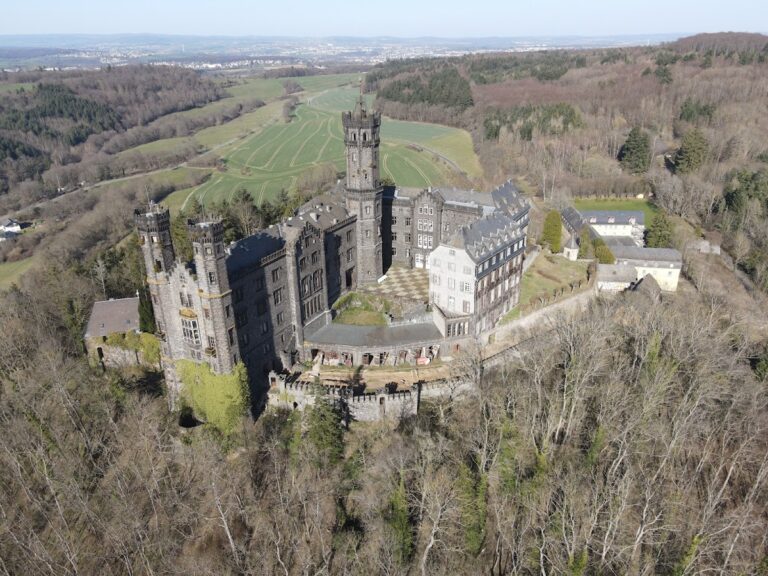
Castle Balduinstein occupies a rocky hilltop spur above Balduinstein and the lower Lahn. Its plan is oval, and parts of the outer walls survive, reaching up to 1.60 metres in thickness. A well-preserved neck ditch, a defensive trench cut across the approach to a spur castle, protects the northern side. On the northwestern side, a lower-lying zwinger, an enclosed defensive area between or outside fortifications, provided an additional line of protection.
Residential and defensive structures
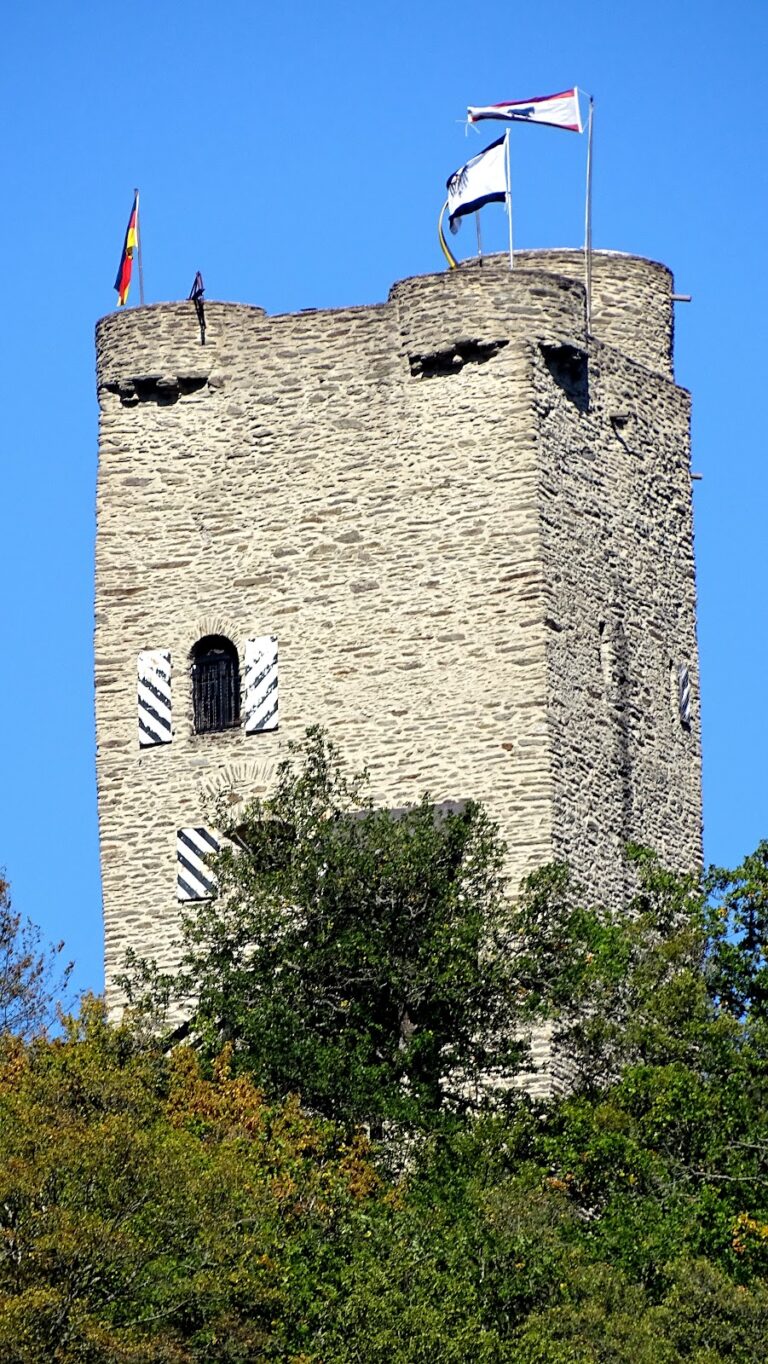
Only the foundations of the three-storey residential building remain. A small tower survives in the southwestern corner of the castle. The site has no bergfried, the principal defensive tower of a medieval German castle. The nineteenth-century villa and its ancillary buildings stand within the castle grounds. Nearby Schaumburg and Balduinstein’s octagonal gate tower, which formed part of the town wall, are also associated with the castle’s setting.
Nearby sites