Schloss Merseburg: A Renaissance Castle and Ducal Residence in Germany


Site at a Glance
- Rating
- 4.7
- Popularity
- Low
- Country
- Germany
- Primary era
- Medieval
- External website
- Open
- Eras represented
- Medieval, Early Modern
- Civilizations
- Electorate of Saxony, Holy Roman Empire
- Site type
- Domestic
- Remains
- Palace
On this page11 sections
History
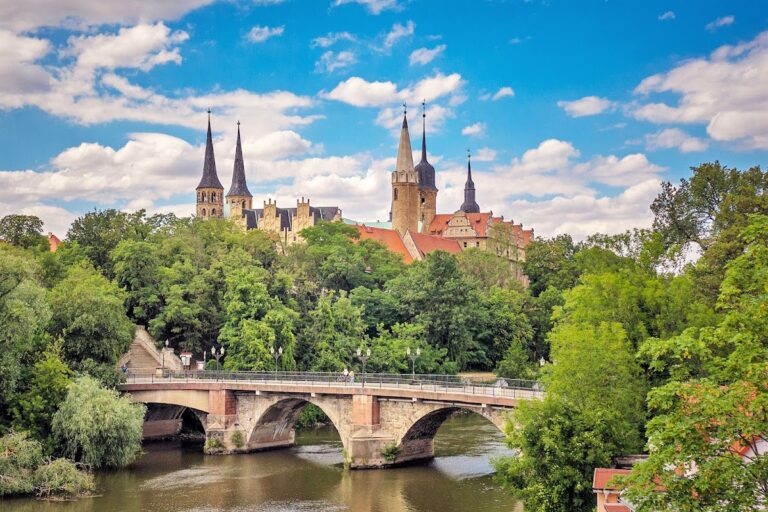
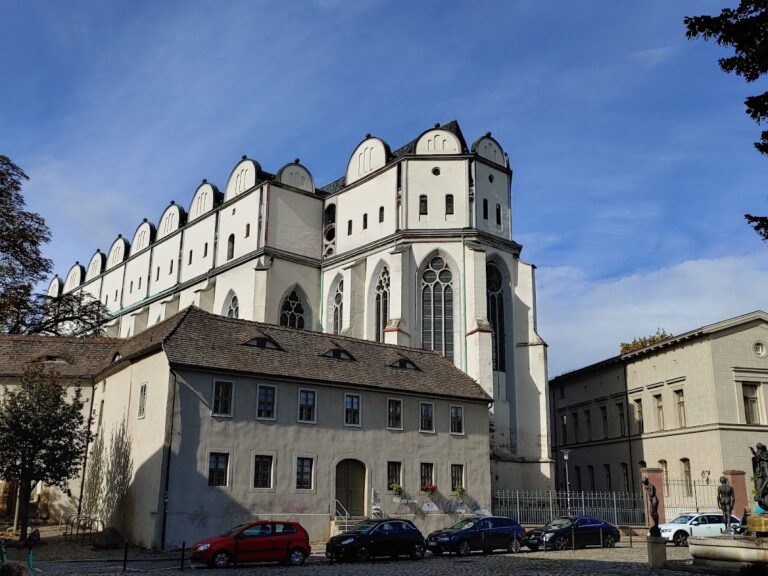
Schloss Merseburg is a Renaissance-style castle in Merseburg, Germany, that served as a royal palace, a bishop’s seat, and a ducal residence. Its present three-wing form was created during the late fifteenth century, with Merseburg Cathedral forming the fourth side of the complex.
Diocesan origins and the medieval castle
Emperor Otto I, a tenth-century German king and Holy Roman emperor, founded the Diocese of Merseburg in 968. Bishop Heinrich von Warin commissioned the first castle at Merseburg, which was built between 1245 and 1265. The castle therefore emerged from the political and religious importance of the diocese, whose bishop held authority in both church affairs and secular government.
The Renaissance rebuilding
During the episcopate of Thilo von Trotha, a late-medieval bishop of Merseburg, a new castle was constructed between approximately 1470 and 1500. The rebuilding produced the Renaissance three-wing complex that survives today, while the cathedral completed its fourth side.
The 1485 Division of Leipzig placed Merseburg within the Albertine Duchy of Saxony. The Albertines were a branch of the Wettin dynasty that ruled Saxony as a duchy and later as an electorate. After the last Catholic bishop died in 1561, the Reformation became established in Merseburg, and the prince-bishopric, a territory governed by a bishop with both religious and secular power, effectively came under the control of the Electors of Saxony. Its own church government continued to administer the territory for the ruling prince until the beginning of the eighteenth century.
The Saxe-Merseburg residence
From 1656 to 1738, Merseburg was the residence city of the Dukes of Saxe-Merseburg, a secondary line of the Albertine dynasty. Delitzsch Castle served as the dowager residence for the duchesses. The castle garden was laid out in 1661 during this period and is now part of the Gardens Dreams network of Saxony-Anhalt.
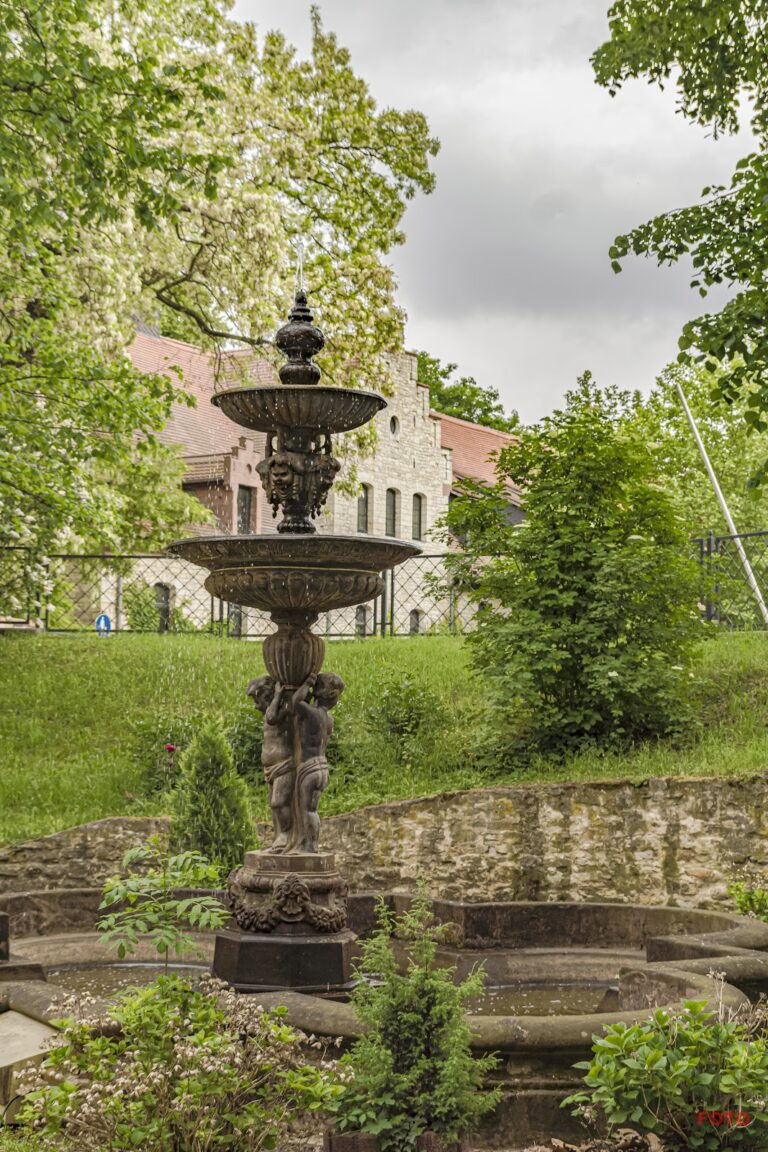
Extensive renovations took place in 1604 and 1605 under Melchior Brenner, commissioned by Administrator Johann Georg I of Saxony. An administrator was an official who governed a prince-bishopric on behalf of its ruling authority. The Neptune fountain in the inner courtyard dates from this renovation phase.
Prussian administration and reconstruction
The castle was renovated again in the nineteenth century. In 1815 it became the seat of the Prussian district government. The east wing was destroyed during the Second World War and rebuilt in a faithful reconstruction completed by 1971.
Today, Schloss Merseburg is owned by the Saalekreis district and houses the district administration. Its buildings also accommodate the Saalekreis Johann-Joachim Quantz District Music School and the Cultural History Museum, an institution founded in 1906 and operated by the district. From 1893, Ewald Adam Gustav Paul Constantin von Ungern-Sternberg commissioned a copy of the castle, called Lindenhof, near Haapsalu in Estonia. The building was never completed, and its ruin survives.
Remains
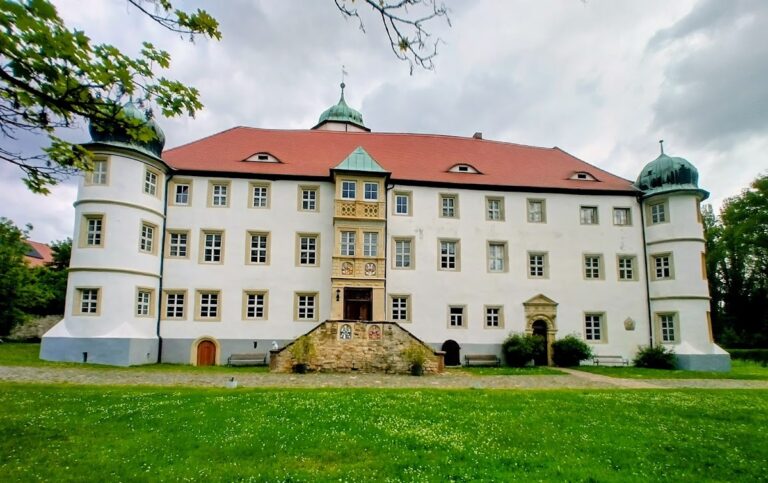
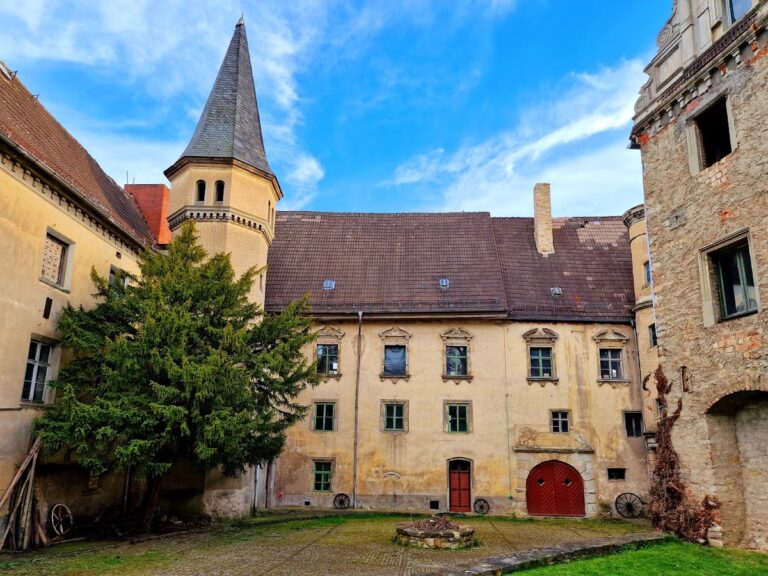
Schloss Merseburg is arranged as a Renaissance complex of three wings, with Merseburg Cathedral forming the fourth wing. The surviving buildings enclose an inner courtyard, where a Neptune fountain from the early seventeenth-century renovation phase provides a notable architectural feature. A gate bears a Wettin coat of arms, linking the complex to the dynasty that controlled Merseburg after the 1485 division.
Castle architecture and heraldry
Courtyard and gate
The inner courtyard contains the Neptune fountain installed during the renovations of 1604 and 1605. The castle gate carries a Wettin coat of arms. Other heraldic features bear the coats of arms of Bishop Adolf of Anhalt, Bishop Sigismund of Lindenau, and Bishop Thilo von Trotha. One of these features is dated 1513.
East wing
The east wing forms part of the reconstructed castle complex. After its destruction in the Second World War, it was rebuilt in its original form by 1971, preserving the Renaissance character of the three-wing arrangement.
Garden
The castle garden was established in 1661. It forms part of Saxony-Anhalt’s Gardens Dreams network and remains an associated element of the castle’s historic setting.
Cultural History Museum
The Cultural History Museum occupies three floors and covers 1,800 square metres within the castle complex. Its permanent exhibitions trace Merseburg’s development from prehistory and early history to the present. Displays include nineteenth- and twentieth-century glass-bead work, historical ignition devices and lighters, and material devoted to the Baroque residence of the Dukes of Saxony-Merseburg.
Nearby sites