Market Church of Our Dear Ladies: A Reformation-Era Parish Church in Halle
Site at a Glance
- Rating
- 4.7
- Popularity
- Low
- Country
- Germany
- Primary era
- Early Modern
- External website
- Open
- Eras represented
- Medieval, Early Modern, Modern
- Civilizations
- Holy Roman Empire
- Site type
- Religious
- Remains
- Church
On this page19 sections
History
The Market Church of Our Dear Ladies is a Protestant Lutheran parish church in Halle, Germany, built in the sixteenth century as a Gothic hall church from the union of two medieval parishes. It replaced St. Gertrude’s Church and St. Mary’s Church in the central market area, and its construction became closely connected with the Reformation in Halle.
Two medieval parishes united
St. Gertrude’s Church stood west of the present building and dated from the eleventh century. It served the salt workers of the Hallmarkt area. St. Mary’s Church, east of the present site, dated from the twelfth century and served merchants and mining-town craftsmen whose streets surrounded the market square.
Cardinal Albrecht of Brandenburg, Archbishop of Magdeburg and Elector of Mainz, wanted a prestigious central church for Halle, his residence city. He and the Roman Catholic members of the city council intended the new building to oppose the spread of the Reformation, the sixteenth-century movement that challenged aspects of the Roman Catholic Church and led to the creation of Protestant churches. The church was also planned as a setting for elaborate services dedicated to the Virgin Mary.
On 17 May 1529, the archiepiscopal council, city magistrate, and parish priests agreed to demolish the two old church naves while retaining their towers. The four towers would be joined by a single nave. The adjoining cemeteries were closed, and a new burial ground was established at Martinsberg outside the city. This became the Stadtgottesacker, later regarded as an important Renaissance cemetery.
Construction and the Reformation
The old naves were removed between 1529 and 1530, and construction of the new church began in 1530. Work proceeded in two main phases, from 1530 to 1539 and, after a short interruption, from 1542 to 1554. The town master builder Caspar Krafft prepared the design. After his death in 1540, Nickel Hoffmann continued the work, completing the western half of the hall and its galleries.
One tradition places the church’s consecration in 1537. Its completion is commemorated by an inscription on the south gallery, dated 1554, which names Nickel Hoffmann as the builder who finished the work with God’s help. Although the project began as a Catholic response to religious change, the building soon became a place where the Reformation took hold.
On Good Friday in 1541, Justus Jonas, a Protestant reformer and preacher, officially introduced the Reformation into Halle with a sermon in the church. Because only the eastern part of the nave had been completed, part of the service took place outdoors. Halle subsequently became Protestant. Jonas later served as priest of St. Mary’s and, in 1544, as bishop of the city.
Cardinal Albrecht left Halle permanently in 1541 after the city estates declared that they would assume his enormous debts. The church retained important associations with Martin Luther, the German reformer associated with the Lutheran movement. Luther’s coffin was displayed there in 1546 during the funeral procession from Eisleben to Wittenberg, and he had preached in the church three times in 1545 and 1546. A local tradition also says that he administered Communion there shortly before his death and knelt to consume wine spilled on the carpet.
Music, scholarship, and religious life
The church’s history also reflects Halle’s musical life. During the Thirty Years’ War, a major European conflict of the seventeenth century, Wallenstein invaded Halle in 1625. Samuel Scheidt became musical director of three Halle churches, including the Market Church, in 1628 after losing his previous position through Wallenstein’s intervention.
George Frideric Handel was baptized in the church on 24 February 1685 and received his first organ lessons from Friedrich Wilhelm Zachow on the small organ. Johann Sebastian Bach inspected the main organ during its early eighteenth-century renovation and took part in its inauguration in 1716, although he declined an offered post. Wilhelm Friedemann Bach served as organist from 1746 to 1764 and became known as the “Halle Bach.”
The church was also linked to Pietism, a Protestant movement that emphasized personal devotion and religious renewal, and to early Enlightenment thought. Siegmund Jakob Baumgarten, a Pietist theologian and bibliophile, became a minister there in 1728. He later became professor of theology and rector of the University of Halle.
In 1552, the church’s senior pastor, Sebastian Boetius, founded the Marienbibliothek. It was Halle’s only public academic library until the university and state library was established in 1694. The collection was kept in the southern watchtower from 1552 to 1609 before moving to a purpose-built Renaissance library.
Alterations, destruction, and conservation
The altar area was redesigned in 1840 and 1841 according to plans by Wilhelm August Stapel and Karl Friedrich Schinkel. Julius Hübner painted a new altarpiece based on the Sermon on the Mount and its passage about considering the lilies.
The church suffered severe wartime damage in 1945. On 31 March, a bomb destroyed a pillar between the northern watchtower and the nave, bringing down part of the vault and damaging the bronze baptismal font. Artillery fire on 16 April damaged the western tracery window, roof, and spires of the watchtowers. Restoration continued from January 1946 until early 1948.
A burst heating pipe caused extensive damage to the interior and furnishings in 1967. From 1968 to 1983, the Institute for the Preservation of Historic Monuments directed a major restoration and conservation programme intended to recover the church’s sixteenth-century appearance. The original polyptych, an altarpiece made of multiple panels, was returned to its former position, while Hübner’s altarpiece was moved to the sacristy area.
A further renovation and adaptation programme began around 2015. It included structural repairs, the restoration and partial reuse of small prayer rooms, renewed interior coloration, and adaptable exhibition spaces. The parish was formed through the merger of the former St. Gertrude and St. Mary congregations. Members of the Ulrich and Moritz congregations joined in the early 1970s, and the Georg congregation joined in 2001.
A small Luther Museum was established in the basement of the Blue Towers in May 2006. The church is a protected historic monument and forms one of Halle’s stations on the Luther Trail in Saxony-Anhalt. In 2004, the church marked its 450th anniversary, and the restored bells of the Blue Towers sounded again after a long period of inactivity.
Remains
Hall church and medieval towers
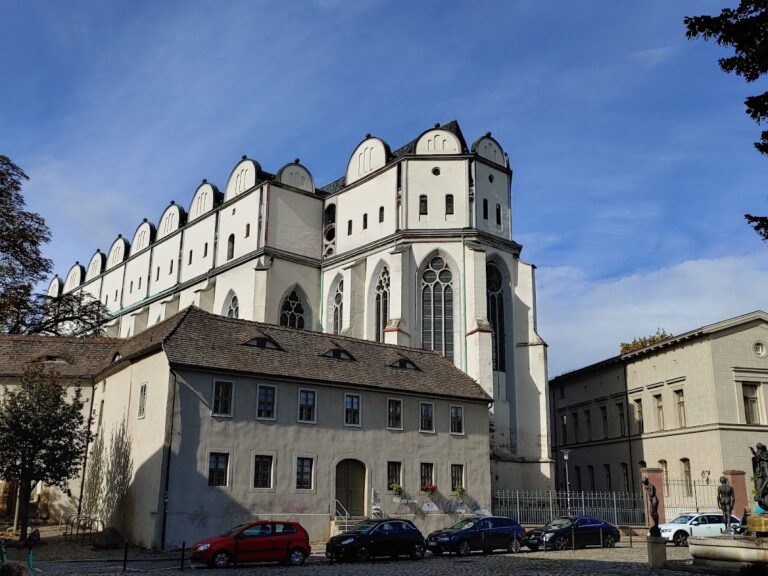
The Market Church is a three-aisled, choirless Gothic hall church approximately 88 metres long and 24 metres wide. A hall church has a nave and side aisles of approximately equal height, while a choirless church lacks a distinct architectural choir or chancel separated from the main interior. The ten-bay interior has an unusually broad central aisle and is supported by ten pairs of slender octagonal piers.
Blue Towers
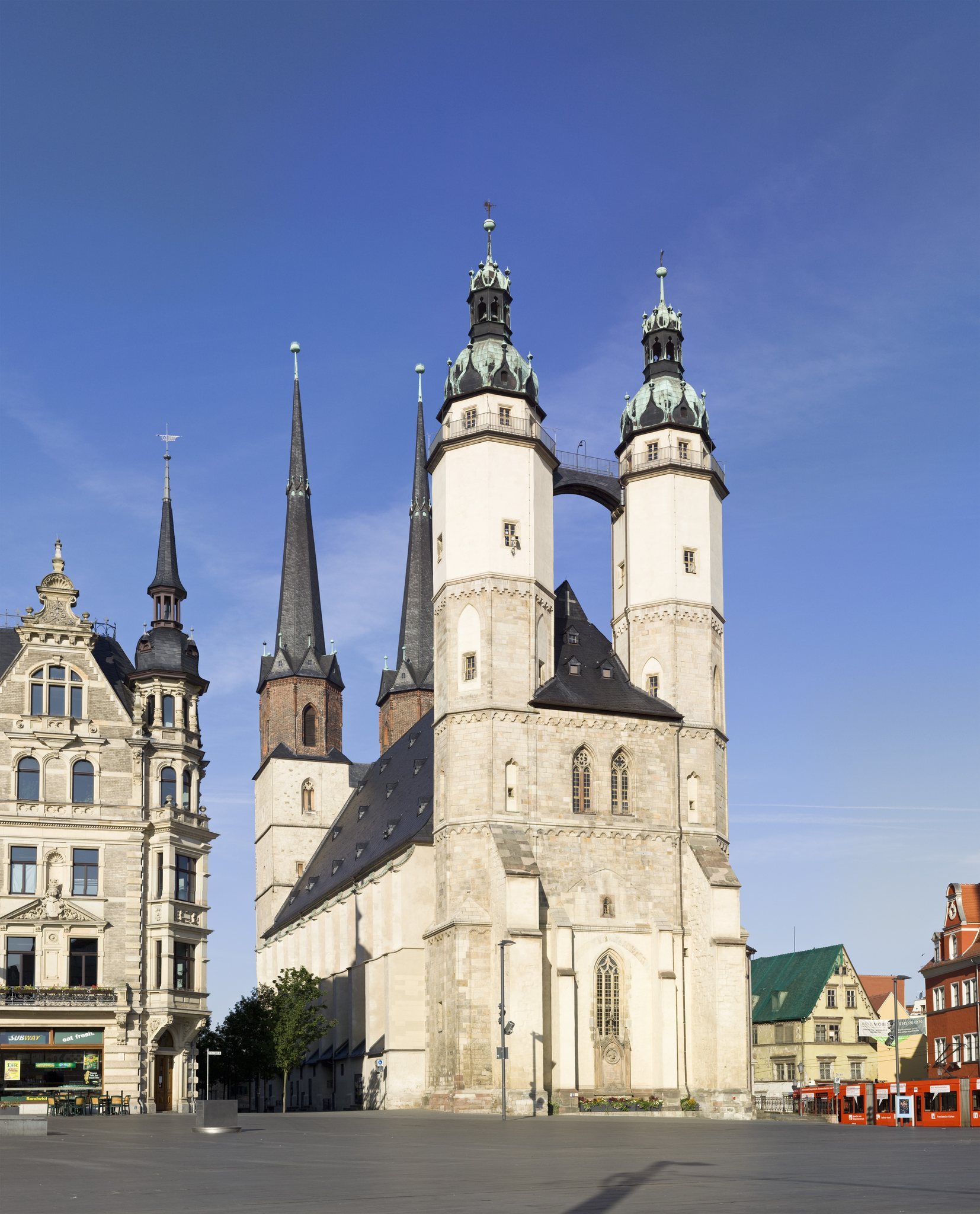
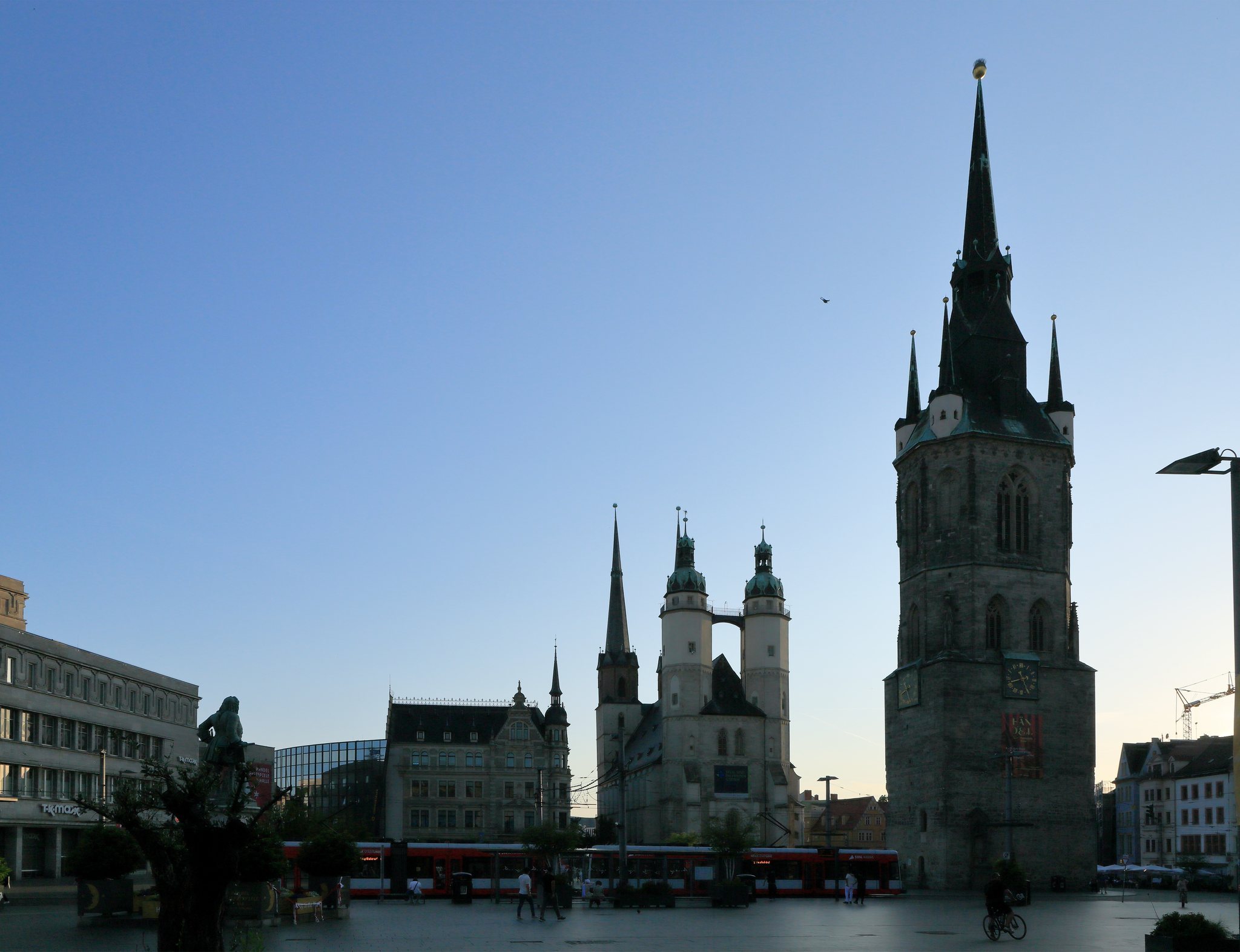
The western facade incorporates the two Blue Towers of St. Gertrude. Their square stone shafts date from the fourteenth and fifteenth centuries. Their octagonal brick upper stages carry tall pointed spires added between 1507 and 1513. The towers rise approximately 83 metres and stand slightly out of alignment because of a geological fault beneath Halle Market Square.
Hausmann Towers
The eastern facade incorporates the two Hausmann, or Watchmen’s, Towers of St. Mary. Their principal shafts date from approximately 1220 to 1230 and are Romanesque, built from Hausstein. Their octagonal plastered upper stages carry Renaissance “Welsh” hoods dating from 1551 to 1554, and the towers are approximately 60 metres high. A bridge joins them at the top.
The watchman’s room was used by the Hausmann, the tower watchman responsible for warning the town of fire or other danger by ringing the bells. The bridge and watchman’s room remain accessible on certain occasions.
Interior structure and Protestant additions
The central aisle has a shallow, barrel-like net vault, while the side aisles have star vaults. Additional ribs spring from the piers and extend toward the vault ribs, sometimes crossing the space freely before joining them. Beneath the central vault, Nickel Hoffmann created a carved stone pendant, or suspended boss, regarded as a major work of late Gothic stone carving.
Narrow Gothic windows with geometric tracery, the ornamental stone framework of a Gothic window, pierce the walls. Two pointed-arch portals open through each long side wall, and their surrounds are richly decorated with mouldings. Closely spaced external buttresses divide the exterior.
Galleries and prayer rooms
The galleries were added after the Reformation was introduced in Halle, mainly between 1550 and 1554. Their Renaissance elements provide important evidence for the development of early Protestant church architecture. Large stone spiral staircases with free-standing wooden central posts lead to the western galleries, and another gallery level was added in 1698.
Small wooden prayer rooms dating from the second half of the seventeenth century are set between the buttresses. They have separate access and open toward the interior like galleries or enclosed boxes. A frieze of biblical quotations and commemorative inscriptions to Martin Luther and Justus Jonas expresses the building’s transformation into a Protestant preaching church.
Altarpiece, pulpit, and furnishings
High altar
The large wooden high altar is a winged altarpiece commissioned by Cardinal Albrecht in 1529. A winged altarpiece has hinged panels that open and close to present different arrangements of images. Lucas Cranach the Elder designed it, and his pupil Simon Franck executed it. The work has four movable and two fixed wings.
When fully open, it shows Cardinal Albrecht kneeling before Mary and the Christ Child on a crescent moon, with the knight saints Maurice and Alexander at the sides. The partly open wings show Mary Magdalene, John the Evangelist, Augustine of Hippo, and Catherine of Alexandria. The closed wings depict Ursula of Cologne, the Annunciation, and Erasmus of Antioch. The predella, the lower section of an altarpiece, shows the Fourteen Holy Helpers. The work probably entered the church around 1539 and is the last surviving altar commissioned by Cardinal Albrecht for Halle’s former collegiate church, now the cathedral.
Pulpit and baptismal font
The sandstone pulpit was made in 1541 as an integrated part of one of the piers and came from Nickel Hoffmann’s workshop. Its forms are late Gothic, while its architectural details are Renaissance. It was restored in 1666 and 1973. The wooden soundboard dates from 1596 and was made by the woodcarver Heinrich Heidenreitter and the painter Heinrich Lichtenfelser. It consists of superimposed eight-pointed stars, with the smaller upper star supported by eight delicate columns and crowned by the Transfiguration of Christ. Tradition associates the pulpit with Luther’s three sermons in the church.
The bronze baptismal font stands before the altar and probably came from one of the predecessor churches. An inscription states that Ludolf von Braunschweig and his son Heinrich cast it in Magdeburg in 1430. Its circular basin rests on four saint figures, while tracery reliefs of Christ, Mary, and the apostles decorate the rim. A small crucifix with Mary and Saint John, probably also from one of the earlier churches, dates from around 1500.
Paintings, stalls, and later works
Heinrich Lichtenfels painted a large lunette, a semicircular or crescent-shaped painted field, for the east wall in 1593. It depicts scenes from the Acts of the Apostles in a carved and polychrome frame. The painting is partly obscured by the Reichel organ, which stands in front of it, and a crucified Christ appears at its centre behind the organ.
The partially preserved Renaissance stalls are made of oak and were produced between 1561 and 1595 in the workshop of Antonius Pauwaert in Ypres. The eastern bridal stalls behind the altar date from 1595 and have strongly carved strapwork and cartouches. Beside a pier to the left of the altar stands a black-iron crucifix made by Johann Peter Hinz of Halberstadt in 1976 using an older nineteenth-century cross. It depicts the suffering Christ drawing away from the cross and extending his right hand in reconciliation.
Organs and bells
Organs
The small Reichel organ stands on the eastern gallery above the altar. Georg Reichel built it in 1663 and 1664 for 200 thalers. It has one manual, no pedal, and six stops, and Alexander Schuke restored it in 1971 and 1972. Its original Cornett-tone pitch was retained in a historically appropriate meantone temperament, a system of keyboard tuning used before modern equal temperament. The organ is among the oldest surviving instruments of its kind in central Germany and was used by the young Handel for his first organ lessons.
The main organ occupies the western gallery behind the historic case of the instrument built by Christoph Cuntzius between 1712 and 1716. The original organ had three manuals and 65 stops. It was reduced in 1840, modified again in 1875, and replaced in 1897 by a pneumatic instrument behind the Baroque case. The present organ was built in 1984 by the Schuke firm of Potsdam and restored and revoiced by Wilhelm Sauer Orgelbau in 2007. It has 4,170 pipes, 56 stops distributed across three manuals and a pedal, mechanical key action, electric stop action, and slider windchests.
Bells
Four bells hang in the Blue Towers. The smallest and oldest, the Bitt- and Prayer Bell, dates from around 1300 and has a period sugar-loaf profile. A bell in the north tower was cast in 1420 and retains incised drawings, including Saint Gertrude holding a model of a church. Two further bells in the south tower date from 1674 and 1685. The earlier of these was cast by Jacob Wenzel of Magdeburg from the cracked 1484 Osanna bell.
Each Hausmann Tower contains a striking bell. The south tower holds the Storm Bell, while the north tower contains a thirteenth-century Hour Bell. Both are out of service.
Memorials and symbolic features
The church archive preserves bronze door knockers and a lion’s head dating from around 1300. A Luther effigy, probably made in the early seventeenth century and formerly kept in the sacristy, remained there until the 1930s. Its wax face and hands were traditionally said to have been made from casts of Luther.
Luther’s death mask was probably made from a plaster cast taken from his face on 19 February 1546 by the Halle painter Lukas Furtenagel. The mask was altered for use in a life-sized effigy between the seventeenth and twentieth centuries, and Hans Hahne reconstructed its original appearance in 1926. It is displayed separately in the old sacristy.
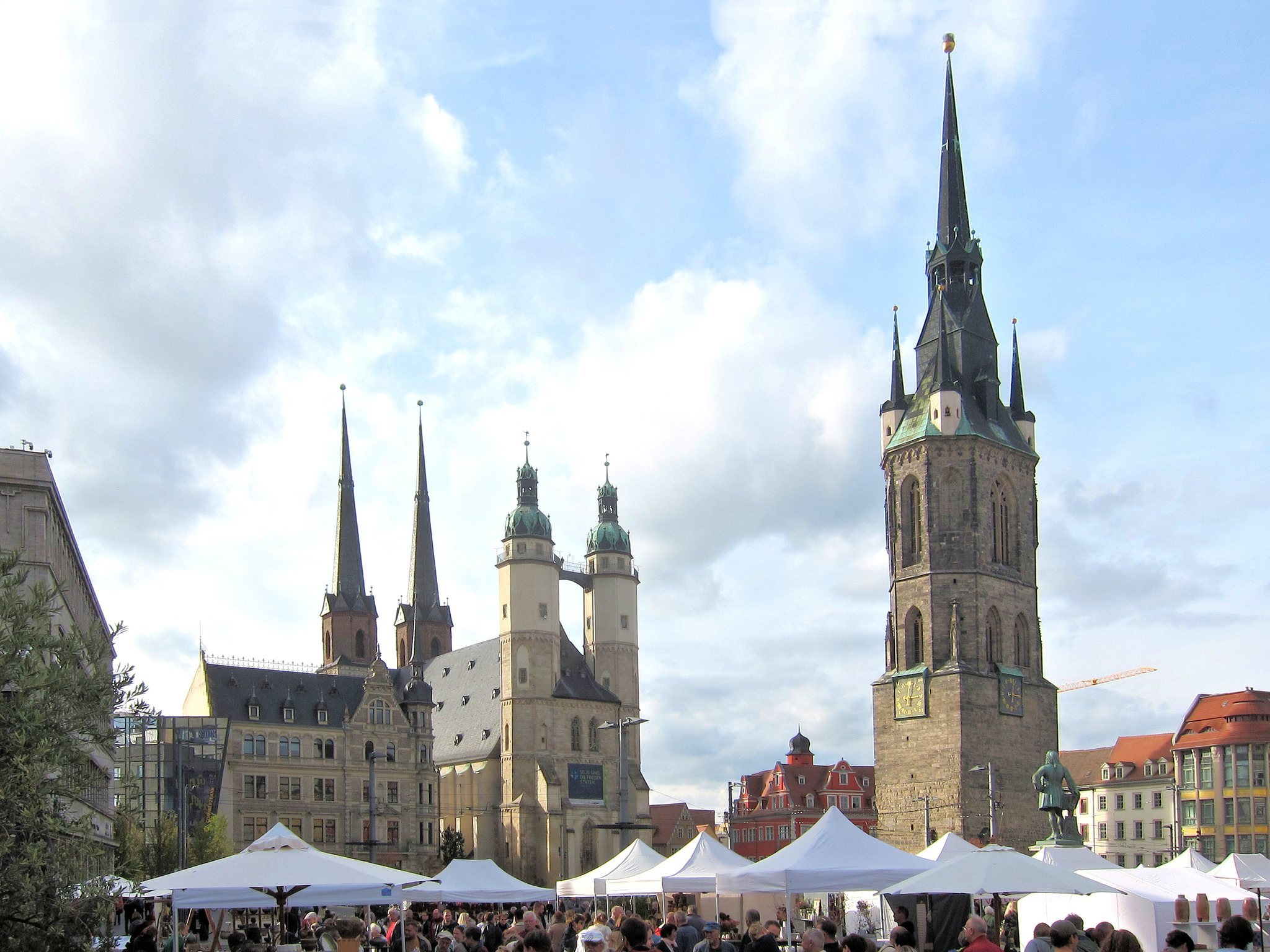
A relief dated 1583 stands on the east side near the small stair tower in the northeast corner. It depicts the medieval legend of a donkey walking on roses, a motif later adopted as a symbol of Halle. The church’s four towers, together with the nearby Red Tower, form the city’s characteristic “City of Five Towers” landmark.