Schloss Marloffstein: A Medieval Castle and Baroque Palace in Germany

Site at a Glance
- Rating
- 4.1
- Popularity
- Very Low
- Country
- Germany
- Primary era
- Early Modern
- Eras represented
- Medieval, Early Modern
- Civilizations
- Holy Roman Empire
- Site type
- Civic
- Remains
- Palace
On this page9 sections
History
Schloss Marloffstein is a castle and later palace in Marloffstein, Germany, whose medieval predecessor stood on the site before 1300. It later became a Baroque palace and served the Bamberg bishopric as a fortified administrative centre, a territorial seat, and security for loans.
Early Bamberg Administration
During the first millennium, the area belonged first to the Nordgau and later to the Radenzgau. Around 1007, Heinrich II, the German king who later became emperor, transferred the Marloffstein area to the newly established Diocese of Bamberg, probably to protect the diocese’s nearby frontier. The castle and settlement were administered as a Hofmark, a territorial estate with local administrative and judicial rights, by noble ministerials serving the bishop.
The settlement appears in written records in 1288 as Maurolfstein. Its supposed namesake, Maurolf, is generally understood as a local noble family, although that identification cannot be verified. In 1315, the Lords of Gründlach held Marloffstein as a Bamberg fief, meaning land or office granted by a superior lord in return for service or obligations. After their line died out, the fief passed to Gottfried, Count of Hohenlohe-Brauneck, and his wife Margarete of Gründlach, the Gründlach heiress.
Officials, Justice, and Territorial Power
Vogts, officials who exercised delegated judicial and administrative authority, administered the territory from the castle. They initially held high justice, which concerned the most serious offenses, and collected the associated revenues. In 1341, after Bamberg reclaimed the fief, high justice and the castle were transferred to the Neunkirchen Hofmark. The Marloffstein vogts nevertheless retained low justice, covering lesser cases and local jurisdiction, in Marloffstein, Rosenbach, and Spardorf, together with the right of low hunting.
The castle and its lands also served the Bamberg bishop as security for loans. Lenders received them as fiefs while acting as Bamberg Amtmänner, officials who administered a territorial office. Maroschalk of Marolfstein appears in 1310, probably as the serving vogt rather than as the founder of a family of that name. Later officials and feudatories included members of the Strobel, Valtzner, Scholl, Haller, Toppler, and Pfinzing families.
In 1383, Marloffstein was described as the property of King Wenceslaus, who granted the Bamberg bishop Lamprecht of Brunn and his representative Konrad Ziegel rights of use. By 1400, a Bamberg Amtmann had replaced the vogt as administrator. The castle later became the seat of administration for the Marloffstein and Neunkirchen areas. Officials in the later sixteenth century included Wilhelm I of Wiesenthau, Christoph and Christoph II of Brandenstein, Friedrich Wilhelm of Guttenberg, Jakob Siegmund of Schaumberg, Philipp II of Pappenheim, and Gottfried Wilhelm of Guttenberg.
War and Rebuilding
Marloffstein survived the German Peasants’ War of 1525 without destruction. The castle was attacked and successfully defended by the then Amtmann, Sigmund III Pfinzing, who held it as a pledge. A separate record states that margrave’s troops had already burned Marloffstein in 1522.
During the Second Margrave War, the sixteenth-century conflict in which Albrecht II Alcibiades attacked territories associated with the Bamberg bishopric, the margrave’s forces plundered and burned the castle in 1552. They captured the Amtmann Albrecht Pfinzing. Bishop Weigand of Redwitz transferred the castle to Albrecht, but Bamberg recovered it in 1553 after Albrecht’s defeat at the Battle of Sievershausen. Sigmund V Pfinzing rebuilt the complex in 1570 and 1571.
The castle suffered serious damage during the Thirty Years’ War, the major European conflict of 1618 to 1648. Between 1691 and 1695, the Stauffenberg family rebuilt it in the Baroque style on the remains of the medieval complex under Bishop Marquard Sebastian Schenk of Stauffenberg.
End of the Administrative Seat
From 1655, Bamberg appointed Oberamtmänner, officials who headed the joint higher administration of Marloffstein and Neunkirchen. The succession included Wolf Philipp of Bach, Johann Gottfried and Karl Rudolf of Guttenberg, Wilhelm of Wiesenthau, Marquard Sebastian and Philipp III of Stauffenberg, Heinrich Christoph Heußlein of Eußenheim, Friedrich Anton Baron of Münster, Marquard Karl of Mertenhausen, Franz Arnold of Blettenberg, Wilhelm III of Künsberg, and Karl Heinrich Groß of Trockau. Groß was the last Oberamtmann to live in the castle, remaining there until 1792.
After 1792, the Oberamt Marloffstein was administered from Bamberg rather than from the castle. Its administration was later dissolved and incorporated into the Neunkirchen court in the early nineteenth century. The loss of the administrative seat removed the financial basis for maintaining the building.
Secularization and Later Uses
In 1806, secularization, the transfer of ecclesiastical property and authority to the state or private owners, brought the castle and its lands to the Bavarian state. They were auctioned to the Bamberg court official Samuel Heßlein, Michael Alexander Lips of Erlangen, and Franz Kröter. By 1808, Lips was the sole owner. He established an agricultural academy in the castle, but the institution failed for lack of state support.
Local inhabitants possessed usage rights in the castle chapel, so Lips built the nearby Chapel of St James in 1812 and 1813. Its purpose was to allow the castle rooms to be used for a brewery, an activity connected with the castle’s brewing rights. The new chapel received the former chapel’s Rococo furnishings, while the castle owner remained responsible for maintaining the building.
Severe deterioration led Lips to demolish large parts of the complex by 1833, reducing the palace to its present form. Later owners included Count August Pestalozza, innkeeper Konrad Singer, and the Erlangen textile merchant Mendlein, who sold the associated lands. Friedrich Aichinger, a master carpenter from Marloffstein, and his wife Katharine, née Rupprecht, bought the castle in 1883 after leasing it from Mendlein since 1880 and opened an inn there.
In 1885, the inn became an off-campus fraternity establishment of the Erlangen fraternity Frankonia. A roof structure renewed around 1930 burned in 1932 and was rebuilt. After the Second World War, Siemens employees and their families lived on the upper floor. The residents shared one water tap and one toilet, while village women collected water from the castle-courtyard well or the draw well outside the Striegel butcher’s shop.
After a co-owner died, the entire estate was sold in the mid-2010s, and the inn closed in 2017. Renovation work begun in 2018 sought to preserve the remaining listed historic fabric.
Remains
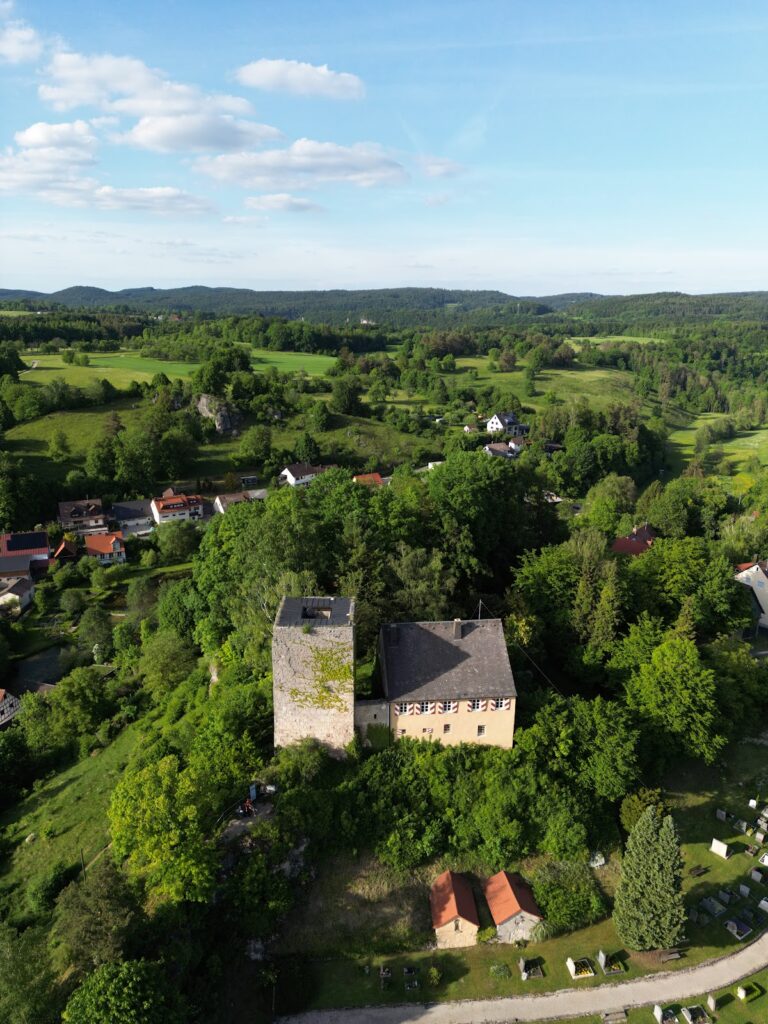
The surviving building represents the reduced form of a medieval castle later rebuilt as a Baroque palace. Before the nineteenth-century demolition, the almost enclosed, ring-shaped complex was protected by a zwinger, a fortified outer area between defensive walls or between a wall and an outer obstacle, and by a broad masonry moat. The Bavarian cadastral survey of the 1810s still showed the semicircular north wing and an atrium courtyard.
The Reduced Palace
The former complex included an octagonal entrance tower with a Welsch dome, a bulbous roof form often topped by a lantern. The northern part of the west wing continued as far as the castle chapel, and the remaining palace had an upper storey. The 1833 demolition removed the entrance tower and dome, the northern section of the west wing up to the chapel, and the upper storey of the remaining palace. The building that survived received a low-pitched roof with a triangular gable and a substantial balcony on its south side.
A roof renewal around 1930 ended in the fire of 1932, after which the roof structure was reconstructed. The later building accommodated an inn, while its upper floor was used as housing after the Second World War. Conservation work begun in 2018 was intended to preserve the remaining historic fabric.
Courtyard and Chapel
A pillar in the present castle courtyard contains an inset coat-of-arms stone of the Bamberg prince-bishopric dated 1211. The Bamberg prince-bishopric was the ecclesiastical principality ruled by the Bamberg bishop, with territorial, judicial, and administrative authority in the region. The stone is the oldest surviving historical monument at the site associated with Bamberg’s jurisdiction.
A two-storey castle chapel was recorded in 1341. Its former Rococo furnishings were transferred to the Chapel of St James, constructed nearby in 1812 and 1813. The chapel’s relocation formed part of the change that allowed the castle rooms to be adapted for brewing and later uses.