Thuisbrunn Castle: A Medieval Hill Castle in Bavaria


Site at a Glance
- Rating
- 4.3
- Popularity
- Very Low
- Country
- Germany
- Primary era
- Medieval
- Eras represented
- Medieval, Early Modern
- Civilizations
- Holy Roman Empire
- Site type
- Military
- Remains
- Castle
On this page9 sections
History
Thuisbrunn Castle is a medieval hill castle in Germany, near Gräfenberg in Upper Franconia, whose existence is first known from 1348 although it was built earlier. Its occupants belonged to the imperial ministerial class, a medieval service nobility whose members held administrative or military duties for the emperor or another powerful lord. In 1348, Knight Hiltpolt von Mayenthal zu Thuisbrunn was identified as the castle lord.
Medieval destructions
Nuremberg troops destroyed the castle in 1388 during the South German War of the Cities. It was then granted as a fief to the burgraves of Nuremberg. In 1420, forces of Louis of Ingolstadt, a fifteenth-century Bavarian duke, destroyed it again during the Bavarian War. Nuremberg troops destroyed the village of Thuisbrunn in July 1449 and again in 1460 during the Princes’ War, but the castle survived those attacks.
War and administrative change
Nuremberg troops destroyed Thuisbrunn Castle once more in 1553 during the Second Margrave War, a sixteenth-century conflict in the Holy Roman Empire that affected Franconia. By 1558, only the district office and the bergfried had been rebuilt. During the Thirty Years’ War, the major European conflict of 1618–1648, and the years that followed, Imperial, Swedish, and Bavarian troops plundered the village and castle seven times.
Probably in 1667, the Vogtei building, an administrative office for a territorial or ecclesiastical authority, was erected in place of the old district office. Apart from this building and the bergfried, the castle remained in ruins. After the Kingdom of Bavaria seized the estates in 1806 during the Napoleonic era, the Vogtei building served as a forestry office. In 1816, cartographer Johann Christoph Stierlein completed the first highly precise map of the castle area and its surviving buildings.
Twentieth-century history
American troops shelled the castle toward the end of the Second World War. The site entered private ownership in 1961 and remains privately owned. Thuisbrunn Castle is recognized as a Bavarian architectural heritage monument and is also recorded as a castle archaeological site.
Remains
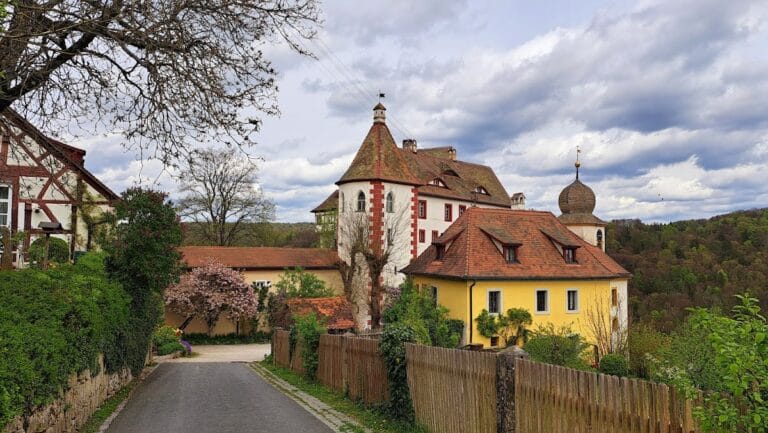
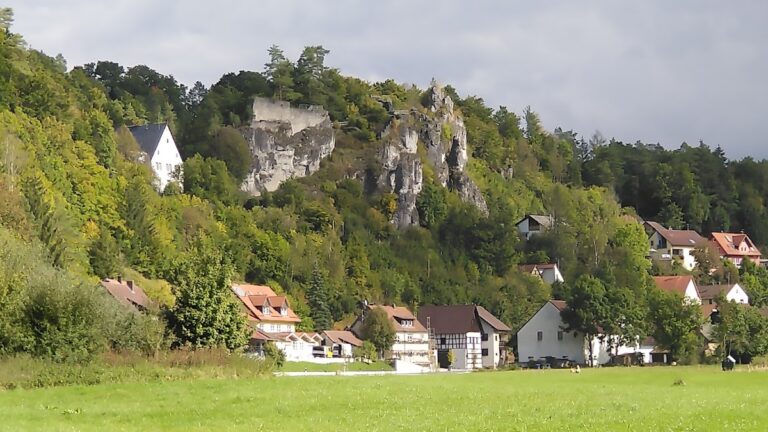
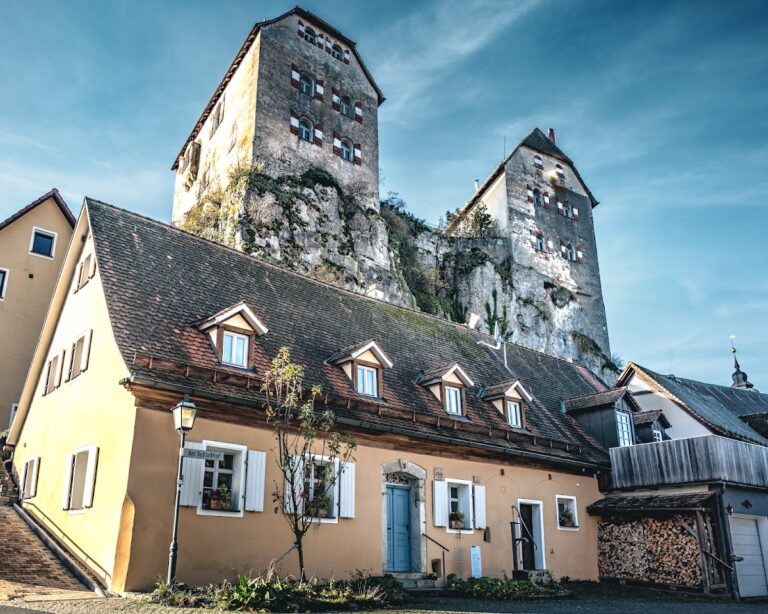
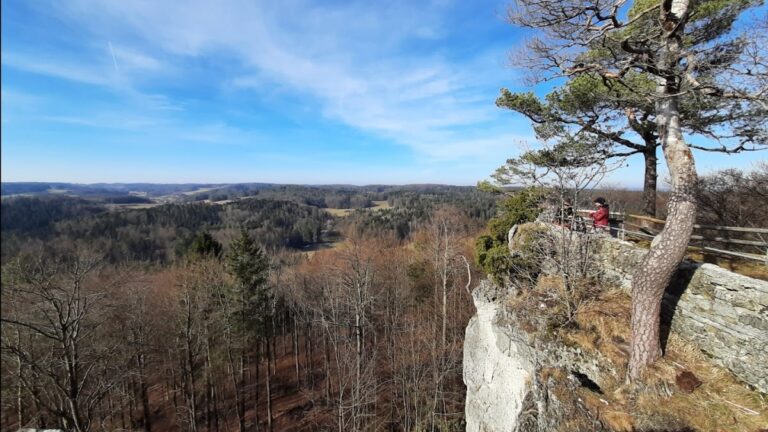
Thuisbrunn Castle occupies the summit of a spur at about 470 metres above sea level, centrally within the Thuisbrunn district of the municipality of Gräfenberg. The surviving complex is a ruin built of ashlar masonry. Its principal surviving elements are the bergfried, the main defensive tower of a medieval German castle, and the Vogtei building, together with associated administrative and agricultural structures.
Surviving buildings and masonry
Bergfried
The bergfried was among the castle structures rebuilt by 1558 and remains part of the ruin. Such a tower served chiefly as a strong defensive and symbolic feature rather than as a permanent residence. Its surviving fabric forms one of the principal visible elements of the castle.
Vogtei building and associated structures
The Vogtei building was probably erected in 1667 on the site of the former district office. It survives as another major component of the complex and later served as a forestry office after the estates passed to the Kingdom of Bavaria. The associated property also includes a building identified as an Amtshaus, or official district office, and a barn.
Former castle building
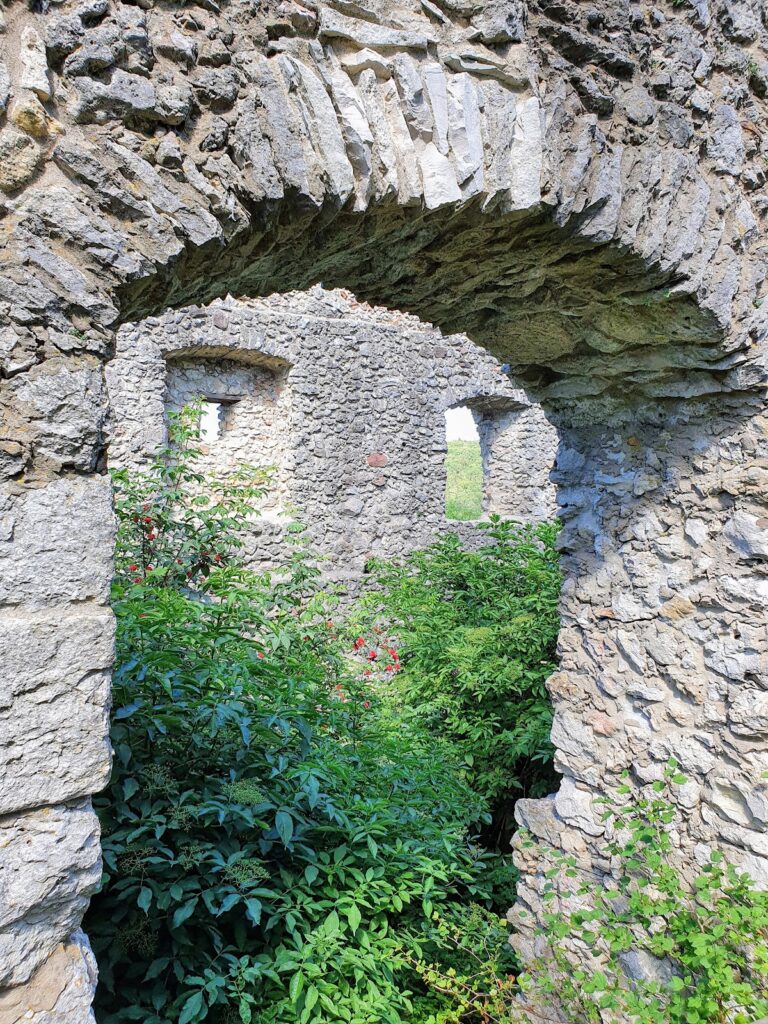
Visible masonry remains on the rock belong to a former castle building. Together with the bergfried and the later administrative structures, these remains preserve the physical outline of a castle that underwent repeated destruction and rebuilding.
Nearby sites