Domaine de l’Abrègement: A Historic Fief and Estate in Bioussac, France


Site at a Glance
- Rating
- 4.7
- Popularity
- Very Low
- Country
- France
- Primary era
- Early Modern
- External website
- Open
- Eras represented
- Medieval, Early Modern, Modern
- Civilizations
- French
- Site type
- Domestic
- Remains
- Castle
On this page8 sections
History
Domaine de l’Abrègement, also known locally as L’Abrègement, is a historic estate and former fief in Bioussac, France, about 400 metres southeast of the village. Its origins are medieval, and its name may refer to an earlier lodging place on a pilgrimage route to Santiago de Compostela in northwestern Spain.
Medieval and early modern succession
The fief was held by the La Rochefoucauld family in the fourteenth century. It later passed to the Saint-Amand family, lords of Châtelard and Saint-Front, and then to the Desmier family, lords of Chenon. The estate was described as passing continuously from parent to child, preserving its place within a long succession of local noble families.
In 1555, Jacquette Desmier married Perceval de Volvire, or Voluyre, a guidon, meaning a military standard-bearer, in the company of the Marquis of Ruffec. Their daughter Anne married Guillaume Massacré in 1579. The Massacré family came from Normandy and had settled in Périgord.
The d’Hémery residence
Marie Massacré, the last heir of her family, married Olivier-Mathurin d’Hémery in 1750. A knight and lord of Cerné, d’Hémery belonged to a family that originated in the Île-de-France region and had established itself in Poitou at the end of the seventeenth century.
Between 1750 and 1751, Olivier-Mathurin d’Hémery replaced the older castle inherited by his wife with a large eighteenth-century residence. Two earlier entrance towers were retained as reminders of the preceding fortified complex. His descendant François d’Hémery (1752–1828) became an influential figure in Charente during the French Revolution. Later members of the family served as mayors of Bioussac and as members or councillors of the departmental general council.
Nineteenth-century development and modern protection
During the mid-nineteenth century, the east wing was entirely rebuilt, and a gallery was added between the central building and its two wings. A neo-Gothic chapel and La Maison des Tantes were also constructed to designs by Paul Abadie, a French architect known for historicist and medieval-inspired work.
The estate remains associated with the d’Hémery family. William Anseau d’Hémery, born in 1988, is identified as a descendant and renovated the park. The château and estate were registered as historic monuments in France on 11 August 2014, while the gardens have carried the Jardin remarquable label since 2009, a French designation for gardens of recognized historical, botanical, artistic, or landscape interest.
Remains
Château and surviving medieval fabric
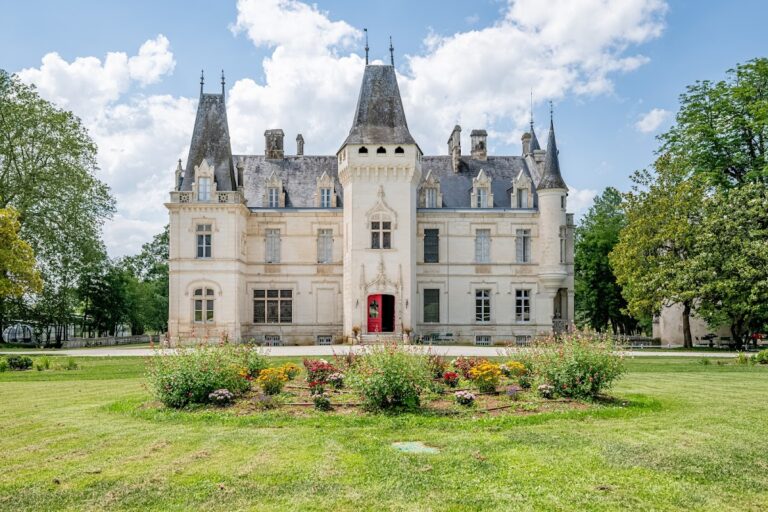
The earliest castle, recorded in 1260 as having seven fortified towers, survives in the vaulted cellars and in sections of the main building’s walls. The present château has a classical central body with two short lateral wings. Its restrained design has been compared with the Château de la Martinière at Rom, the Château d’Epanvilliers, rebuilt in 1773, and the north wing of the former Notre-Dame-de-La-Réau Abbey, although L’Abrègement is smaller in scale.
Inside the residence, eighteenth-century features include marble fireplaces, parquet floors, and wood panelling. These elements belong to the large house created by Olivier-Mathurin d’Hémery after the older castle was replaced.
Chapel and associated buildings
The neo-Gothic chapel is tiled and contains period stained-glass windows. The windows probably depict the patron saints of the owners of that period. The chapel and La Maison des Tantes form part of the nineteenth-century additions designed by Paul Abadie.
Park, gardens, and arboretum
An oak forest was planted on the estate during the eighteenth century. The park later expanded beyond the arrangement shown on the 1819 plan and now includes an arboretum, a cultivated collection of trees, with notable cedars and sequoias. Other features include a kitchen garden, perennial flowers, a gourd arbour, a green amphitheatre, and a small stream.
The gardens and vegetable garden were designed by landscape designer Philippe Dubreuil in collaboration with Elizabeth d’Hémery. In 1999, the Martin storm severely damaged the park and destroyed or injured 15,000 trees. Artists later transformed surviving stumps into contemporary sculptures, including works by Andy Goldsworthy, Antony Gormley, Christian Lapie, and Joel Shapiro.
Nearby sites