Schloss Justingen: A Renaissance Palace and Castle Ruin in Germany
Site at a Glance
- Rating
- 4.3
- Popularity
- Very Low
- Country
- Germany
- Primary era
- Early Modern
- Eras represented
- Early Modern
- Civilizations
- Holy Roman Empire
- Site type
- Domestic
- Remains
- Elite Residence
On this page8 sections
History
Schloss Justingen, also known as Hohenjustingen, is a ruined Renaissance palace in Germany, situated above Hütten in the city of Schelklingen. It stands on the site of the ancestral castle of the Lords of Justingen, a noble family first documented in 1090. The medieval castle was replaced by a Renaissance residence in 1567, and the surviving ruins preserve the history of a lordship that played a role in medieval politics and sixteenth-century religious reform.
The Lords of Justingen and the Staufer conflict
In 1211, Anselm von Justingen and Heinrich von Neuffen were commissioned to bring the young Staufer Frederick II from Sicily to Germany. The Staufers were a major medieval German ruling dynasty, and Frederick had been elected king by German princes who rejected the rival Welf ruler Otto IV of Brunswick. Anselm later became marshal under Emperor Frederick II.
When Frederick came into conflict with his son, the separately elected German king Henry (VII), Anselm supported Henry together with the Lords of Neuffen. Frederick besieged the castles of his son’s supporters in 1235, and the Bishop of Constance destroyed Justingen Castle in 1236. Henry’s supporters were outlawed, and Henry remained imprisoned until his death in 1242.
Inheritance and the Renaissance rebuilding
After the Lords of Justingen died out in 1343, the rebuilt castle and its lordship passed by inheritance to the edelfrei Lords of Stöffeln near Gönningen. Edelfrei described a medieval noble status whose holders were not ordinarily subordinate to another noble lord. The property included a large estate and four villages. It was sold to the Lords of Stotzingen in 1494 and then to Hans Kaspar von Bubenhofen in 1497. His son, Hans Marx von Bubenhofen, sold the castle and lordship in 1530 to Ludwig, known as Lutz, von Freyberg of Öpfingen.
In a later inheritance division among the sons of Georg Ludwig von Freyberg the Elder, the Lordship of Justingen fell to Michael Ludwig. Before 1574, Michael Ludwig married Felicitas Landschad von Steinach. In 1567, the couple replaced the medieval castle with a Renaissance palace, a residence shaped by architectural forms and artistic ideals drawn from classical antiquity.
Religious reform and courtly life
The Freybergs supported the teachings of Kaspar Schwenckfeld, whose Christian reform movement emphasized an inward and spiritual understanding of faith. Schwenckfeld had been expelled from Ulm in 1539, and the Freybergs gave him asylum at Schloss Justingen for several years during the 1540s. In the second half of the sixteenth century, the palace became a center of Schwenckfeldianism.
The Freybergs also brought Adam, Johann, and Nikolaus Heyden to the palace. In 1573, they appointed Daniel Friedrich of Strasbourg, an expelled Schwenckfeldian, as household steward and pastor of Justingen. Catholic worship was reintroduced in the Lordship of Justingen during the seventeenth century.
On 5 and 6 April 1589, Georg Ludwig von Freyberg the Younger held his wedding at Schloss Justingen with his second wife, Barbara von Eberstein. Lucas Osiander the Elder, the Württemberg court preacher, delivered both wedding sermons in the presence of Duke Ludwig of Württemberg, and the sermons were printed.
Sale, demolition, and protection
Duke Carl Eugen of Württemberg bought the Lordship and Schloss Justingen in 1751 and established Merino sheep breeding on the castle estates. The palace was sold to the municipality of Hütten in 1834 and demolished. The remaining parts of the former complex subsequently fell into ruin. They are protected as historic monuments and are included in the list of Schelklingen’s architectural monuments.
Remains
Palace fabric and enclosure
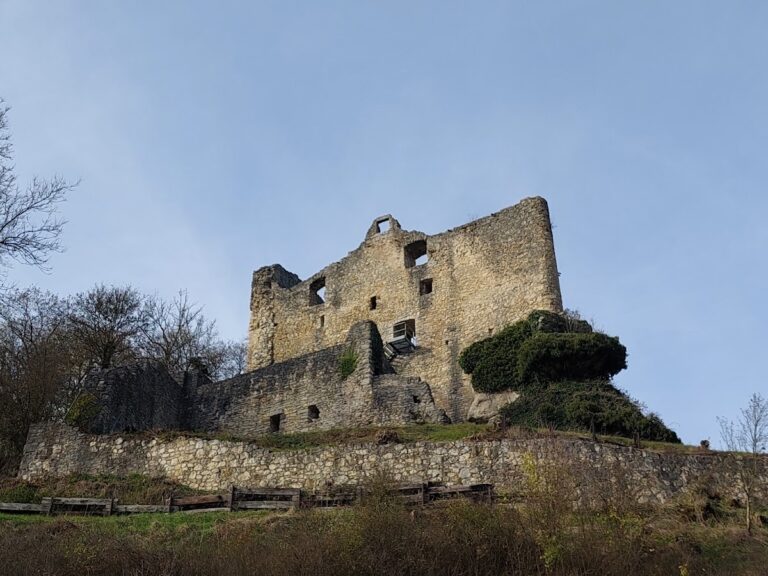
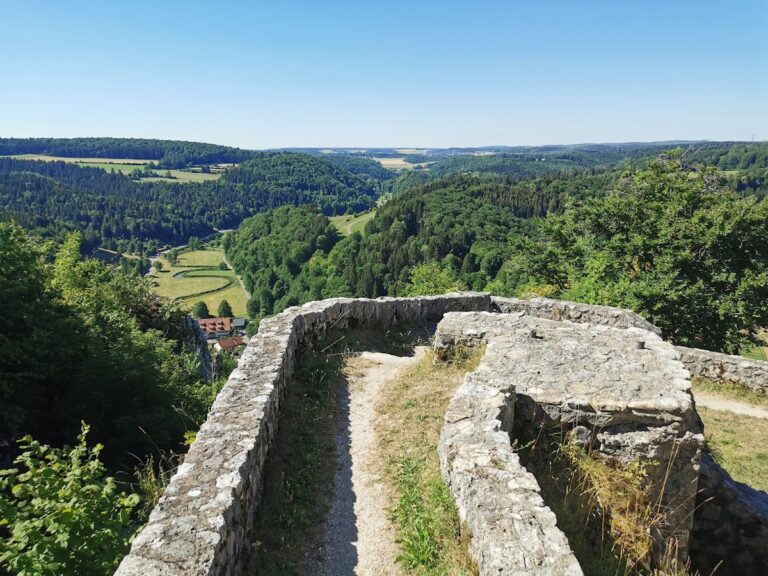
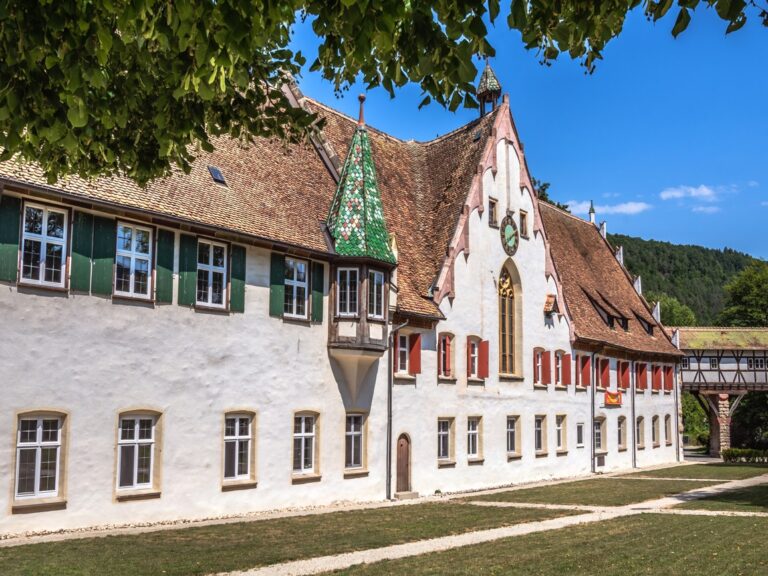
The ruins stand above Hütten on the southern edge of the Swabian Jura, on the same site where the medieval castle was replaced by the Renaissance Schloss Justingen in 1567. The former palace complex was extensive. Parts of its substantial cellar vaults and enclosing walls survive, preserving elements of the building’s lower structure and boundary. The cellar vaults have been repaired through private initiative over several years.
Inscribed and carved elements
An information board on the grounds displays a copy of the building inscription formerly positioned above the palace portal. The original inscription, bearing the coats of arms of the two builders, is preserved in the Schelklingen local history museum. Two carved wooden columns that supported the interior gallery also survive, together with a chimney stone bearing an inscription.