Schloss Heiligenberg: A Hessian Grand-Ducal Summer Residence in Germany



Site at a Glance
- Rating
- 4.5
- Popularity
- Low
- Country
- Germany
- Primary era
- Modern
- External website
- Open
- Eras represented
- Modern
- Civilizations
- German
- Site type
- Domestic
- Remains
- Castle
On this page14 sections
History
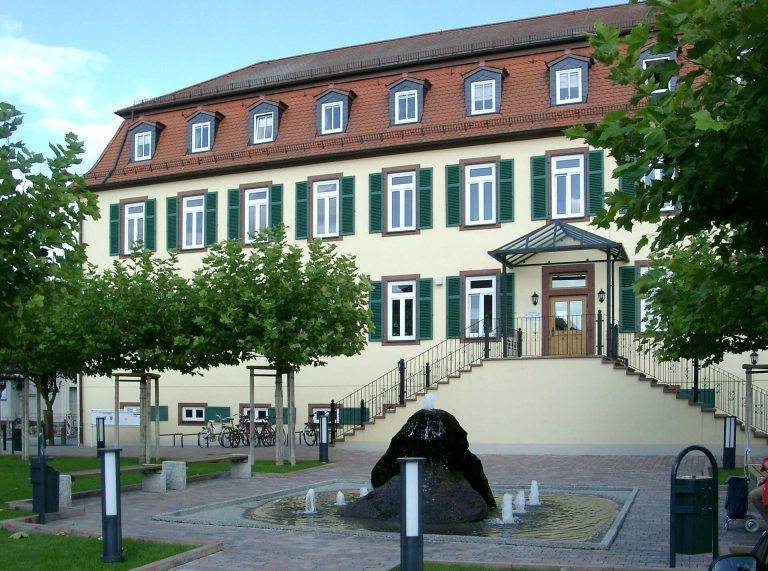
Schloss Heiligenberg is a nineteenth-century castle in Germany, east of Jugenheim in Seeheim-Jugenheim, developed from an agricultural estate and expanded in the architectural period of the Hessian grand ducal court. Its history is closely connected with Wilhelmine of Hesse and by Rhine, the Battenberg family, and the changing educational and institutional uses of the twentieth century.
From agricultural estate to summer residence
After secularization in 1803, the transfer of church property to secular ownership, and the settlement of outstanding leases held by the Lords of Hausen, the Heiligenberg returned to agricultural use. In 1811 it passed to August Konrad Hofmann, a councillor of the Hessian court chamber. Hofmann commissioned an agricultural estate at the foot of the later Marienberg between 1813 and 1816. Georg Moller, the Darmstadt court building director and a major nineteenth-century architect, may already have contributed to its planning.
Construction searches found no evidence of an earlier settlement on the site. This finding made later speculation about a Frankish estate there untenable. In 1827 Hofmann sold the estate to Wilhelmine of Hesse and by Rhine, then Hereditary Grand Duchess, a rank immediately below that of a grand duchess in the succession. She used it as a summer residence. After her husband Ludwig became grand duke, she had the estate enlarged into a castle from about 1831, with Georg Moller serving as architect.
The Battenberg family and an international court circle
Prince Alexander of Hesse and by Rhine, the couple’s third-born son, later lived at Schloss Heiligenberg with his morganatic wife, Princess Julia of Battenberg. In a morganatic marriage, the spouse of lower dynastic rank and the couple’s children did not normally receive the full succession or status rights of the higher-ranking partner. Alexander and Julia founded the House of Battenberg, a European princely family whose British branch adopted the surname Mountbatten during the First World War.
From 1862 the couple carried out repeated extensions and alterations over the following five years, with further work continuing until 1886. These changes apparently followed plans drawn by Moller in 1846. The family’s extensive dynastic connections made the castle a regular destination for the Russian imperial couple and a meeting place for kings, princes, and diplomats until 1914.
Princess Marie Karoline of Battenberg, Alexander and Julia’s eldest daughter, described life at Heiligenberg in her autobiography. She recalled visits by grand princes and emperors, the inauguration of the Golden Cross, and changes to the castle’s architecture. Princess Louise of Battenberg was born at Schloss Heiligenberg in 1889. From 1950 until her death in 1965, she was Queen of Sweden.
Sale, state use, and educational history
In 1920 Alexander’s son, Prince Ludwig Alexander of Battenberg, sold the castle after financial difficulties that followed his discharge from the Royal Navy in 1918. Known since 1917 as Louis Mountbatten, 1st Marquess of Milford Haven, he sold the property to the Berlin privy councillor Dr. Theodor Görges and his son-in-law Heinrich, Prince of Hohenleuben. In the mid-1930s, the already Nazi-coordinated Hessian state apparently acquired the castle to settle tax debts.
During the Nazi period the building first served as a regional leadership and domestic-economics school for the League of German Girls, the female branch of the Nazi youth organization. Until the end of the Second World War, it was then used as an auxiliary military hospital. The interior was remodeled after the war, and the complex subsequently housed several specialist schools and institutions.
The Pädagogisches Institut Jugenheim operated at the castle from 1946 to 1963. Relocated from Darmstadt at the end of 1945 because of a lack of space, it trained primary- and middle-school teachers in Hesse. The American occupying authorities intended the institute to help address the teacher shortage and establish democratic teacher training. Its influential director until 1961 was the political scientist Friedrich Trost. Professor Martin Wagenschein taught there, and Walter Asmus transferred to the institute from Weilburg in 1954. Heinz-Joachim Heydorn, Ludwig Neundörfer, Georg Geißler, and Ernst Fraenkel began their academic careers there through teaching assignments, while students included Margarete Dierks, Norbert Groddeck, and Ursula Wölfel.
The institute founded the nearby Schuldorf Bergstraße. Its final director was the philosopher and education scholar Hans-Michael Elzer. The institute closed in 1963 after the Hochschule für Erziehung in Frankfurt, founded in 1960 and 1961, assumed teacher training for primary and lower-secondary schools. That institution became part of Goethe University Frankfurt in 1967. The Amt für Lehrerbildung continued to occupy the castle until 2011.
Preservation and cultural use
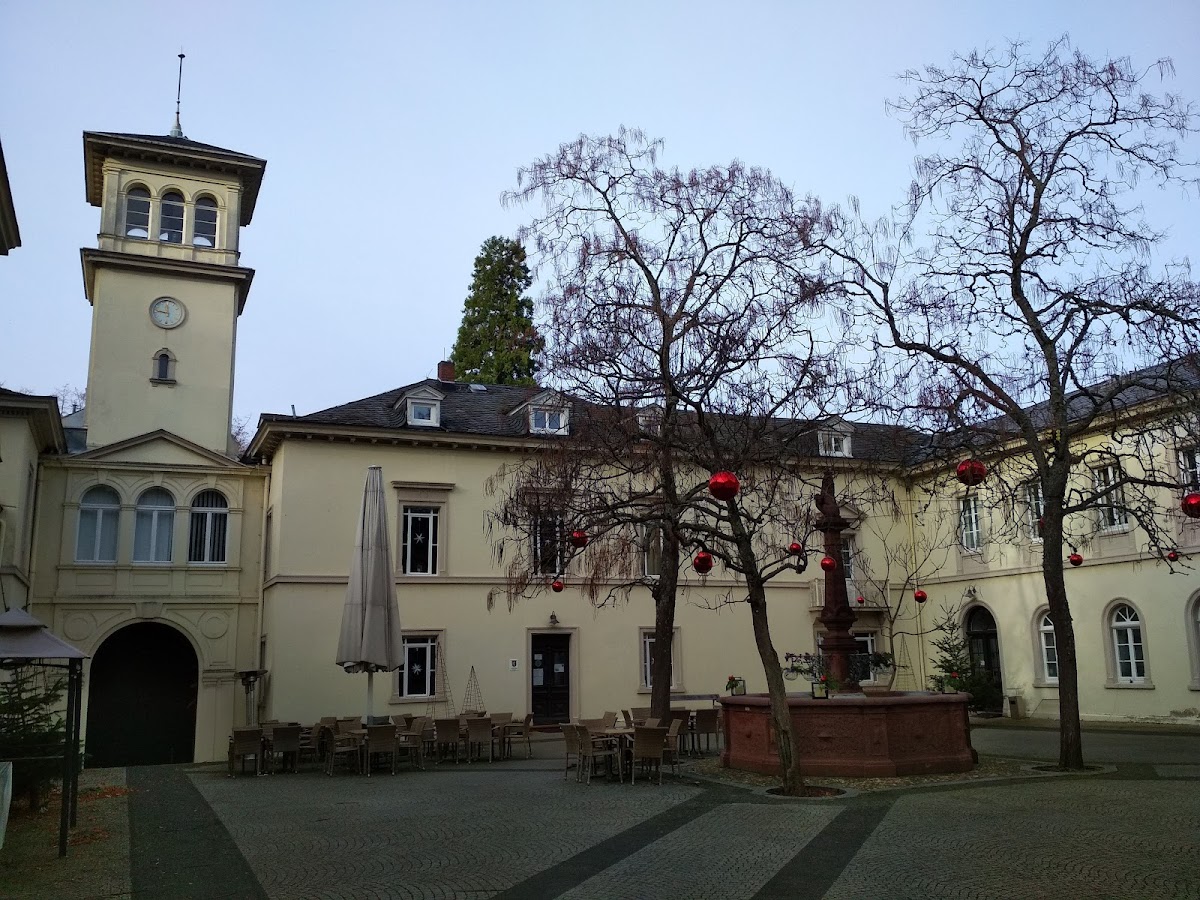
The Heiligenberg Foundation took over the castle in 2012 for the preservation of monuments, art, and culture. The State of Hesse currently owns the site. The complex includes a restaurant, seminar and event facilities, and a room for civil marriages. The garden hall and courtyard are used for art exhibitions and concerts, while the association Kultur im Schloß Heiligenberg, founded in 1995, organizes annual cultural events, especially musical ones.
A proposed department of plastic surgery for Jugenheim District Hospital was abandoned because the technical requirements for an operating theatre could not be reconciled with the building’s monument-protection requirements. The castle lies within the Natura 2000 protected area “Kniebrecht, Melibocus and Orbishöhe near Seeheim-Jugenheim, Alsbach and Zwingenberg,” designated as FFH area 6217-305 under the European Habitats Directive.
The earlier Heiligenberg monastery
The nearby Heiligenberg monastery probably originated by the beginning of the twelfth century, when the Lords of Bickenbach established it as a proprietary family monastery for unmarried or widowed female relatives. In 1413 Archbishop Johann of Nassau-Wiesbaden-Idstein incorporated the convent into Lorsch Abbey because its income no longer ensured independent survival. Lorsch Abbey then paid the priest of the Jugenheim church and appointed a provost to the monastery. The incorporation document prohibited the two remaining nuns from admitting new members, although the monastery continued in use for more than a century. A record from 1493 names Eberhard Scheubel as its priest.
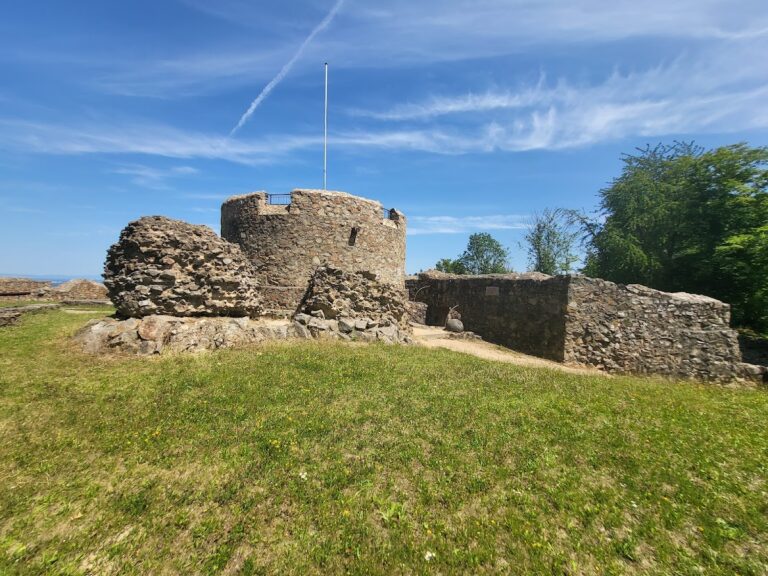
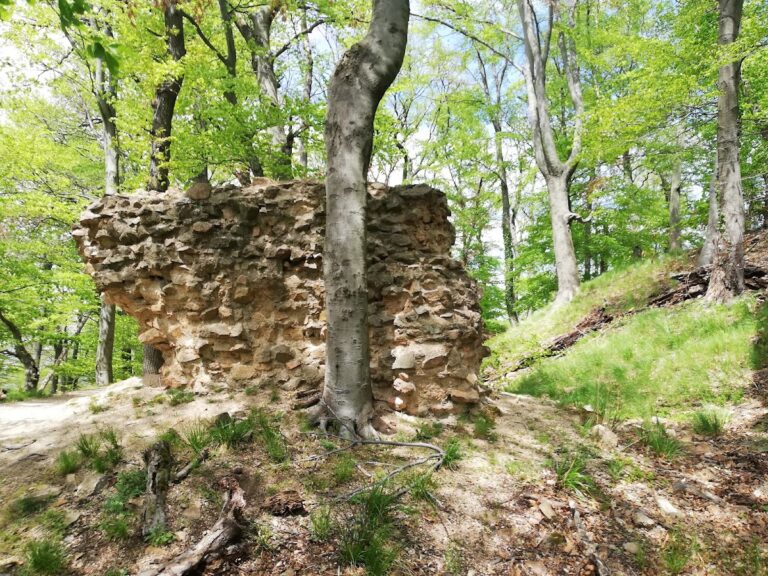
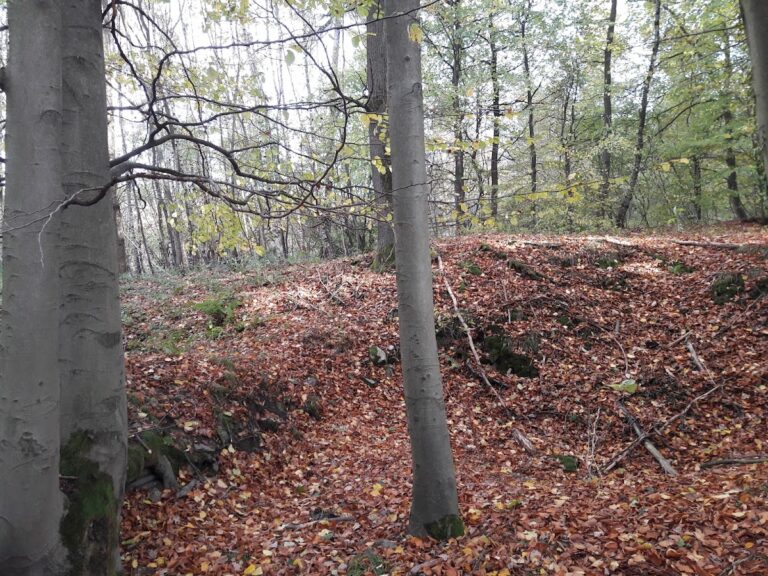
After the Reformation reached the Electoral Palatinate and Lorsch Abbey was secularized, the monastery continued as part of the estate. Its buildings began to decay no later than after plundering during the Thirty Years’ War, followed by illicit excavations and the rewilding of the Heiligenberg.
Remains
Schloss Heiligenberg stands at about 209 meters above sea level, roughly 240 meters east of the actual Heiligenberg and at the foot of the 331.6-meter Marienberg. The castle overlooks the Rhine Plain, with views extending from the Palatinate to the Taunus. Its grounds form part of a park that was once considerably larger and more open, flowing gradually into the surrounding northern Bergstraße landscape. A landscape-maintenance program commissioned by the Heiligenberg Foundation is gradually revealing parts of the former park design.
Castle and park
Main building and grounds
The castle is set within landscaped grounds whose surviving planting includes a large incense cedar in front of the main building and a sequoia beside the pond. Other exotic plants also remain in the park. The garden hall and courtyard provide spaces for exhibitions, concerts, seminars, and similar events, while the complex also contains a restaurant and a room for civil marriages.
Monastery and historic landscape features
Monastery ruin
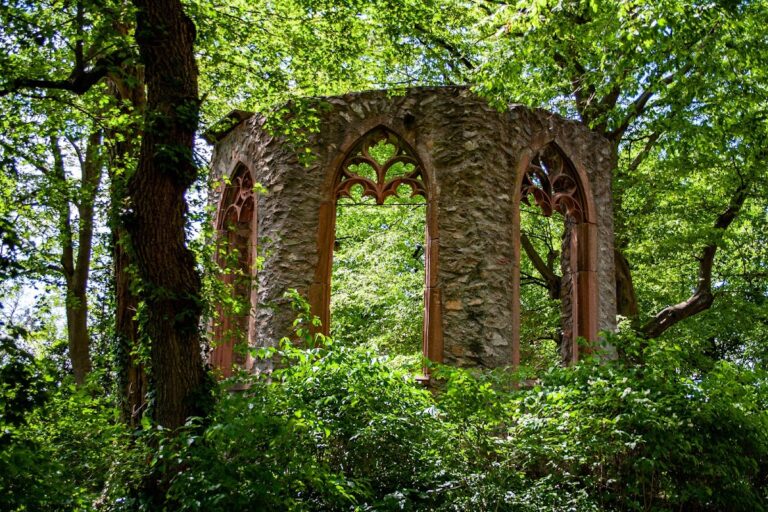
The nearby Heiligenberg monastery survives as a ruin. An artificial ruin erected in 1830 stands on the foundations of the Romanesque chapel choir and incorporates original Gothic tracery from Bensheim-Gronau. Gothic tracery is patterned stone framework used to divide and decorate windows and other openings.
Centlinde
The Centlinde, a natural monument beside the monastery ruin, is variously estimated at about 800 years old today and formerly at about 1,000 years. From the thirteenth to the sixteenth century, the Cent court met beneath it. This medieval and early-modern territorial court had jurisdiction over serious criminal cases.
Golden Cross
The Golden Cross, a landmark of Jugenheim, was erected in 1866 in memory of Wilhelmine, the former resident of Heiligenberg. Her four children inaugurated it on 28 May 1866. The cross stands on a black syenite pedestal and is about 8.5 meters high. Its gilded surface makes it visible from the Rhine Plain. Syenite is a coarse-grained crystalline stone similar to granite but with little or no quartz.
Battenberg mausoleum and burial site
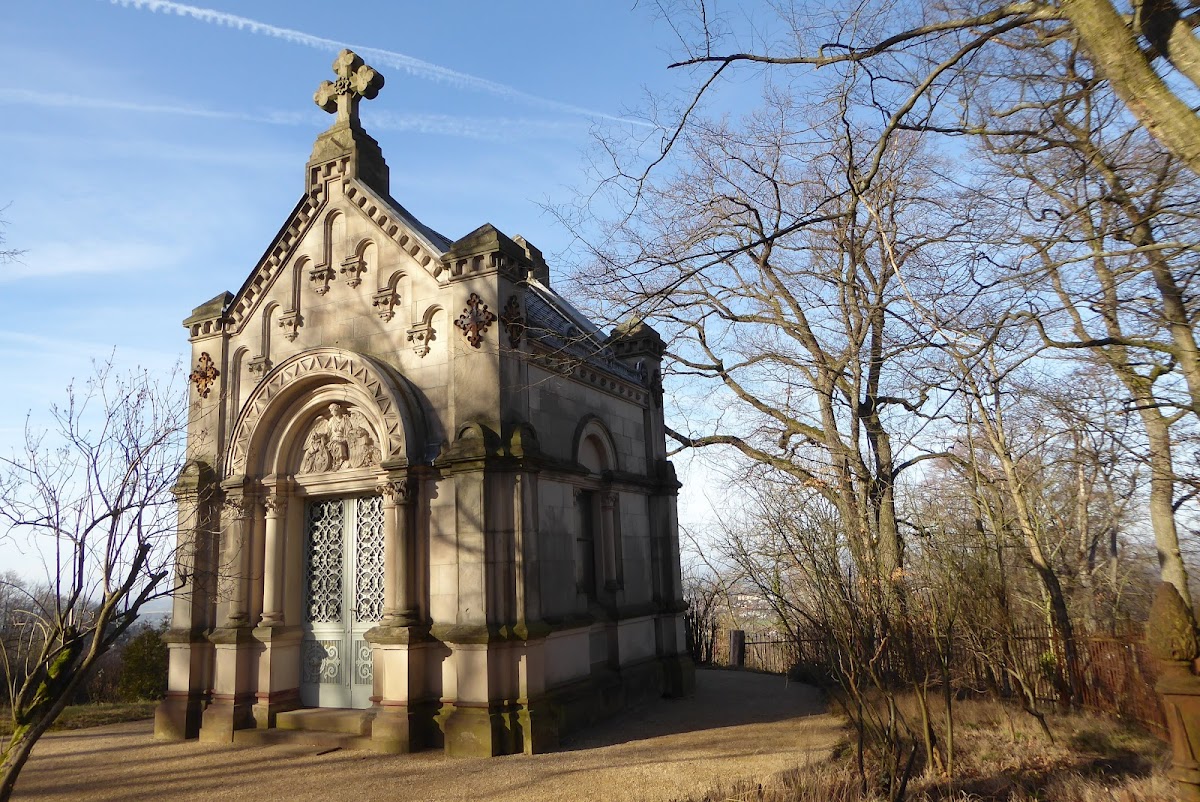
The Battenberg family mausoleum beside the cross was completed in 1894 for Prince Alexander, who died in 1888, and Julia, who died in 1895. After their remains were transferred in 1902 to a masonry crypt beneath the burial site in front of the Golden Cross, the mausoleum became a memorial chapel for the House of Battenberg. A memorial stone at the burial site commemorates their grandson Louis Mountbatten, who was murdered by the IRA in 1979. A grave slab associated with the Heiligenberg complex commemorates Conrad von Weinsberg-Breuberg.