Schloss Fürstenstein: A Medieval Castle and Baroque Palace Complex in Germany


Site at a Glance
- Rating
- 4
- Popularity
- Very Low
- Country
- Germany
- Primary era
- Medieval
- External website
- Open
- Eras represented
- Medieval, Early Modern, Modern
- Civilizations
- Duchy of Bavaria, German, Holy Roman Empire
- Site type
- Military
- Remains
- Castle
On this page12 sections
History
Schloss Fürstenstein is a castle and palace complex in Fürstenstein, Germany, built by Duke Albrecht I of Bavaria between 1347 and 1365. First recorded in 1365 as the stone structure belonging to the high-born Duke Albrecht, it is one of the three buildings that gave the Dreiburgenland its name, alongside Saldenburg and Englburg.
Ducal Foundation and Noble Ownership
A Puchberger served as the duke’s administrator in 1366. In 1381, Albrecht I granted the castle to Johann of Leuchtenberg, a landgrave, or high-ranking territorial noble in the Holy Roman Empire, as a life tenure. In 1396, ownership passed to Wilhelm Puchberger. After Wilhelm died in 1416, his son sold Fürstenstein to his nephews Georg and Asam of Winzer. Asam soon became the sole owner and sold the castle to Leonhard, Bishop of Passau, for 2,800 ducats in 1435.
The sale was reversed in 1437, and Asam’s son Hartlieb then became lord of Fürstenstein. After Hartlieb’s death in 1460, his daughter Elisabeth sold the castle in 1476 to the Schwarzensteiners of Englburg. The oldest known depiction of Fürstenstein appears in the regional maps made by Philipp Apian, a sixteenth-century Bavarian cartographer and scholar, in 1566.
Palace Expansion and Religious Use
Artolf, also known as Ortolf, Schwarzensteiner enlarged the castle into a palace in 1570. When the Schwarzensteiner family became extinct in 1617, Fürstenstein passed to the Counts of Taufkirchen. Through marriage, it subsequently came into joint possession of Wilhelm Notthafft of Wernberg and Christoph of Thürheim.
The two owners established a palace chaplaincy in 1625. A palace church followed in 1629, modeled on the Chapel of Grace at Altötting. It developed into a heavily visited pilgrimage church and retained that religious role until the nineteenth century. Its devotional focus was the Black Madonna of Altötting, a venerated image of the Virgin Mary associated with the Bavarian pilgrimage center of Altötting.
War, Damage, and Reconstruction
Swedish troops plundered Fürstenstein during the Thirty Years’ War, the European conflict of 1618 to 1648 that combined political and religious struggles and caused extensive destruction in the German lands. After 1680, the palace passed through the marriage of its heiress to Ludwig, Count of Perusa. Pandurs, irregular light troops particularly associated with Habsburg forces, reached the locality in 1742. A Bavarian free company drove them back, but the palace was devastated in 1744.
Marriage transferred Fürstenstein in 1803 to Heinrich von Oyen, a lieutenant general in the Grand Duchy of Hesse. He sold the estate to the Bavarian state in 1836, while selling the palace separately to the postmaster Maier. The chaplaincy was raised to a benefice in 1839, meaning that it became an endowed ecclesiastical institution supported by designated income.
The palace was later used as an inn with a brewery. A fire destroyed it in 1848, and the complex fell into ruin. Bishop Heinrich von Hofstätter of Passau acquired the ruins in 1860 for 22,000 gulden, rebuilt Schloss Fürstenstein, and transferred it in 1861 to the English Ladies, a Catholic women’s religious congregation that operated schools and educational institutions.
School and Modern Cultural Use
In 1893, the educational home became a boarding school with a boys’ primary school. At some periods, it accommodated as many as 200 pupils and about 30 religious sisters. A chapel was added to the stable wing in 1952. The English Ladies closed the residential school in 2001 because pupil numbers were falling and too few new religious members were joining the congregation.
Schloss Fürstenstein and Englburg were offered together on the eBay auction website in 2005. Annette Pinker, a German woman living in Spain who died in 2014, acquired the approximately 5,000-square-metre complex in 2007. She intended to make parts of it accessible through a cultural, educational, and gastronomic project. After major renovation, the palace hosted individual events, including the annual Europe Summit initiated by Konrad Kobler, as well as cultural events in the Knights’ Hall and palace courtyard. The castle and its archaeological remains are protected as both a listed monument and an archaeological monument. The archaeological designation includes underground late-medieval and early-modern remains in the area of the castle and later palace.
Remains
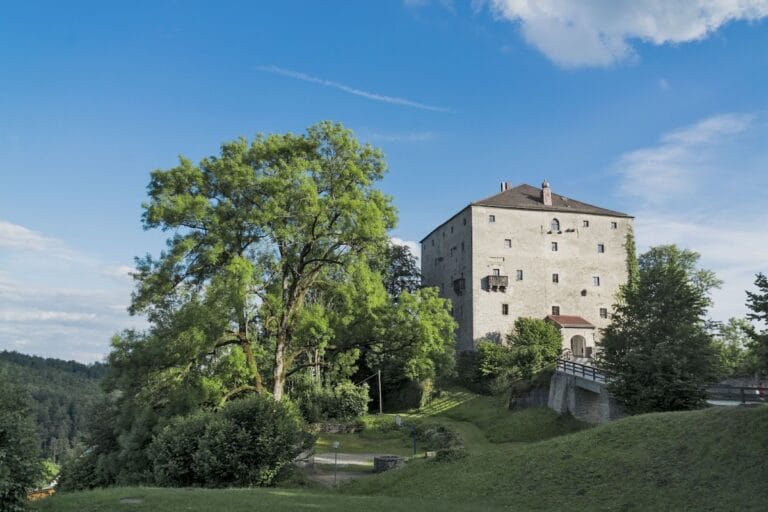
Schloss Fürstenstein occupies a rock at 578 metres above sea level, rising about 70 metres above the road junction below the settlement. The surviving complex consists of a lower castle and an upper castle, known as the Hochschloss. The lower section is organized around an inner courtyard, while an open staircase leads from this courtyard to the upper building. The adjoining Catholic parish church of the Assumption of Mary also forms part of the complex.
Castle and Palace Structures
Lower Castle
The lower castle is arranged around an inner courtyard. Three massive round towers stand along its eastern side, and medieval building fabric survives within them. The northern wing contains the public area of the palace and is opened during events, while the remaining areas are private. These elements preserve the relationship between the fortified medieval complex and its later palace use.
Upper Castle
The Hochschloss is a two-winged building reached by the open stairway from the lower courtyard. Remains of the medieval fortifications can still be seen along its southern side. Together, the lower and upper sections show the division of the present complex into distinct defensive and residential areas.
Parish Church and Chapel
Church Development
The parish church of the Assumption of Mary stands directly beside the palace, with a staircase connecting the church to a side room of the building. It developed gradually from the seventeenth-century Chapel of Grace and retains an early Baroque replica of the Black Madonna of Altötting, installed as its devotional image around 1620. The church then called itself the Church of Our Dear Lady and Palace Chapel of New Altötting in the Forest near Fürstenstein.
In 1867, the church was extended westward and received a 28-metre-high octagonal Neo-Gothic tower topped by a pointed cap. During a major rebuilding in 1956, all parts except the choir octagon and tower were demolished. The spacious church built around the surviving octagon was consecrated in 1957. A separate chapel was added to the stable wing in 1952.
Interior and Later Alterations
Except for the devotional image, the church received entirely new furnishings in 1957. Karl Reidel designed them mainly in local granite and bronze. During the church’s 375th anniversary in 2004, further renovation and partial modernization took place. Reidel added an altar island with a stone people’s altar and additional seating, while Stefan Fritsch redesigned the interior colors.
The choir octagon received bright orange wall surfaces and became a sacrament chapel. A bronze altar cross and the people’s altar form a unified ensemble with a centrally placed tabernacle. The wooden ceiling cladding was removed and replaced with a light-grey finish, and a metal light tree was installed in front of the devotional image to emphasize the small Madonna.