Hilgartsberg Castle Ruins: A Medieval Hilltop Castle in Germany


Site at a Glance
- Rating
- 4.6
- Popularity
- Low
- Country
- Germany
- Primary era
- Medieval
- External website
- Open
- Eras represented
- Medieval, Early Modern
- Civilizations
- Duchy of Bavaria, Holy Roman Empire
- Site type
- Military
- Remains
- Castle
On this page9 sections
History
Hilgartsberg Castle Ruins are the remains of a medieval hilltop castle in Germany, near Hofkirchen, first mentioned in 1112. The castle occupied a fortified spur above the Danube and belonged at that time to the County of Windberg as a fief, land granted by a superior lord in return for service or allegiance, from the bishops of Bamberg. During the twelfth century, the Counts of Sulzbach held the associated protective and administrative authority over Hilgartsberg and other Bamberg fiefs north of the Danube.
From Bamberg Fief to Noble Lordship
When the Counts of Sulzbach died out in 1188, an agreement between Bamberg and Holy Roman Emperor Frederick I, known as Frederick Barbarossa, transferred the castle to Frederick’s sons Otto and Friedrich. In 1207, Hilgartsberg and other properties were granted to Walchunus of Kamm. He later bequeathed them to his nephews Alram and Albert of Hals and to Bernhard of Uttendorf.
The bishops of Passau and Bamberg opposed this succession, beginning a long dispute over the lordship. An arbitration court awarded Hilgartsberg to Count Rapoto II of Ortenburg in October 1226. After the death of his son Rapoto III in 1248, Rapoto’s daughter Elisabeth and her husband, Hartmann I of Werdenberg, sold the property to Duke Heinrich of Lower Bavaria in 1259.
Ducal Administration and the 1357 Siege
The Bavarian dukes initially governed Hilgartsberg through custodians, officials who administered a lord’s castle. Seifried of Puchberg held it as a fief in 1309, and Schweiker I Tuschl received it in pledge from 1332. The Ecker family of Eck later acquired the fortress. Peter Ecker of Eck fell out of favor with Duke Albrecht, who besieged and captured the castle in 1357.
In 1360, Duke Albrecht strengthened Hilgartsberg with ramparts and a tower. The castle then returned to administration by ducal custodians. Toward the end of the fifteenth century, the Weisenberger family received it as a fief. After that family died out, Rudolph, Baron of Pollweil and Weilerthal, obtained the estate in 1596. His family also became extinct in 1617.
Fugger Ownership and Destruction
After 1617, Elector Maximilian I granted Hilgartsberg, together with the Hofmarks of Schöllnstein, Rannetsreit, Garham, Leithen, and Oberngschaid, to Hanns Ernest, Count Fugger of Kirchberg and Weißenhorn. A Hofmark was a landed jurisdiction with authority over local subjects. The Fugger family exercised higher jurisdiction over these territories, including authority in serious civil and criminal cases, but did not reside at the castle.
A fire damaged the castle in 1626, after which the Fuggers substantially enlarged the complex. The estate included a storage building for payments made in kind. In 1698, Count Franz Ernst Fugger acquired Hilgartsberg and the Hofmark of Grubhof as personal property.
Austrian forces occupied the castle in 1704 during the War of the Spanish Succession, a major European dynastic conflict involving the Habsburg monarchy and other powers. During the War of the Austrian Succession, another eighteenth-century conflict involving the Habsburg monarchy and rival dynastic powers, Austro-Hungarian troops under Lieutenant Colonel Count Gorani captured and burned Hilgartsberg on 11 November 1742. The Fuggers did not rebuild it.
State Ownership and Preservation
Joseph Eligius, Count Fugger of Glött, sold the lordship to the Bavarian state in 1821. The remaining buildings passed in 1823 to an innkeeper and farmer from Garham and later, in part, to a brewery owner from Vilshofen. Because upkeep had become too expensive, the owners transferred all the buildings to the state without charge in 1838.
A school serving the former municipality of Hilgartsberg occupied the site until 1970. The school building was then sold to the owner of the castle inn. On 18 December 1995, the market town of Hofkirchen acquired the ruins from the Free State of Bavaria. The Castle Promotion Association has maintained the complex since then. Hilgartsberg is protected as a listed architectural monument of Hofkirchen and is also designated an archaeological monument, covering buried medieval and early-modern features and finds connected with the high-medieval castle.
Remains
Castle Layout
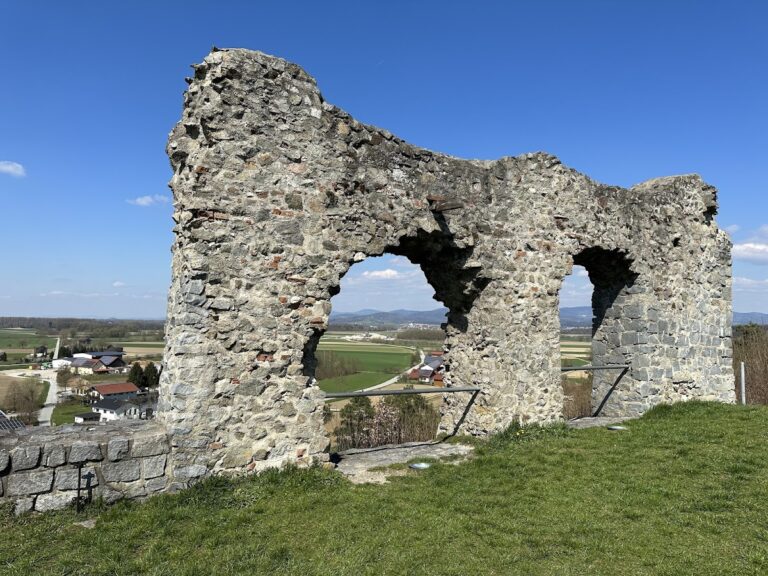
Hilgartsberg is a ruined spur castle on a projecting ridge, positioned at about 365 metres above sea level on a steep slope above the left bank of the Danube. Here the river leaves the Dungau and enters the breakthrough valley between the southern foothills of the Bavarian Forest. The castle follows a triangular ground plan and is divided into an outer defensive enclosure, an inner defensive enclosure, and a castle courtyard.
From the northeast, a ditch, a defensive trench, and a gatehouse lead into the outer enclosure. Successive gate towers connect the outer enclosure with the inner enclosure and the inner enclosure with the courtyard. This arrangement separates the principal areas of the castle while following the defensive organization of the hilltop complex.
Chapel of St George
The outer enclosure contains the well-preserved medieval Chapel of St George, which is attached to the curtain wall, the main enclosing defensive wall. Much of the chapel belongs to the Romanesque period, a medieval architectural style marked by massive construction and rounded forms. Its later interior combines a cross-ribbed vault, a ceiling supported by intersecting masonry ribs, with grotesque decoration and medallion paintings, which place images within framed circular or similar compartments.
Most of the furnishings date from the sixteenth century. The altar belongs to the Rococo period, while the altarpiece showing the Annunciation was probably made in the early seventeenth century. The chapel underwent major restoration in 2003 and remains the best-preserved medieval structure within the outer defensive enclosure.
Gates, Courtyard, and Underground Passage
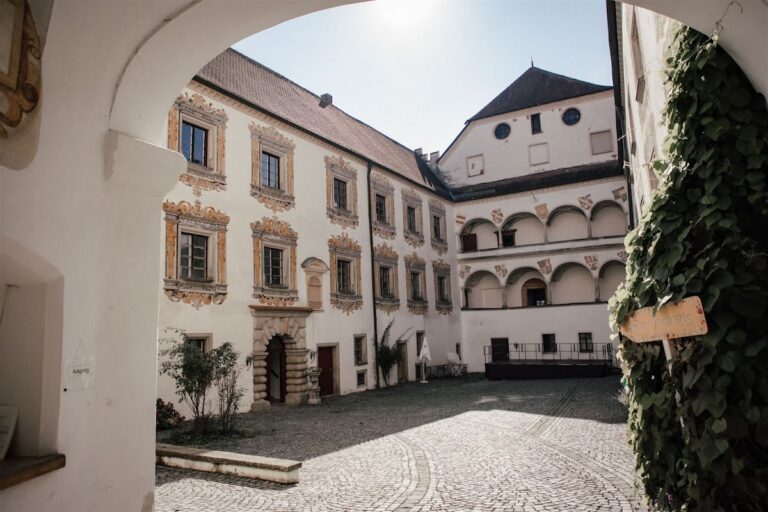
A gate tower provides the passage from the outer defensive enclosure into the inner enclosure, and a second gate tower leads onward to the castle courtyard. An open-air stage now occupies the courtyard. One corner contains a deep well, which forms the starting point of an underground passage running beneath the walls to the outer enclosure.
The surviving ruins retain the castle’s layered defensive arrangement, from the northeastern ditch and entrance to the successive enclosures and central courtyard. Their position above the Danube also provides a view across the river valley.