Château de La Grange-aux-Ormes: A Former Seigneurial Estate in France
Site at a Glance
- Rating
- 4.1
- Popularity
- Low
- Country
- France
- Primary era
- Early Modern
- External website
- Open
- Eras represented
- Early Modern
- Civilizations
- French
- Site type
- Domestic
- Remains
- Castle
On this page8 sections
History
Château de La Grange-aux-Ormes is a former seigneurial estate in France, at Marly on the Genestoy locality of the Frescaty plateau. Its first château was built in 1187 by the religious communities of Notre-Dame-aux-Champs and Saint-Symphorien of Metz, establishing an estate whose ownership and functions changed repeatedly over the following centuries.
Medieval Estate and Destruction
The Counts of Bar later sold the estate for 300 deniers to Collignon, who acknowledged himself as their vassal in 1322. A vassal was a person bound to a superior lord through a feudal relationship. The Vry family acquired La Grange-aux-Ormes in 1404 and sold it to the chapter of Metz Cathedral in 1409. The estate then passed to the Apremont family, who pledged it to several aristocratic families from Metz, including the Gournays in 1436.
On 12 October 1444, the people of Metz deliberately burned the château. They feared that troops of Charles VII, king of France from 1422 to 1461, and marauding soldiers might use it as a shelter. The destruction formed one of the more dramatic episodes in the medieval history of the estate.
Changing Ownership in the Early Modern Period
La Grange-aux-Ormes was sold to the Chauvrain family in 1500. Claude d’Apremont sold it to the Gronnaix family in 1586, after which ownership passed successively to Jehan de Travald; Mathurin Chauveau and the chapter of Metz Cathedral, which retained it until 1611; Jacques Loys in 1614; and Jean de Cherisey in 1661. Jean de Cherisey’s daughters Jeanne and Nicolle held it from 1681.
In 1709, M. Le Goullon sold the château to Coislin, bishop of Metz, who made it his episcopal residence, meaning his principal dwelling. The Saint-Hélier family acquired the estate in 1728. In 1785 it belonged to the Counts of Ourches, then passed by inheritance to the Viscounts of Nettancourt and later to the Clermont-Tonnerre family. The duchess of Clermont-Tonnerre made the property available to the minor seminary of Montigny-lès-Metz, an institution that prepared boys and young men for possible entry into the Catholic priesthood.
The Jeanne d’Arc Claim
La Grange-aux-Ormes is also associated with a disputed episode involving Jeanne d’Arc. On 20 May 1436, the Gournay family received a woman who claimed to be Jeanne la Pucelle and said that she had not been executed at Rouen. Pierre d’Arc and Jean d’Arc came from Vaucouleurs and formally recognized her as their sister. After receiving visits and gifts from prominent people in Metz, she was taken to Vaucouleurs. She later travelled through Marieulles, Arlon, and Cologne and married Robert des Armoises.
The chronicler Jacomin Husson maintained that the woman was Jeanne d’Arc, while Philippe de Vigneulles doubted the claim. The woman became associated with the name Jeanne des Armoises, which was accepted by some contemporaries and rejected by others.
Agricultural Estate and Modern Transformation
Hyacinthe Bogenez bought the property in 1923 and operated an agricultural enterprise there until 1963. The estate produced potatoes, peas, wheat, rye, barley, sugar beets, eggs, and milk, while also supporting cattle breeding and horse sales. An enclosure was later reserved for deer.
During the 1960s, the adjacent woodland was converted into residential subdivisions. La Grange-aux-Ormes was developed in 1972, followed by the Clos des Lilas and, in 1980, the Clos des Acacias. A golf course was established in the park behind the château in 1991, and the former outbuildings were converted into a clubhouse and restaurant.
Remains
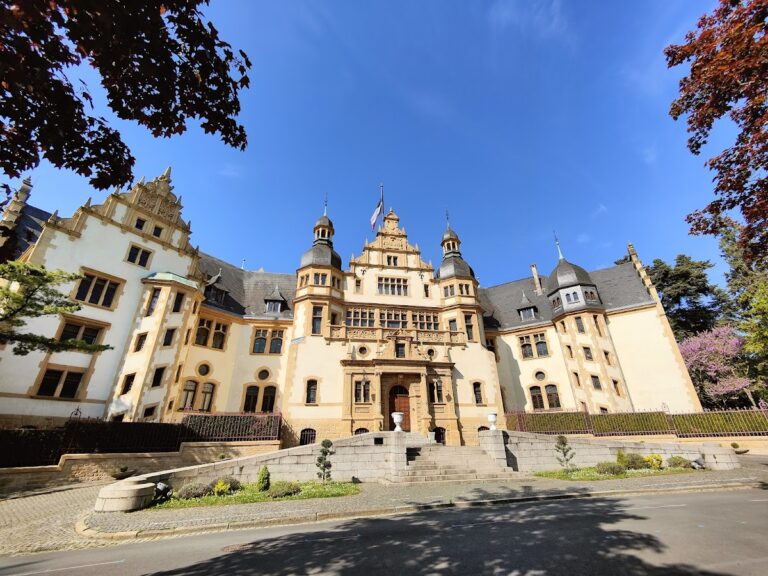
The present château was built during the first half of the eighteenth century. It stands at the end of a long avenue and was formerly accompanied by several buildings associated with the owner’s household and estate activities. The Seille runs alongside and then across the wider area, while the park extends behind the château.
Chapel
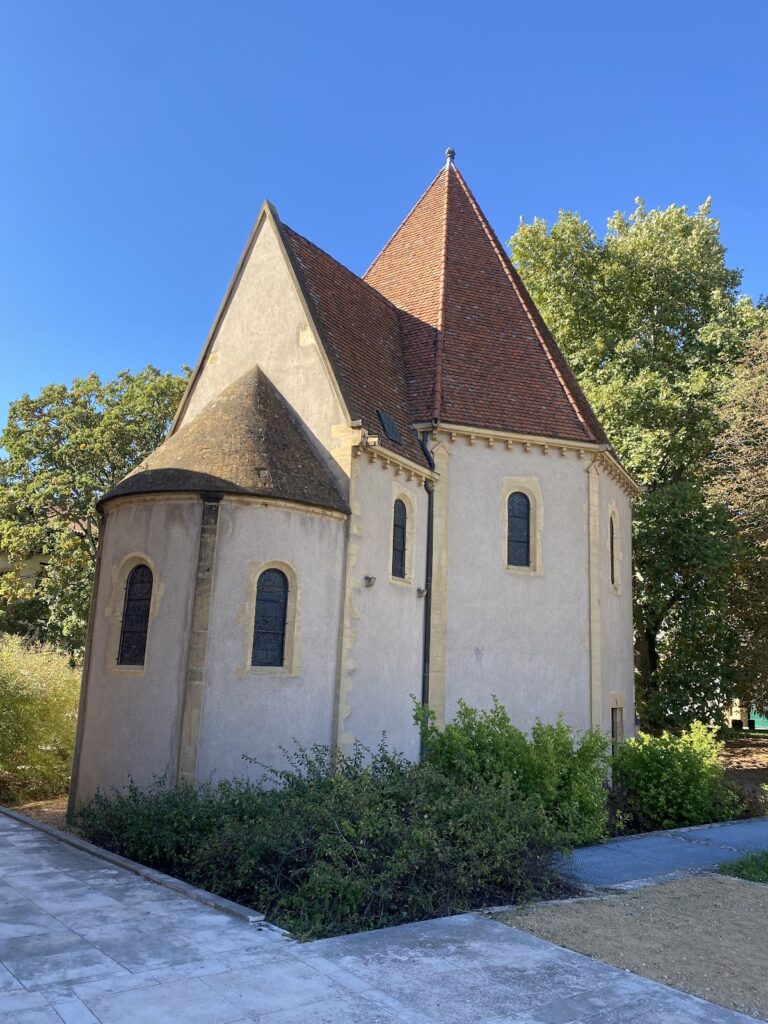
A chapel formed part of the estate. On 22 July 1768, Chandellier, the parish priest of Marly, described it as being in good condition and suitably ornamented for the celebration of Mass.
Park and Former Dependencies
The park behind the château now contains a 27-hole golf course designed by Philippe Gourdon across a wooded, undulating site of 100 hectares. Its 18-hole course, called “Le Bois brûlé,” measures 6,194 metres and has a par of 72. The layout combines long and short holes with numerous water features and sloping fairways. A separate nine-hole course, “Le Breuil,” measures 2,001 metres and has a par of 31. The estate also includes a water practice range, and drainage allows use throughout the year. The former dependencies contain the golf clubhouse and restaurant.
Nearby sites