Kammer Castle: A Baroque Water Castle in Austria


Site at a Glance
- Rating
- 4.6
- Popularity
- Very Low
- Country
- Austria
- Primary era
- Early Modern
- Eras represented
- Medieval, Early Modern
- Civilizations
- Habsburg, Holy Roman Empire
- Site type
- Domestic
- Remains
- Castle
On this page11 sections
History
Kammer Castle is a water castle in Austria at Schörfling am Attersee. Its history reaches back to the twelfth or thirteenth century, and a fortified site existed there by about 1200. The castle later became a Baroque lakeside palace, an elaborate architectural form that developed in Europe during the seventeenth and eighteenth centuries. Its fief became an administrative center of the Attergau, a historical region of Upper Austria, and the fortress also formed part of the defenses maintained for protection and civilian refuge.
Medieval Origins and the Schaunberg Fief
Haidfalk von Chammer was identified as the castle’s first owner in 1165. Gotfrid and Haidfolch von Chamer appeared in a document of 1249, while a record from 1260 placed the castle under the Counts of Schaunberg, a powerful medieval noble family in Upper Austria. The counts granted Kammer as a fief to the family that later adopted its name from the castle. Through this arrangement, Kammer became closely associated with the organization of the Attergau.
The castle was drawn into the conflict between Count Heinrich von Schaunberg and Duke Albert III of Austria. Reinprecht II von Wallsee captured Kammer for the duke during this struggle. In 1386, the Schaunbergers were compelled to sell the castle to the Habsburgs, the dynasty that ruled Austria and held extensive territories in central Europe.
Habsburg Administration
Under Habsburg control, Kammer was repeatedly pledged to noble families, including the Geymann, Wallsee, Praun, and Polheimer families. Christoph Jörger became custodian in 1483, and Tiburtius Sinzendorfer received Kammer as a fief in 1488. The lordship returned to Emperor Maximilian II in 1570. Hektor Pirschinger was then entrusted with its administration, and Hans von Hohberg served as imperial administrator from 1576 to 1581.
The Khevenhüller Lordship
In 1581, Emperor Rudolf II sold Kammer, together with the lordships of Kogl and Frankenburg, to Baron Johann Khevenhüller. Khevenhüller was raised to the rank of count in 1593, and the three lordships were combined as the County of Frankenburg. The medieval fortress was transformed into a three-storey lakeside palace between 1622 and 1649, creating the Baroque water-castle character that defines the surviving complex.
After Bavaria temporarily occupied Upper Austria from 1810 to 1816, the Khevenhüllers sold Kogl and Frankenburg but retained Kammer. August Horváth von Szent György became its owner in 1886 through his wife, Ida, Countess Khevenhüller. Financial ruin led to the sale of the property to the provincial mortgage institution in 1904. It was resold to Julius Steiner that same year, and Sophie Gassauer owned it in 1909.
Twentieth-Century Ownership and Conservation
In 1925, the castle was acquired jointly by the Berlin actress Eleonora von Mendelssohn and her future husband, the cavalry officer Emmerich von Jeszenszky. Following their divorce in 1936, Jeszenszky became the sole owner. The Jeszenszky family retained Kammer until the early 1990s and also managed the adjoining agricultural estate. The castle was used as a hotel for a period during the 1960s, and conservation work in 1970 focused especially on its roof structure.
Ownership passed to the Max-Theurer family in the early 1990s, including Elisabeth Max-Theurer, a former Austrian Olympic dressage champion. The castle was at risk of falling into ruin, but it was subsequently renovated. The municipality of Schörfling acquired much of the castle park for a public facility, while the castle itself remained privately owned and was used for official events. Kammer has been protected as an Austrian monument since 1993 under protection number 37478.
Remains
Lake Setting and Main Building
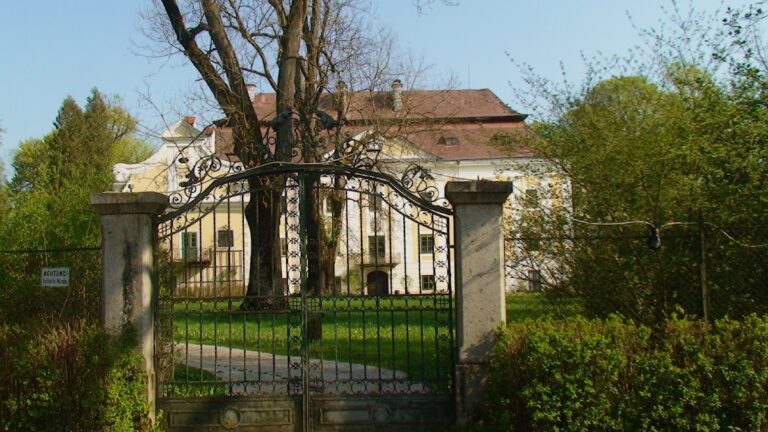
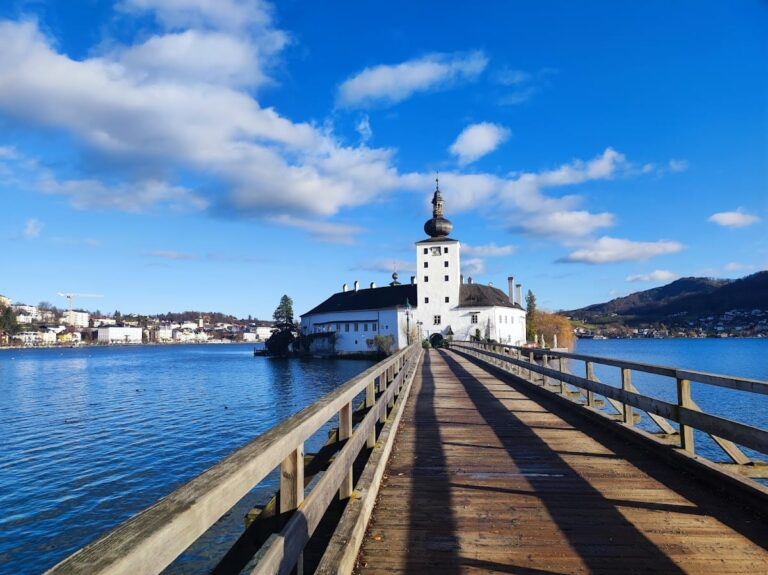
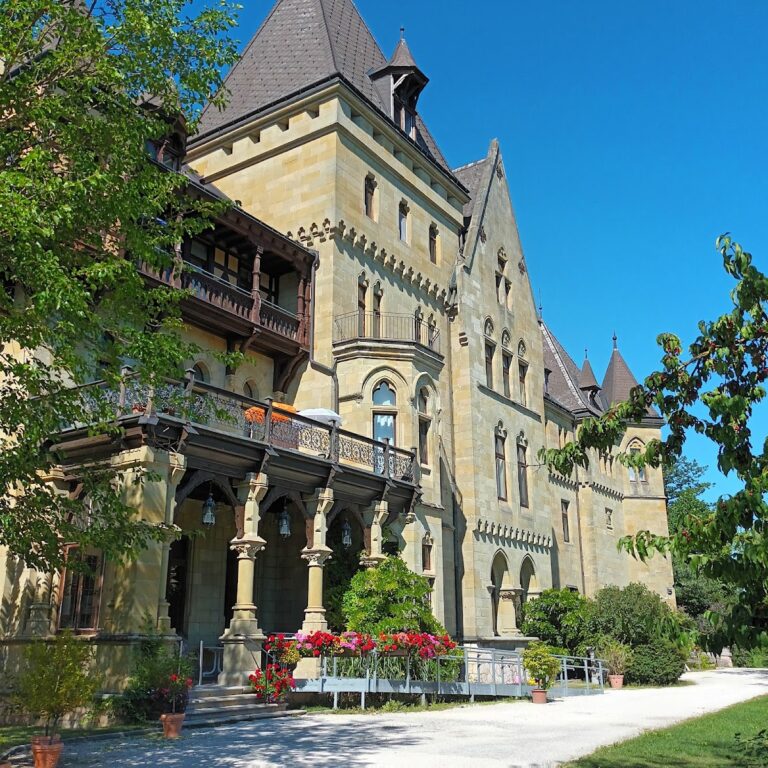
Kammer Castle originally stood on an island in the northern part of Lake Attersee and was reached by a footbridge. The former island later became connected to the mainland, leaving the castle on a peninsula. Beside the lake, the principal building forms a massive rectangular block of three storeys. Its scale and imposing roof preserve the commanding appearance associated with the palace created from the earlier fortress.
Baroque Palace
The rebuilding carried out between 1622 and 1649 produced the present three-storey palace and included the knight’s hall, known as the Rittersaal, together with the New Castle. These works altered the earlier defensive complex into a lakeside residence shaped by Baroque architectural ideals. The principal hall is reached by a broad staircase and serves as a ballroom or ceremonial hall with space for up to 500 people.
Wings, Courtyard, and Entrance
Two lower side wings were added under the direction of Johann Michael Prunner, a Baroque master builder active in Linz. The wings enclose an internal courtyard described as pentagonal, and arcades run along their ground floors on the courtyard side. A gate building from the same construction phase forms the entrance, with a pergola standing in front of the tower.
Interiors and Chapel
The large salons contain inlaid floors, mirrors, Venetian chandeliers, period furniture, and large oil paintings. The staircase leading to the ballroom dates from 1748. An eighteenth-century chapel has stucco decoration and is dedicated to the Virgin Mary, adding a religious interior to the palace’s ceremonial and residential spaces.
Approach Avenue and Paintings
A notable lime-tree avenue leads toward the castle. The castle, its grounds, and the avenue were depicted repeatedly by Gustav Klimt, the Austrian painter associated with the Vienna Secession and decorative, symbolist works. His oil painting Kammer Castle on Lake Attersee III, dated 1909–1910 and measuring 110 by 110 centimeters, is held by the Austrian Gallery Belvedere in Vienna. The gallery also holds his 1912 painting Avenue to Kammer Castle, which depicts the approach to the castle.
Nearby sites