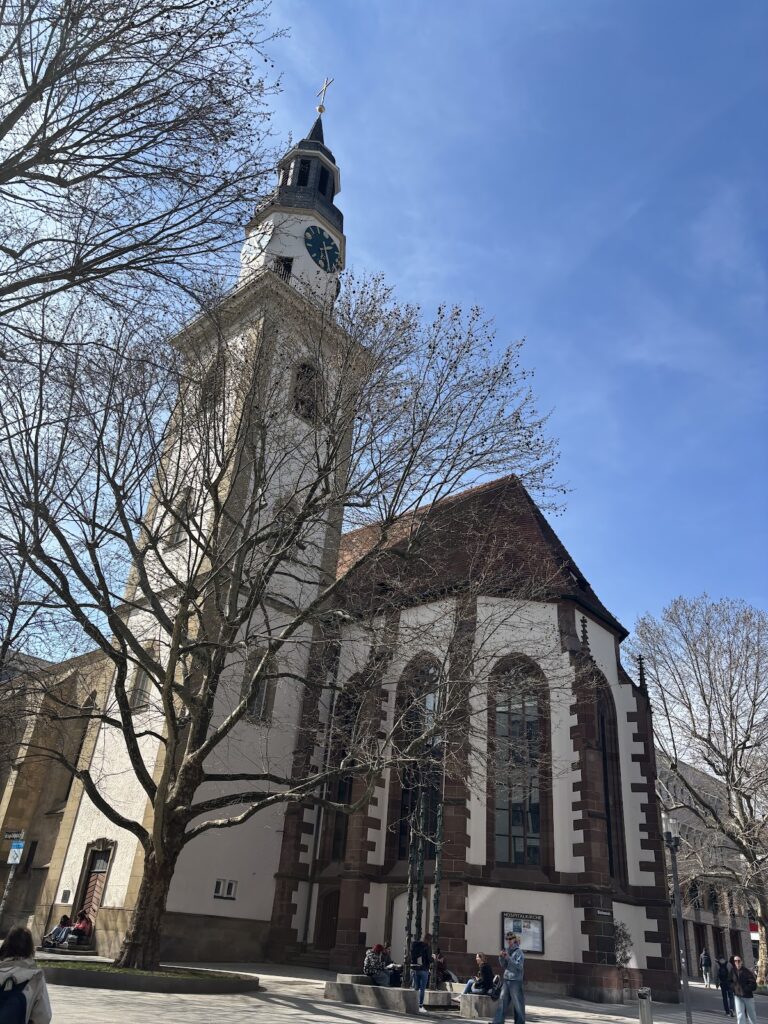
St. Martin in Sindelfingen: A Romanesque Lutheran Church in Germany


Site at a Glance
- Rating
- 4.6
- Popularity
- Low
- Country
- Germany
- Primary era
- Medieval
- External website
- Open
- Eras represented
- Medieval
- Civilizations
- Holy Roman Empire
- Site type
- Religious
- Remains
- Basilica
On this page18 sections
History
St. Martin in Sindelfingen, Germany, is the town’s Lutheran main church and a Romanesque basilica begun in 1080. Dedicated to Martin of Tours, a fourth-century Christian bishop and widely venerated early medieval saint, it served both a collegiate foundation and the local parish. Its history reaches back to an earlier Christian presence on the site and continues through the Reformation, later restorations, and its use as an active church and venue for church music.
Early Christian site and collegiate foundation
A church may have stood here as early as the seventh century, an inference drawn from the dedication to Martin of Tours. Excavations also revealed a Christian cemetery dating from the eighth century. Around 1050, Adalbert II, Count of Calw, founded a Benedictine double monastery at his principal seat in Sindelfingen. He soon transferred that institution to Hirsau and established a secular Augustinian collegiate foundation in its place. A collegiate foundation was a community of clergy governed by statutes and serving a church, without necessarily being a monastery.
The church for the new foundation was conceived around 1059 on the foundations of the earlier building. Construction of the present Romanesque basilica began in 1080. The church was consecrated on 4 July 1083 by the Bishop of Würzburg and the Archbishop of Salzburg, and work was completed in 1132 under Welf VI of Spoleto.
Medieval administration and transfer to Tübingen
The collegiate foundation occupied the site of an older manor belonging to the Counts of Calw. Its bailiwick, the authority responsible for protecting and administering the foundation, passed from the Counts of Calw to Welf VI around 1131. It later came to the Counts Palatine of Tübingen and, through the Lords of Rechberg, to the Württemberg rulers between 1351 and 1369.
In 1477 the collegiate foundation was transferred to Tübingen. Its wealth and its canons formed an economic, personnel, and intellectual basis for the later University of Tübingen. A sandstone relief in St. Martin commemorates the transfer by depicting Archduchess Mechthild and her son, Count Eberhard im Bart, kneeling before Christ in prayer.
Augustinian reform and the Reformation
The assets that remained in Sindelfingen were used to establish a regulated Augustinian foundation, initially consisting of seven members. The community joined the Windesheim Congregation, an Augustinian reform movement that promoted stricter communal religious discipline, and Augustinians arrived from the Kirschgarten monastery in Worms. In 1525 the foundation was still described as a rich monastery.
The Reformation reached Sindelfingen in 1535. With one exception, the canons rejected the new faith and accepted life annuities in exchange for surrendering their rights. The foundation was formally dissolved in early 1536. Its buildings were subsequently used for storage and administration, and parts of the complex were demolished. A Lutheran pastor named Martinus is recorded at the church in 1540.
Restoration and continuing use
St. Martin was restored and remodeled in several major phases. Christian Friedrich von Leins directed work from 1863 to 1868, followed by interventions under Ernst Robert Fiechter and H. Seytter in 1933, and Martin Stockburger in 1973 and 1974. The campaigns of 1863 to 1868 and 1973 to 1974 removed post-Romanesque alterations, and their changes are no longer apparent in the interior.
The church contains burials associated with Württemberg and regional nobility. Among those connected with the church are Count Ulrich of Württemberg, who died at Speyer on 8 March 1348, Count Palatine Rudolph of Württemberg and his son Hugo, Countess Agnes of Württemberg, Count Hugo of Eberstein and Baden, members of the Hutten family, and nobles from Wurmlingen, Hailfingen, Altingen, Jesingen, Neuhausen, Bernhausen, and other places.
St. Martin remains an active Lutheran building. Since the Martinusweg pilgrimage trail opened in 2011, its main route has led to the church through the dioceses of Rottenburg-Stuttgart and the Archdiocese of Freiburg. The building is also used for church-music events.
Remains
Romanesque church and medieval tower
Basilica plan
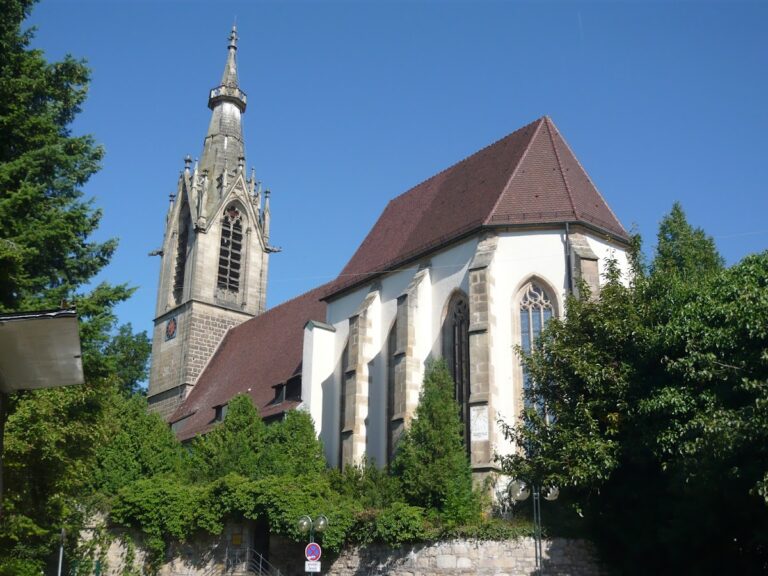
St. Martin preserves a three-aisled Romanesque basilica, a longitudinal church with a high central nave flanked by lower aisles. The building has a traditional basilica plan and a flat wooden ceiling. Its choir was originally raised above the main floor and included a crypt. The eastern end terminates in three apses, or rounded sanctuary spaces. The form of the tower, the arcades carried by pillars, and the arrangement of the three apses point to Italian architectural influences.
Campanile and exterior fabric
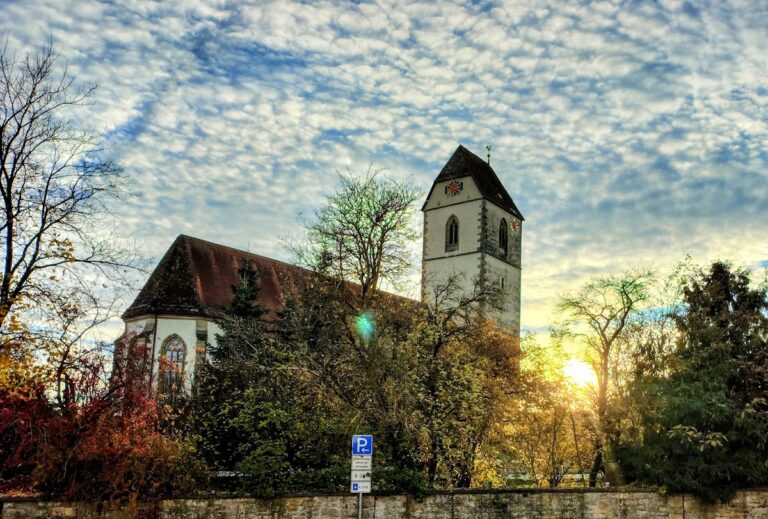
The 42-metre tower was originally a freestanding campanile, meaning a bell tower standing separately from the church. Its roof and the sacristy were built in 1270 during the Gothic period under the canon Konrad of Wurmlingen. The exterior retains connecting walls between the tower and nave, round-headed windows in the side aisles, and Neo-Romanesque sound arcades in the bell stage. Tower clocks belong to the nineteenth-century remodeling.
Ceiling and portals
The approximately 900-year-old fir-wood ceiling survives from the building period. The timber was felled in 1131, linking the surviving structure to the final phase of the Romanesque construction. Its paintings of the symbols of the four Evangelists, Matthew, Mark, Luke, and John, were designed by Ernst Fiechter and executed in a deliberately archaizing manner in 1933.
The west portal door retains Romanesque fittings from the twelfth century. Its lion-head door ring is associated with the granting of the right of sanctuary. In the choir, a crucifix dates from around 1600. Walter Kohler designed the stained-glass windows installed in 1933. They present the life and Passion of Jesus Christ in 24 scenes, extending from the Nativity to the Resurrection.
Bells, burials, and archaeological evidence
Bell ensemble
The bell ensemble consists of six bells, together with a small school and Vespers bell in the side tower. The largest is the 4,820-kilogram Christ Bell, regarded as one of the largest and most sonorous bells in Württemberg.
Burials and coin hoard
The church’s burials connect its interior with the medieval and early modern history of Württemberg and neighboring noble families. A twelfth-century coin hoard found in the church floor in 1973 provides additional archaeological evidence for activity within the building.
Organs and musical equipment
Early instruments
The earliest recorded organ dates from 1576, when the case of a removed instrument was still present. Records from the beginning of the seventeenth century also name appointed organists. In 1661 Jakob Müntzer built a new organ because the earlier instrument was considered too quiet. Five old stops and two bellows were reused, while three tin stops and another bellow were added.
The instrument was fundamentally renewed and enlarged in 1687. It then had ten stops, new bellows, a new manual, a new coupler, a pedal, and two additional stops containing 48 pipes. Further repairs and restorations followed.
Walcker organs
In 1830 Eberhard Friedrich Walcker of Ludwigsburg built a two-manual organ. It had three bellows, 19 stops, and a pedal extending over two and a half octaves, and it was installed in the older case. During the remodeling of 1862 to 1864, that case was replaced by a simpler one intended to harmonize with the church. By 1879 the organ had 20 stops and 1,092 pipes.
A second Walcker organ was commissioned as a concert instrument and installed in 1920. It began with two manuals, a pedal, and 15 stops, although its design allowed later expansion to 45 stops. Prospect pipes from the earlier organ had been requisitioned for wartime purposes in 1917, and 891 marks were paid into the organ fund as compensation.
The 1920 instrument was dismantled and stored during the church renovation of 1933. Its case was altered during reassembly and covered the west window. Two stops were added in 1935, bringing the organ to three manuals and 22 stops. Severe woodworm damage later made the instrument expensive to repair.
Weigle main organ
Friedrich Weigle of Echterdingen built the present main organ in 1961. Martin Stockburger modified it in 1974, and it was altered again in 1991. Before its 2016 renovation, the instrument had 37 stops on three manuals and pedal, mechanical key action, electric stop action, four free manual combinations, and two free pedal combinations.
In 2016 the Mühleisen organ workshop of Leonberg completely dismantled, cleaned, restored, and tonally revised the instrument. It now has 41 stops, renewed electrical systems, a gamben stop, and a 25-note tubular-bell stop. Trumpet and oboe replaced the Dulcian and Schalmei, while Viola, Viola di Gamba, Salizional, and Voix céleste were added. Some compound high-pitched mixtures were removed or altered for aesthetic and spatial reasons.
A modern setter system stores thousands of registrations. Additional wind equipment, improved wind regulation, and a crescendo roller provide greater volume and dynamic range. The retained couplers are II/I, III/I, III/II, I/P, II/P, and III/P. New sub-octave couplers serve II/I, II/II, III/I, and III/II, while super-octave couplers serve II/II, II/P, and III/P. MIDI input and output support recording and playback.
Choir organ
Tilman Trefz built a one-manual choir organ in 2008 and 2009 as two independent sections. A mobile nine-stop chest organ was inaugurated in 2008, followed in 2009 by a separate three-stop pedal section with its own wind supply. The sections can be combined as a concert and service organ, although the manual and pedal cannot be coupled.
The chest organ’s divided stops allow its single manual to produce effects comparable to a two-manual instrument. Two 8-foot and 4-foot stops can be retuned to 415 Hz by exchanging pipes for historically informed performance. Its low case allows the organist to see or cue a conductor, while two colored-glass windows by Fritz Mühlenbeck regulate volume in place of a swell box. Both sections stand on casters and can be moved easily.
The former choir organ was a one-manual, pedal-less Weigle “Schütz-Positiv” series instrument from the 1950s. After technical and tonal refurbishment for a new use, it was moved to a small room in Burghalden Cemetery for funeral services.
Nearby sites