Schloß Bloemersheim: A Late-Medieval Water Castle in Germany


Site at a Glance
- Rating
- 4.4
- Popularity
- Low
- Country
- Germany
- Primary era
- Early Modern
- External website
- Open
- Eras represented
- Medieval, Early Modern, Modern
- Civilizations
- Holy Roman Empire, Kingdom of Prussia
- Site type
- Domestic
- Remains
- Castle
On this page10 sections
History
Schloß Bloemersheim is a late-medieval water castle complex in Germany near Neukirchen-Vluyn, whose fortified residence was surrounded or partly enclosed by water-filled ditches. First recorded in 1406, it became the hereditary seat of the von der Leyen family in 1802 and remains associated with estate administration, fruit sales, and forestry operations.
Medieval Origins and the von Baldrich Family
The estate appears in 1406 under the name Gut Blomertshof as a fief, meaning property granted by a superior authority in return for service or allegiance, held from Haus Gastendonk. The Lords von Baldrich owned it until 1510. Members of the family served as judges and bailiffs in Gelderland, and part of the castle grounds lay within the Duchy of Guelders.
The date of the first water castle, including its forebuilding and later main castle, is unknown. During the earlier history of the complex, the boundary between the Duchy of Guelders and the County of Moers crossed the grounds and even ran through the kitchen of the main building. These were neighboring historical territories whose border gave Bloemersheim an unusual political position.
Marriage Alliances and the von Pelden Estate
Around 1560, an heiress of the von Baldrich family brought the estate by marriage to the Lords of Hoennepel, also known as von der Impel. Bloemersheim remained with this family for more than 150 years.
In 1667, after another marriage to an heiress of the von der Impel family, the complex was granted as a fief to Baron von Pelden, also called Cloudt, who was Droste of the County of Moers. A Droste was a senior territorial official with judicial and governmental responsibilities. Bloemersheim served mainly as a hunting castle, while Schloss Lauersfort and Haus Impel in Moers were the principal residences of the von Pelden family.
The castle was repeatedly attacked and heavily damaged. The first von Pelden called Cloudt to hold the estate had the destroyed outer courtyard rebuilt. At that time, the water ditches between the outer and main parts of the castle were filled and levelled. The complex also provided refuge for nearby farmers during wartime.
Territorial Change and Decline
In 1724, under Prussian rule, the boundary was changed so that the entire castle grounds became part of the Principality of Moers. Reinhard von Pelden, also called Cloudt, lived from 1702 to 1770 and served as Government President of the Principality of Moers, making him a leading official of the territory.
Around 1790, French forces plundered and devastated Bloemersheim. The last Cloudt heirs were impoverished and could neither renovate nor maintain the estate. The property consequently entered a period of decline.
The von der Leyen Family
In 1802, the Cloudt family sold the entire estate for 17,000 thalers to Friedrich Heinrich von der Leyen, a Krefeld silk producer and mayor. He was ennobled as the Prussian Baron von der Leyen zu Bloemersheim in 1816.
The von der Leyen family expanded the castle and its park into the present Schloss complex. In 1837, as owners of the manor, they became founding members of the Rhenish Knighthood, a corporate association of the region’s landed nobility whose members included owners of recognized manorial estates such as Bloemersheim.
Since 1802, Bloemersheim has remained the hereditary seat of the von der Leyen family. In 1992, the agricultural and fruit-growing enterprise of Schloss Dyck and Nikolauskloster was taken on lease. The agricultural enterprises are currently administered by Friedrich Freiherr von der Leyen zu Bloemersheim.
Remains
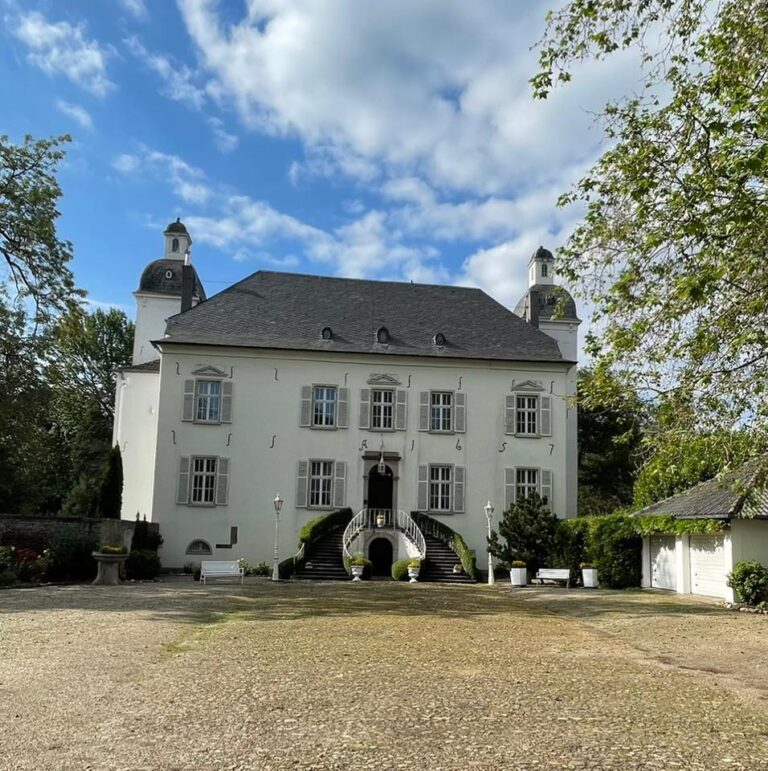
Schloß Bloemersheim survives as a water-castle complex historically organized into a forebuilding and a main castle. The documented components of the present grounds include the castle courtyard, castle garden, associated park, and castle pond. The original approach required crossing two drawbridges, while later rebuilding altered the water divisions within the complex.
Castle Buildings
Forebuilding
The forebuilding formed one of the two principal parts of the historic water castle. It belonged to the approach and defensive arrangement reached by crossing a drawbridge. After earlier attacks caused severe damage, the outer courtyard associated with this part of the complex was rebuilt, and the ditches between it and the main castle were filled and levelled.
Main Castle
The main castle formed the second principal part of the complex. Its rear side faces the castle pond, and the historic territorial boundary between Guelders and Moers once ran through the main building’s kitchen. The surviving castle stands within the courtyard, garden, park, and pond setting that defines the present Schloss complex.
Courtyard, Garden, Park, and Pond
The castle courtyard and castle garden form part of the grounds surrounding the buildings. The associated park was developed by the von der Leyen family as they expanded the estate after acquiring it in 1802. The castle pond remains a defining water feature, particularly along the rear side of the Schloss.