Baumgarten Castle: An Austrian Estate Residence
Site at a Glance
- Popularity
- Low
- Country
- Austria
- Primary era
- Early Modern
- Eras represented
- Medieval, Early Modern
- Civilizations
- Habsburg, Holy Roman Empire
- Site type
- Domestic
- Remains
- Castle
On this page5 sections
History
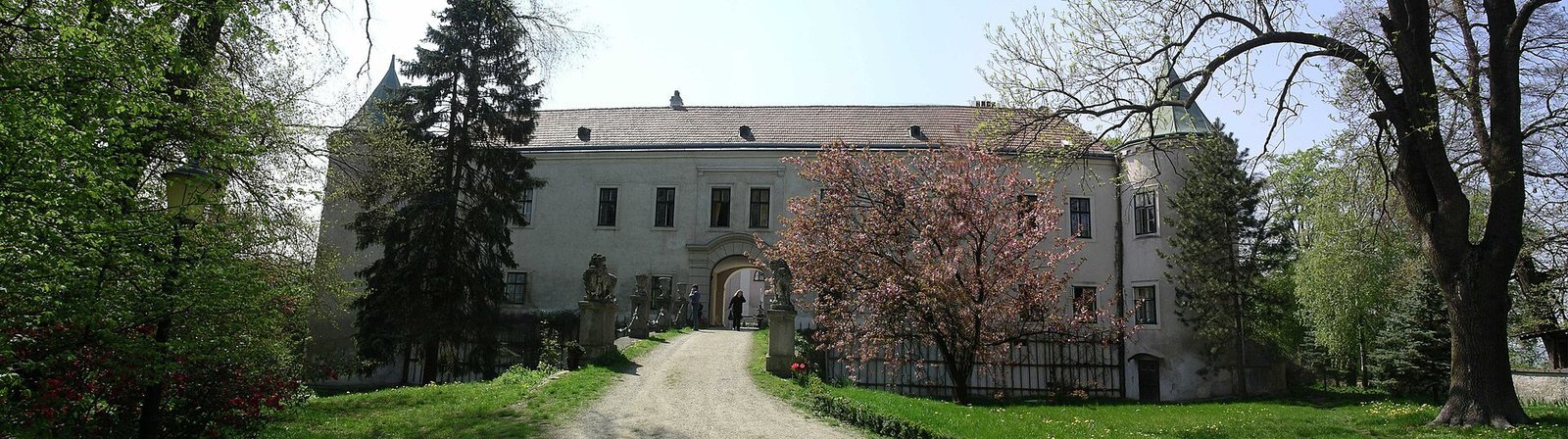
Baumgarten Castle is a former estate residence in Ollersbach, Austria, within the municipality of Neulengbach in Lower Austria. Its owners chiefly valued it as the center of an estate, and members of the high nobility who held it rarely lived there.
Medieval origins
The castle was first recorded in 1074 as property of the Formbach noble family, at a settlement then identified as Adelgeresbach or Algersbach, now Ollersbach. Later, the estate passed to the ministeriales, a service nobility whose members held land or positions under a lord. The Totzenbach family belonged to this group and later adopted the name “of Baumgarten.”
Country residence and destruction
In 1565, the Counts of Trauttmansdorff owned Baumgarten and converted it into a country residence. During the Second Ottoman siege of Vienna, the Ottoman campaign against the Habsburg capital in 1683, Ottoman raiding parties destroyed the castle, which had only limited fortifications. It was rebuilt soon afterward.
Estate ownership and later history
In 1822, Baumgarten was described as a locality of three buildings. It belonged to the parish of Ollersbach, whose school its children attended, while the lordship of Neulengbach held judicial authority there.
Later owners included Countess Auersperg from 1709 to 1717, Count von Galen and his family from 1717 to 1809, Maria von Pidoll zu Quintenbach from 1809 to 1841, and Count Bussy-Mignot from 1841 to 1865. The Geissler-Kühnell family owned it from 1865 to 1931, followed by the Lechner family from 1938 to 1968. Schmid-Schmidsfelden held the property from 1968 to 1978, Riedl-Riedenstein from 1978 to 1996, and Raiffeisen-Leasing from 1996 to 2001.
The castle burned in 1945, during the Lechner family’s ownership, and Baumgarten subsequently remained in non-aristocratic hands. After it was auctioned in 2001, the Wimmer-Schick family became its owner. A veterinary practice and several businesses now operate in the castle. It is legally protected as a monument in Austria.
Remains
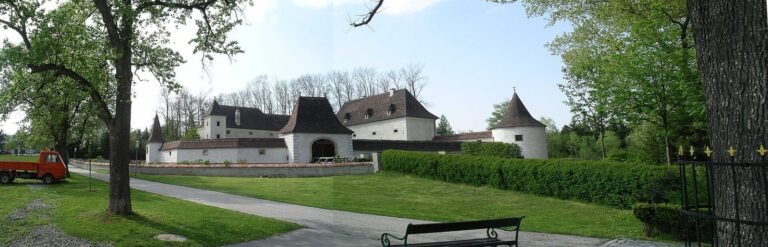
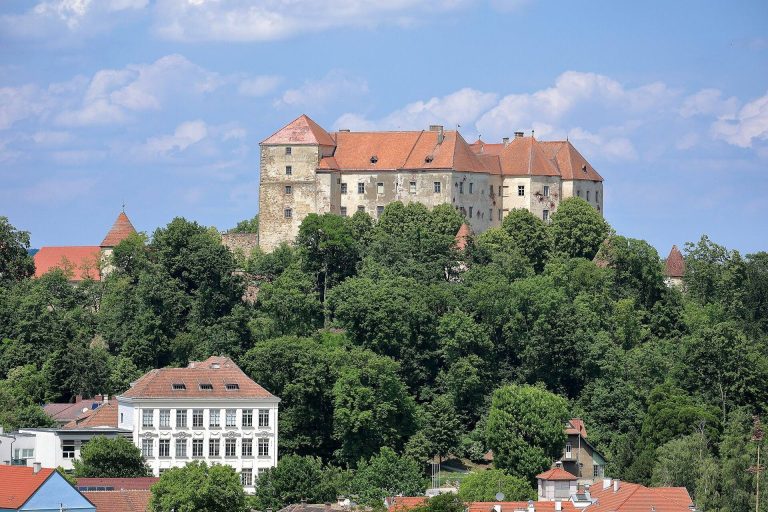
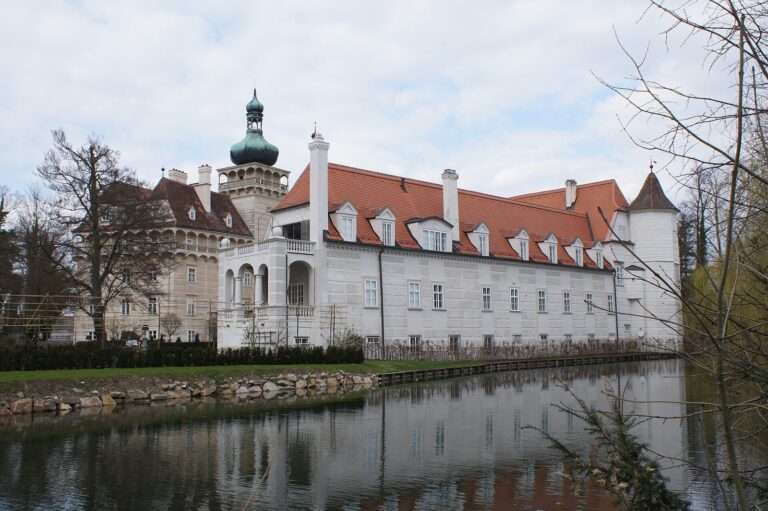
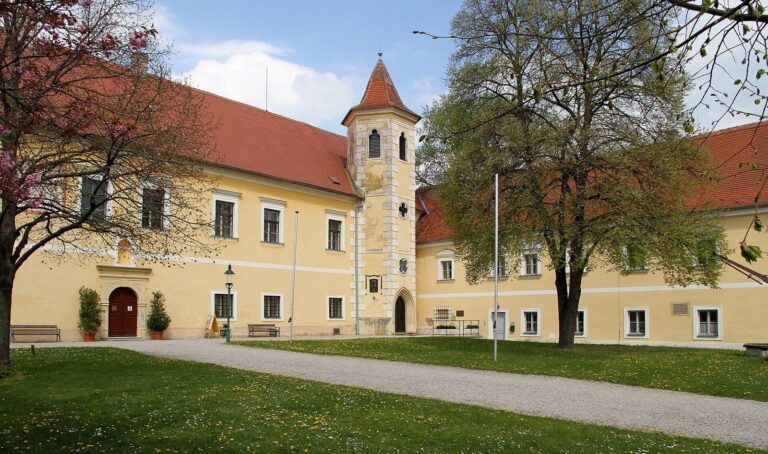
The castle’s principal building group consists of a south wing and three other wings. During rebuilding after the 1683 destruction, the south wing, previously three storeys high, was reconstructed with two. The other three wings, which had each been one storey high, were raised to two storeys. Following the 1945 fire, the exterior was fully restored and the interior fitted out in a modern style.