Bärenstein Palace: A Medieval Castle Transformed into a Residential Palace in Germany


Site at a Glance
- Rating
- 3
- Popularity
- Very Low
- Country
- Germany
- Primary era
- Medieval
- Eras represented
- Medieval, Early Modern, Modern
- Civilizations
- German, Holy Roman Empire, Margraviate of Meissen
- Site type
- Domestic
- Remains
- Castle
On this page9 sections
History
Medieval Castle and Border Seat
Bärenstein Palace in Germany developed from a medieval hilltop castle above the Müglitz Valley in Bärenstein, now part of Altenberg. The castle was first documented in 1324, while the knight Albrecht von Bernstein is mentioned as early as 1165, suggesting that the site’s origins reach further back. It served as the ancestral seat of the noble von Bärenstein family, whose members were also commonly called Bernstein. Between the thirteenth and fifteenth centuries, the family increased its importance through numerous possessions.
The castle occupied a strategically favorable position overlooking the Saxon-Bohemian border region. From this area, settlement in the upper Ore Mountains and the exploitation of local mineral resources developed during the fourteenth century. In 1348, Knight Walzko von Bernstein received the castle as a fief from Margrave Frederick the Elder of Meissen. A fief was property granted by a superior lord to a vassal in return for defined obligations. Frederick was a margrave of Meissen from the Wettin dynasty, and the title originally referred to a ruler responsible for a frontier territory.
Rebuilding and Changing Ownership
A major fire in 1576 largely destroyed the old castle. It was then rebuilt as a residential palace, shifting the complex toward domestic and representational use rather than an exclusively defensive purpose. The surviving building fabric reflects this long transition from medieval stronghold to aristocratic residence.
After Dam von Bernstein died in 1638, the family’s possessions were placed under sequestration, meaning that they were temporarily placed under official control during an unsettled inheritance. Siegfried von Lüttichau acquired the properties at auction in 1675. Ownership later changed again, including a transfer to the von Schönberg family in 1699.
Christian Gottlieb von Holtzendorff took control of the Bärenstein estate in 1711 and became an Imperial Count in 1745. This was an elevated aristocratic rank within the former Holy Roman Empire. In 1749, Countess Friederike Christiane von Holtzendorff married Count Friedrich August von Cosel, an illegitimate son of Augustus the Strong and Constantia von Cosel. Their two sons died unmarried, and in 1795 the palace passed by inheritance to a daughter married to a Count von Bünau.
The von Lüttichau Estate and the Twentieth Century
In 1816, Hanns Friedrich Curt von Lüttichau bought Bärenstein Palace from his mother-in-law, Countess von Bünau, and received it as a fief. The property therefore returned to the von Lüttichau family, which retained it until its expropriation in 1945.
The 1945 land reform, a state redistribution of landed property, expropriated Hannibal von Lüttichau-Bärenstein. Until 1991, the palace was used by the National Democratic Party of Germany, or NDPD, an East German political party operating within the ruling system of the German Democratic Republic, as a training and holiday home. The palace is now privately owned.
Alterations to the Estate
Alterations carried out around 1880 substantially reduced the complex’s formerly fortified appearance. A small palace park was later created beside the west wing, adding a landscaped element to the historic estate.
Remains
Castle Plan and Medieval Towers
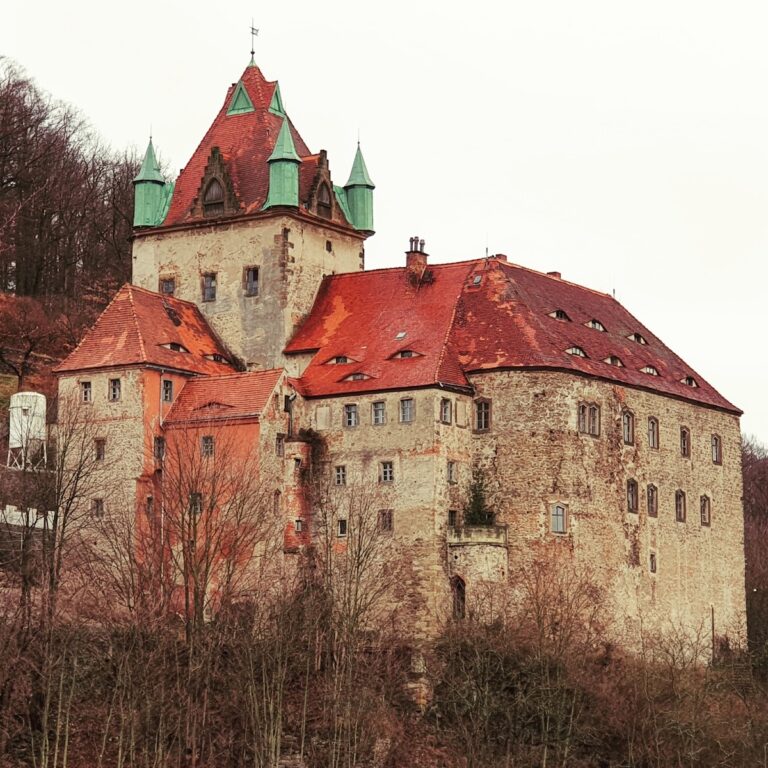
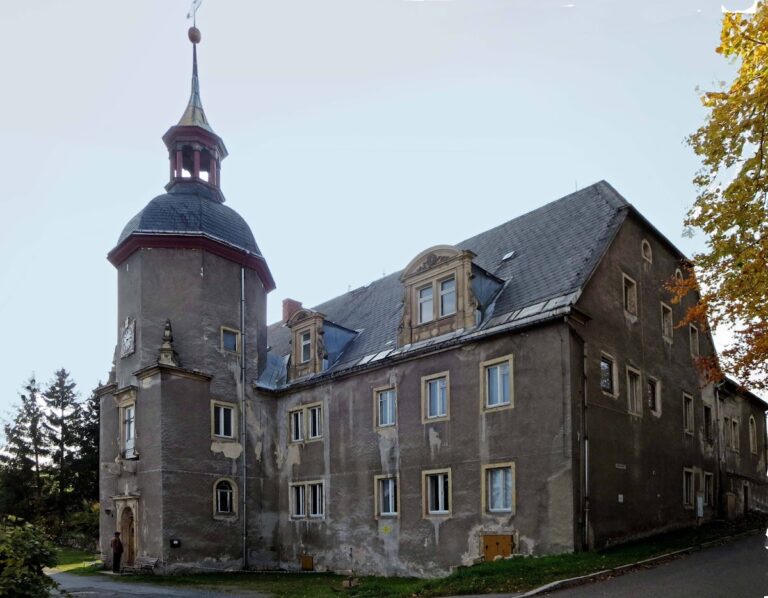
Bärenstein Palace stands beside the village center on a spur above the Müglitz Valley. Its irregular buildings form an angular, hooked plan that developed from the earlier hilltop castle. The south wing is the oldest section and contains a round tower from the fourteenth century. The tower was heightened in 1489 and has carried a shallow conical roof since the sixteenth century.
A second round tower links the two palace wings. The first upper story of a round tower contains a Gothic star vault, a ceiling formed by ribs spreading in a star pattern. Another star vault survives at the lower level of the castle tower and also belongs to the early phase of the complex. Together, these towers and vaulted spaces preserve parts of the medieval structure within the later palace.
Portals and Renaissance Additions
The east wing has two Renaissance portals with round arches. A heraldic inscription dates them to 1522. Beneath the coat of arms of the Bernstein family, a Gothic pointed-arch portal from the castle’s early period also survives. These entrances preserve evidence of successive building phases, from the medieval castle to the Renaissance residence.
Interior Features and Park
Little of the historic building fabric remains inside the palace, but several notable elements survive. A ballroom has large round-arched windows, while the first upper story of the round tower retains its Gothic star vault. Several wooden ceilings in the second upper story date from the seventeenth century and carry marbled painted decoration. Beside the west wing, the small palace park forms a later landscaped part of the complex.
Nearby sites