Schauenburg: A Ruined Hilltop Castle in Germany

Site at a Glance
- Rating
- 4.5
- Popularity
- Very Low
- Country
- Germany
- Primary era
- Medieval
- Eras represented
- Medieval
- Civilizations
- Unclassified
- Site type
- Military
- Remains
- Castle
On this page7 sections
History
Schauenburg is a ruined hilltop castle in Germany, probably built between AD 600 and 800 during the period when the Hessengau, an early medieval region in what is now northern Hesse, had become part of the Frankish kingdom. It probably served as a residence and refuge, and may also have formed part of a frontier defensive system against the Saxons alongside Numburg, Weidelsburg, Kugelsburg, and Desenberg.
Counts of Schauenburg
The castle and Count Adalbert of Schauenburg were first mentioned in 1089, in a deed of gift issued for Helmarshausen Abbey. The counts held the high court of Ditmelle, later known as Ditmold, and took their comital title from this possession. They were also probably protectors of Kirchditmold and of the monasteries at Weißenstein and Kaufungen.
The County of Schauenburg became involved in the competing interests of the Landgraviate of Thuringia, later the Landgraviate of Hesse, and the Archbishopric of Mainz. In 1223, the counts accepted Wallenstein Castle in the Knüll Mountains as a fief from Hersfeld Abbey. A fief was a holding granted by a superior authority in return for service or allegiance, and Hersfeld Abbey supported Mainz in the regional political struggle.
Transfer and later occupation
Count Berthold’s death in 1252 brought the Schauenburg comital line to an end. The county, castle, and associated court were probably sold to the Archbishopric of Mainz no later than the first half of the thirteenth century. In 1250, the Archbishop of Mainz pawned the castle to the knight Hermann Hund of Holzhausen. By the beginning of the fourteenth century, it was pledged to the lords of Dalwigk, who received it as an hereditary castle fief in 1332.
The Dalwigk family established a new estate at the foot of the hill. Known as “im Hobe” from 1366, it became the beginning of the present village of Hoof. The Schauenburg court included Hoof, Breitenbach, Elmshagen, and Großenhof, now called Martinhagen.
Abandonment and preservation
By 1543, Schauenburg had probably fallen into disrepair and was no longer habitable. It was abandoned as a residence, later used as a quarry, and gradually collapsed. Since 1989, the Habichtswald Nature Park and the municipality of Schauenburg have worked to secure and preserve the surviving masonry. The municipality acquired the Burgberg, including Schauenburg, from the von Kiekebusch family for this purpose. Between 2005 and 2007, the castle complex was surveyed, and its outer wall and visible building remains were cleared in cooperation with the Hessian State Office for Monument Preservation.
Remains
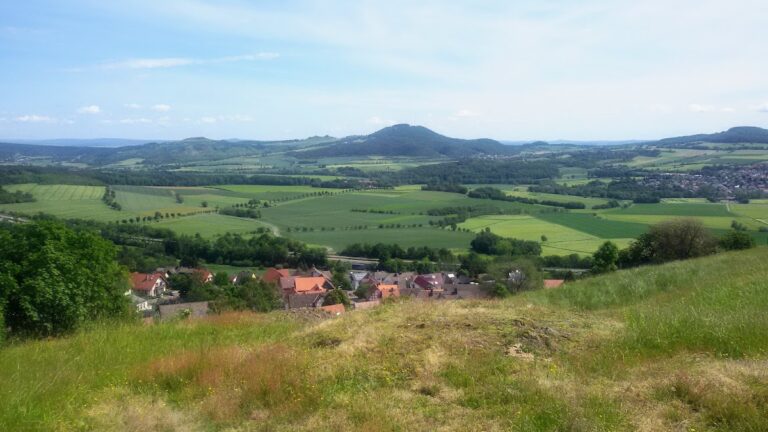
Schauenburg occupies the summit of the Schauenburger Burgberg, a 499.9-metre basalt cone in the Habichtswald Nature Park. The hill forms the northern extension of the Langenberge in the Hoofer Gate and rises southwest of an upper section of the Bauna River. The ruins stand between Hoof to the east and Breitenbach to the west, about 12 kilometres southwest of Kassel. Surviving masonry is concentrated on the southern side of the hill.
Hilltop layout
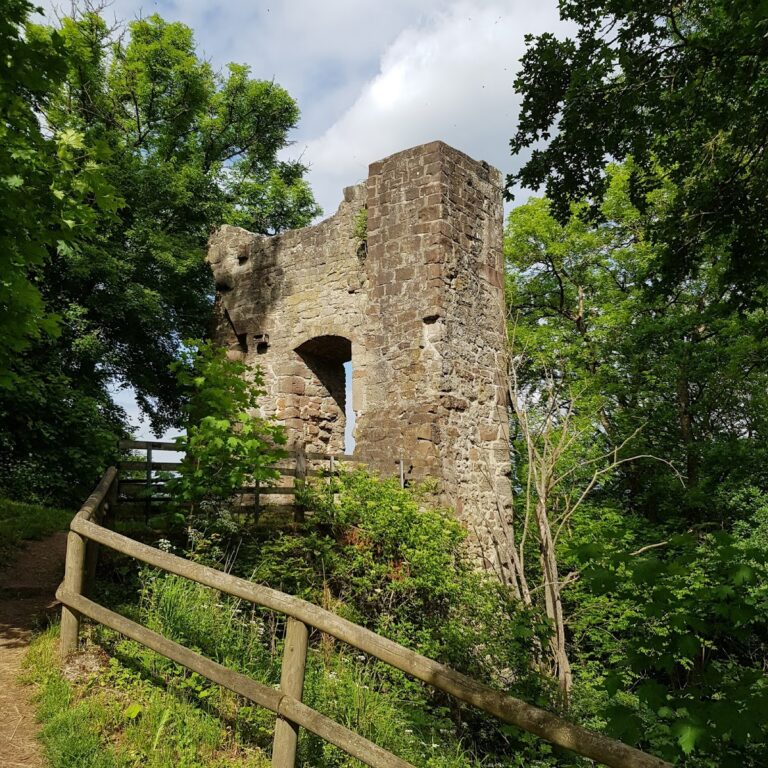
The site is a hilltop castle, meaning a fortified residence or stronghold built on elevated ground for defense and visibility. Its remains consist of fragments of buildings, sections of wall, and a vaulted cellar. Dense bushes and woodland cover parts of the site, while later clearance work exposed the outer wall and visible building remnants.
Walls and surviving structures
The outer wall survives in sections, together with fragmentary building walls and the vaulted cellar. These remains represent the physical core of the former castle complex and have been subject to continuing securing and preservation work. The castle has appeared under several historical forms of its name, including Scouwenburg, Scouwenborg, Scowenburch, Schowinburc, and Scoenburc.
Nearby sites