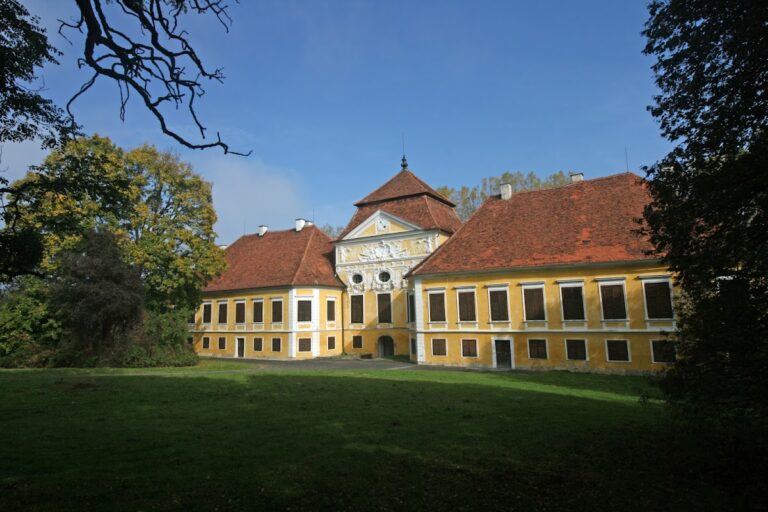
Feistritz Castle: A Moated Castle in Austria


Site at a Glance
- Rating
- 4.4
- Popularity
- Very Low
- Country
- Austria
- Primary era
- Early Modern
- Eras represented
- Medieval, Early Modern
- Civilizations
- Habsburg, Holy Roman Empire
- Site type
- Military
- Remains
- Castle
On this page8 sections
History
Feistritz Castle is a medieval moated castle in Austria, several kilometers north of Ilz in eastern Styria. Its associated church was already functioning as a parish church by 1170, placing the castle and its ecclesiastical complex within the region’s medieval landscape by that date.
Origins and medieval lordship
According to Fritz Posch, the castle developed from a manorial farm established after 1122 by Hartwig von Reidling, a member of the originally high-free noble family of Traisen-Feistritz. Hartwig was also associated with the foundation of neighboring Großhartmannsdorf. His brothers Walter and Adalram were linked respectively with Waltersdorf and Seckau Abbey, while Adalram donated nearby Hainersdorf to his collegiate foundation.
Feistritz appears in a surviving record from 1170, when the parish priest was ordered by the Archbishop of Salzburg, together with other priests, to deliver specified tithes to Vorau. The reference indicates that the castle and its associated church were already established by then. In 1270, Alram von Feistritz held land in the Traisen region, was married to a sister of the powerful marshal Hartnid von Wildon, and served the territorial ruler as a ministerial, a member of the medieval service nobility who held office and land in return for service. He was also one of the burgraves of Radkersburg.
After Alram’s son died, his son-in-law Alram von Reifenstein acquired the principal inheritance as freehold property. The Reifensteins also served as cellarers of the territorial rulers in Fürstenfeld. When the family died out between 1400 and 1407, Tybolt Kellermeister and his sons held the Feistritz lordship and church patronage, the legal right to influence a church’s clergy and administration.
Territorial administration and later owners
Feistritz passed to the territorial ruler in 1471, possibly in connection with the Baumkircher Feud, a late-fifteenth-century Styrian conflict associated with the nobleman Andreas Baumkircher and the territorial ruler. The lordship was then administered by appointed custodians, including Jörg Reichenburger in 1473, Martin Klöcher in 1474, Pangraz Gosseneder in 1483, and members of the Mindorfer family in 1493. In that year, the court steward Siegmund von Mindorf received the lordship as an enfeoffment, the formal granting of a fief by a superior.
In 1532, the Feistritz lordship was a medium-sized estate with 102 subjects and a tax base of 186 pounds of pfennigs. It covered all or most of Leithen, Tambach or Dambach, Buchberg, Obergrien or Obgrün, and Hainrichsdorf or Hainersdorf. It also included the detached areas of Aichperg or Eichberg and Hochenegg, together with individual farmsteads in several surrounding administrative districts.
During the Reformation, the sixteenth-century religious movement that challenged established Western Christian institutions, the castle church lost its status as a parish church. After the Mindorfer family died out in 1648, the lordship passed to their related barons and counts of Wildenstein. It was sold in 1809 to the counts of Lamberg, and Hugo Raimund, Imperial Count of Lamberg, was born at Feistritz.
Destruction, rebuilding, and preservation
In 1605, the Heiduks devastated and burned the castle. The complex was subsequently restored and enlarged. The Lambergs sold the moated castle to the Hamker family in 1959, and it remains privately inhabited. The Lamberg family archive has been held by the Styrian State Archive since 1948. In 1890, the Graz archival director J. von Zahn praised Feistritz as a “pearl” among the water castles, emphasizing that its fabric preserved visible stages of development from fourteenth-century additions to the grand building work of the seventeenth century.
Remains
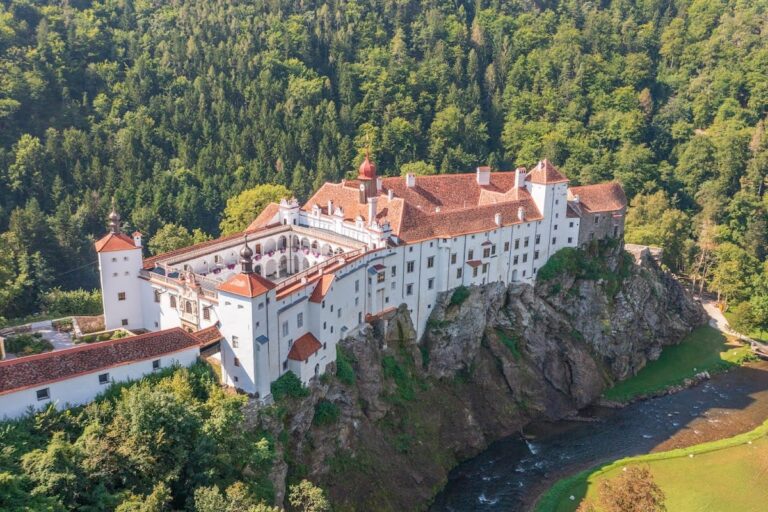
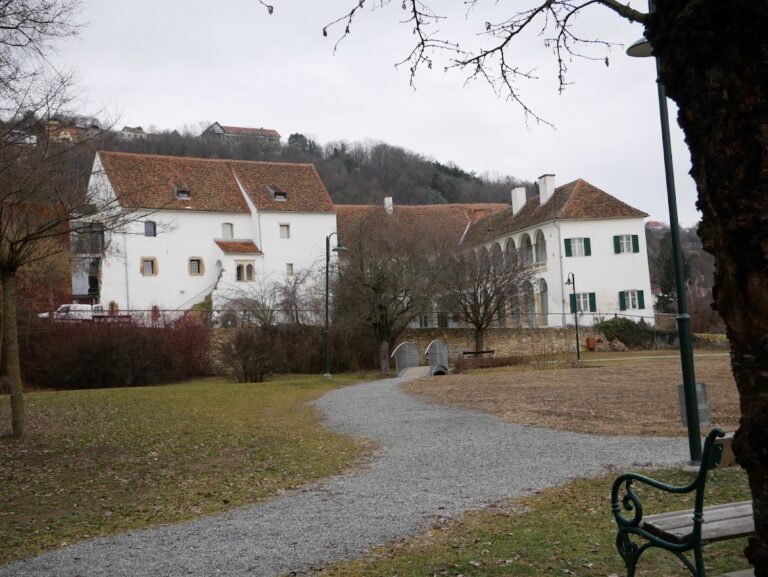
Feistritz Castle stands at an elevation of approximately 304 meters in eastern Styria. Its early form was probably a fortified court centered on a tower, enclosed by a ring wall and a water-filled defensive ditch supplied by the Feistritz River. Later construction expanded this compact medieval arrangement into the larger castle complex that survives in substantially transformed form.
Medieval fortified court
The twelfth- and thirteenth-century complex probably consisted of a simple tower court surrounded by a ring wall and moat. The water supplied by the Feistritz River formed part of its defensive setting. The Reifenstein family later added a building known as the “House” to the earlier complex, extending the residence beyond its original tower-centered arrangement.
Renaissance and post-fire complex
Around 1570, the Mindorfer family remodeled the castle approximately into the form in which it stands today. The Heiduk attack of 1605 then caused extensive damage by devastation and fire. Restoration and enlargement after the attack produced the later fabric associated with the castle’s seventeenth-century development.
Castle church
The church formed part of the castle’s associated complex. Its role as a parish church is known from the 1170 reference to the priest of Feistritz and the payment of tithes to Vorau. It later continued as a church within the castle complex after losing its parish status during the Reformation.
Nearby sites