Schloss Wilhelmshöhe: Former Summer Residence and Museum in Kassel


Site at a Glance
- Rating
- 4.7
- Popularity
- Medium
- Country
- Germany
- Primary era
- Early Modern
- External website
- Open
- Eras represented
- Early Modern, Modern
- Civilizations
- Holy Roman Empire
- Site type
- Domestic
- Remains
- Palace
On this page11 sections
History
Schloss Wilhelmshöhe is a former summer residence in Kassel, Germany, built for the rulers of Hesse-Kassel between 1786 and 1798 in the classical tradition. It served the Landgraves and Electors of Hesse-Kassel in this role from 1794 to 1866, before becoming a royal and imperial residence and later a museum complex.
From religious foundation to hunting lodge
A religious institution occupied the site from the twelfth century. It began as an Augustinian canons’ foundation and later became an Augustinian nunnery known as Weißenstein. During the Reformation, Landgrave Philip I of Hesse secularized the institution. The buildings were subsequently used from time to time as a hunting lodge.
Landgrave Moritz of Hesse-Kassel replaced the earlier complex with a new hunting lodge between 1606 and 1610. His successors enlarged the lodge substantially, and the original monastery buildings were lost during this development.
The eighteenth-century palace
The present palace was commissioned by Landgrave Wilhelm IX of Hesse-Kassel. Simon Louis du Ry designed the Weißenstein and Kirch wings, while Heinrich Christoph Jussow designed the central wing. Wanstead House and Prior Park in England served as architectural models. Wilhelm IX became Elector Wilhelm I in 1803, placing the palace within the changing political structure of Hesse-Kassel. A landgrave was a territorial prince, while an elector was entitled to participate in choosing the Holy Roman Emperor.
During the Napoleonic occupation from 1806 to 1813, the palace was temporarily called Napoléonshöhe. It sometimes housed Jérôme Bonaparte, Napoleon Bonaparte’s younger brother and the king installed by Napoleon as ruler of Westphalia, after Kassel City Palace burned in 1811. Jérôme’s nephew Charles-Louis-Napoléon Bonaparte, later Emperor Napoleon III, also visited during this period.
Imperial residence and political refuge
After Napoleon III was captured and deposed following the Battle of Sedan in the Franco-Prussian War, Wilhelm I assigned Wilhelmshöhe to him as a residence. Napoleon arrived on 5 September 1870, and his wife Eugénie visited him on 30 October. He left for exile in Britain on 19 March 1871.
Following the annexation of the Electorate of Hesse by Prussia in 1866, the palace passed into Hohenzollern ownership. The Hohenzollerns ruled Prussia and, from 1871, the German Empire. From 1891 to 1918, Schloss Wilhelmshöhe was regularly used as the German imperial family’s summer residence. Emperor Wilhelm II also treated it as a retreat during personal and political crises.
After the Armistice of Compiègne in 1918, the palace briefly housed Germany’s Great Headquarters, the country’s supreme wartime military command. It also hosted the press center during the East German-West German summit meeting on 21 May 1970. French President Valéry Giscard d’Estaing visited the palace during his 1980 visit to Germany.
War damage and later use
Allied air raids struck Wilhelmshöhe during the Kassel bombing night in 1943 and in further attacks in 1944 and 1945. Bombing in February 1945 severely damaged the palace, especially its domed central section. Furnished rooms on the park side survived as high as the second floor, but inadequate postwar protection was followed by the progressive removal of remaining historic interiors during rubble clearance. Some palace furnishings are now held in Villa Hammerschmidt in Bonn.
Between 1961 and 1974, the central section was given its present form under the direction of the modernist architect Paul Friedrich Posenenske. The rooms containing the Old Masters Picture Gallery and the Collection of Antiquities were renovated from 1994 to 2000. Since 23 June 2013, Schloss Wilhelmshöhe has formed part of Bergpark Wilhelmshöhe, a UNESCO World Heritage Site. The palace now functions primarily as a museum complex, while the Protestant congregation continues to hold services in the historic chapel.
Remains
Palace plan and setting
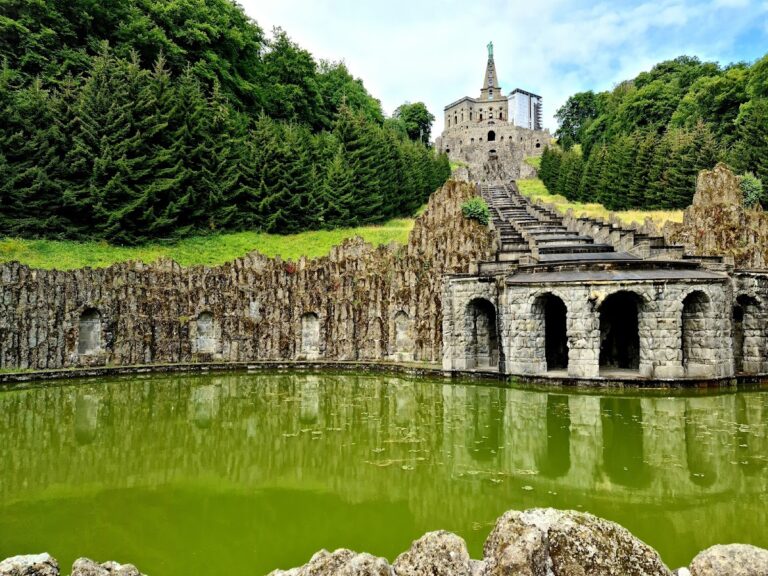
Schloss Wilhelmshöhe stands in the lower part of Bergpark Wilhelmshöhe, in Kassel’s Bad Wilhelmshöhe district, at approximately 280 metres above sea level. It lies above the western end of Wilhelmshöher Allee. The palace, the Hercules Monument, the central axis of the park, and the avenue form a continuous visual alignment toward central Kassel.
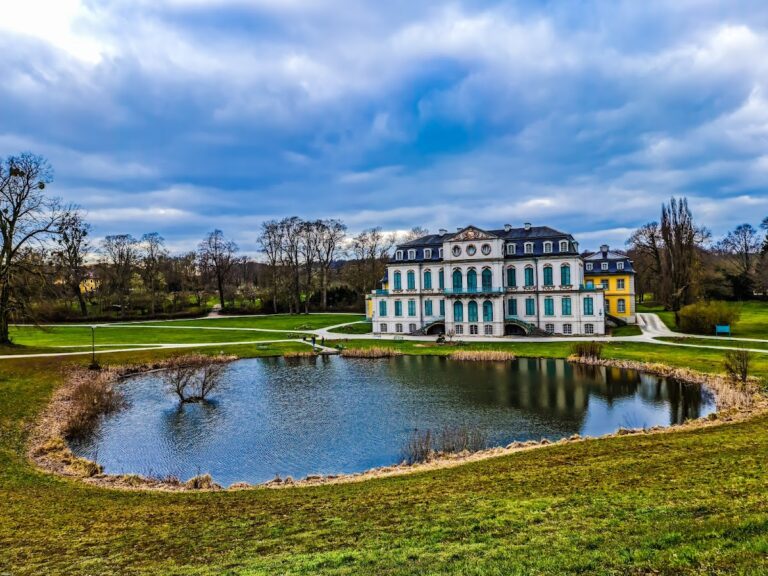
The palace is a symmetrical three-wing complex opened toward the park. Its central Corps de Logis, the principal residential block of a palace, faces west, while two slightly oblique side wings extend on either side. Each wing is joined to the central section by a connector with a semicircular ground plan. The southern wing is the Weißenstein Wing, named after the former monastery, and the northern wing is the Kirch Wing.
Side wings and connecting structures
The long, narrow side wings have semicircular expansions at their inner ends. Their long façades are emphasized by projecting sections, each carrying eight free-standing columns across both upper storeys. These sections end in low attic structures, architectural forms placed above the main façade, crowned with vases.
The three buildings were originally freestanding. Single-storey connections were added from 1806 onward, and under Elector Wilhelm II the court architect Johann Conrad Bromeis raised them to their present height. These alterations, together with the loss of the original white finish, reduced the delicacy of the classical design.
Central section and museum collections
The central section was heavily damaged during the Second World War and restored without its dome, window muntins, or shutters. Its original interior arrangement was not reconstructed. Instead, a glass roof was installed to illuminate the paintings, and the roof remains visible from the Hercules Monument.
The reshaped central section contains the Collection of Antiquities, the Old Masters Picture Gallery, the Graphic Collection, and temporary exhibitions. The picture gallery places particular emphasis on Flemish and Dutch Baroque painting, with works by Rembrandt, Frans Hals, and Peter Paul Rubens, alongside Old German, Italian, and Spanish paintings.
Kirch Wing and palace chapel
The northern Kirch Wing was largely gutted and rebuilt for administrative use by the State Museums of Kassel. The palace chapel remains part of the complex. Louise von Bose, a daughter of Elector Wilhelm, was confirmed there in 1828.
Weißenstein Wing interiors
The Weißenstein Wing retains the palace’s only historically authentic interiors. Arranged according to historical models over two storeys, its rooms contain numerous furnishings from the late eighteenth and early nineteenth centuries, including surviving pieces from the building period in the Louis XVI and early Neoclassical styles.
The rooms include three writing desks by David Roentgen, Empire furniture by Bernard Molitor associated with Jérôme Bonaparte’s period, bronzes by Pierre-Philippe Thomire, and porcelain from Sèvres. They also contain numerous paintings by Johann Heinrich Tischbein the Elder and seven hunting paintings by Jean-Baptiste Oudry. From 1948 to 1976, the palace housed the German Wallpaper and Upholstery Museum.