Bergpark Wilhelmshöhe: A Historic Landscape Park and Water Garden in Kassel, Germany


Site at a Glance
- Rating
- 4.7
- Popularity
- Very High
- Country
- Germany
- Primary era
- Early Modern
- External website
- Open
- Eras represented
- Early Modern, Modern
- Civilizations
- Holy Roman Empire
- Site type
- Domestic
- Remains
- Park
On this page27 sections
History
Bergpark Wilhelmshöhe is a historic landscape park in Kassel, Germany, developed by the landgraves and electors of Hesse-Kassel from the late seventeenth century through the nineteenth century. Its first major phase followed Baroque garden principles of formal geometry, axial planning, and controlled water displays, while later work introduced the irregular paths and varied views associated with the English landscape garden. The park takes its name from Landgrave Wilhelm IX, who later became Elector Wilhelm I of Hesse-Kassel.
Before the landscape park
Before the park was laid out, the site was a wooded slope of the Habichtswald more than five kilometres beyond Kassel’s seventeenth-century city boundary. In 1143, Augustinian Canons from Mainz founded Weißenstein monastery there. The institution became a women’s convent in 1193 and was dissolved during the Protestant Reformation. Landgrave Philip I subsequently used the surviving buildings as a hunting residence.
Landgrave Maurice of Hesse-Kassel built a hunting palace at Weißenstein between 1606 and 1610. It was later demolished and replaced by Schloss Wilhelmshöhe, which became the principal palace of the developing park.
The Baroque conception
Landgrave Charles began transforming the wooded slope into a Baroque garden in the late seventeenth century. His first major undertaking was the Kleiner Herkules, also known as the Alter Winterkasten, on the 555-metre Hüttenberg. The proposed site was later rejected as the principal viewpoint, and construction was abandoned. Foundations and sections of its walls survive.
In 1696, Charles engaged the French inventor Denis Papin to build a steam pump for a fountain. The machine never operated reliably, and the landgrave stopped financing the project. A separate attempt to collaborate with Gottfried Wilhelm Leibniz also failed. From 1701, however, Charles and the Italian architect Giovanni Francesco Guerniero developed the principal Baroque complex, comprising the Oktogon, the Hercules monument, the cascades, and the main water axis.
The water displays were first presented publicly on 3 June 1714, and the Hercules statue was installed in 1717. The scheme drew on Italian Baroque hillside gardens and French formal-garden principles. Its long central axis joined monumental architecture with descending water, creating the organizing idea that still governs the upper park.
From formal garden to landscape park
From 1785, Landgrave Wilhelm IX initiated a major reconstruction and enlargement between the cascades and the palace. The design shifted toward the English landscape-garden ideal, which used winding paths, changing views, lawns, woods, and carefully arranged impressions of naturalness rather than strict geometric regularity.
From 1786, the earlier Weißenstein palace was demolished and replaced by Schloss Wilhelmshöhe. Simon Louis du Ry designed the new palace in the Neoclassical style. Heinrich Christoph Jussow, the landgrave’s garden architect, created or developed many of the park’s defining features, including Löwenburg, the Lac, the Fontänenteich, the Teufelsbrücke and Höllenteich, and the aqueduct. Garden director Daniel August Schwarzkopf helped establish the English landscape-park character. Karl Steinhöfer later designed the Steinhöfer Waterfall and the New Waterfall.
Dynastic rule and political change
During the Napoleonic period, French troops displaced Elector Wilhelm I in 1806. Jérôme Bonaparte, Napoleon’s younger brother and king of the newly created Kingdom of Westphalia, governed from Schloss Wilhelmshöhe, which was renamed Napoleonshöhe. The palace was enlarged during his rule, and a court theatre was built beside it.
After Napoleon’s defeat, Elector Wilhelm I returned to Kassel and the park in 1813. In 1826, his successor, Elector Wilhelm II, commissioned the New Waterfall, the last major water feature added to the complex. The park’s development therefore continued beyond the original Baroque project, with later rulers adapting its buildings, scenery, and water engineering to changing tastes.
Hesse-Kassel sided with Austria in the Austro-Prussian War, the 1866 conflict that led to Prussian control over several German states. Prussia annexed the territory after the war, and Kassel ceased to be a princely residence. This ended the ruling dynasty’s centuries-long role as patron of the park and brought its major expansion to an end.
From imperial residence to heritage site
Schloss Wilhelmshöhe served briefly as a state prison in 1870 for the defeated French Emperor Napoleon III after the Battle of Sedan. From 1899, German Emperor Wilhelm II used the palace as an annual summer residence, making the palace and park a setting for European political life.
Following the November 1918 armistice, the palace housed the German Supreme Army Command until February 1919. From a nearby building, Paul von Hindenburg organized and directed the withdrawal and demobilization of the German army. In 1972, West German Chancellor Willy Brandt and East German Prime Minister Willi Stoph met at Schloss Wilhelmshöhe for negotiations between the two German states.
No major extensions were made to the park during the twentieth century. Conservation generally aimed to preserve its eighteenth- and nineteenth-century fabric, although roads and parking areas altered parts of the historic landscape. Allied bombing during the Second World War damaged Schloss Wilhelmshöhe and the New Waterfall. The palace was reconstructed between 1968 and 1974 as a museum, while the New Waterfall was not restored to the operating sequence of the water displays.
The Museumslandschaft Hessen Kassel took responsibility for the park in 2006 and was renamed Hessen Kassel Heritage in 2023. The park joined the European Garden Heritage Network in 2009. Hesse submitted its World Heritage application in January 2012, and on 23 June 2013 the UNESCO World Heritage Committee inscribed Bergpark Wilhelmshöhe during its 37th session in Phnom Penh under cultural criteria (iii) and (iv). The designation recognizes the park as an internationally important expression of European absolutism and as an exceptional combination of Baroque landscape architecture and monumental water engineering. The State of Hesse remains its owner, while the palace and associated buildings serve museum, administrative, exhibition, and event functions.
Remains
Landscape setting and principal axis
Bergpark Wilhelmshöhe covers approximately 2.4 square kilometres on the slope of the Habichtswald. It rises from the lower palace area, about 282 metres above sea level, toward the Karlsberg plateau at 526.2 metres. The Hercules monument stands at about 515 metres, approximately 238 metres above Schloss Wilhelmshöhe and about 292 metres above the lower end of Wilhelmshöher Allee.
The main visual axis runs from the Hercules monument in the west through the cascades to Schloss Wilhelmshöhe in the east. Open lawns, wooded sections, winding paths, viewpoints, ponds, and landscape-garden plantings occupy the lower park and visually merge with the surrounding Habichtswald. The wider Baroque conception also includes Wilhelmshöher Allee, a straight east-west avenue about 4.5 kilometres long that connects Kassel with Schloss Wilhelmshöhe and the Hercules. Rasenallee extends northward from the park toward Schloss Wilhelmsthal.
The upper monument and water system
The upper park combines monumental architecture with a gravity-fed water system. Rainwater and surface runoff are collected through channels and reservoirs in the Habichtswald. The Sichelbach reservoir, about one kilometre west of the Hercules near the Sichelbach farm, covers 6,300 square metres, reaches seven metres in depth, and holds approximately 40,000 cubic metres.
The Hercules monument
The Hercules monument occupies the highest and westernmost point of the principal axis. Built between 1701 and 1717 to designs by Giovanni Francesco Guerniero, it consists of a monumental Oktogon and a pyramid topped by a copper statue of Hercules, the Roman name for the ancient Greek hero Heracles. The figure follows the Farnese Hercules type, which shows the hero resting after his labours. The monument is Kassel’s landmark and the starting point of the water displays.
Basins and sculptural figures lie beneath the monument, including centaurs and fauns holding horns. When the display operates, changes in water pressure produce sounds through the horns.
The Baroque cascades
The older Baroque water axis descends from below the Oktogon through the Vexierwassergrotte, the Artischockenbassin, the Krumme Kaskaden, the Riesenkopfplateau, the Halbrunde Kaskaden, the Great Cascades, the Neptunbassin, and the Neptungrotte. This section extends approximately 320 metres from the Vexierwassergrotte to the Neptunbassin, while the principal cascade is about 250 metres long.
The Vexierwassergrotte contains a hydraulically operated cylinder organ, known as a water organ. Across the wider system, fountains, grottoes, channels, water wheels, aqueducts, basins, ponds, waterfalls, and two hydraulic organs form connected stages of the display.
The gravity-fed display
The displays operate by gravity without pumps. Valves and sluices are opened and closed by hand. Water takes about ten minutes to pass each individual station, and the complete sequence lasts approximately one hour and fifteen minutes. Up to 2,100 cubic metres can be used in a display. The water eventually flows into the Lac, then through its outlet into the Drusel and onward to the Fulda rather than being pumped back to the upper reservoirs. Water shortages can prevent some displays from operating late in particularly warm summers.
The Great Fountain
The Great Fountain forms the climax of the water displays. At one stage, about 430 cubic metres of water can descend across a width of 50 metres and a depth of 20 metres. The fountain can propel approximately 200 cubic metres of water to a height of about 50 metres in ten minutes. It developed from an earlier eighteenth-century fountain that was later rebuilt and moved. Its present geyser-like form and height were achieved in the second half of the eighteenth century.
Landscape-garden water features
The Steinhöfer Waterfall
Karl Steinhöfer created the Steinhöfer Waterfall in 1793. Originally called the Waldwasserfall, it is arranged as an abandoned eighteenth-century quarry reclaimed by vegetation. Basalt columns, standing inferior stone, extracted blocks awaiting removal, and spoil heaps form part of its constructed setting.
The Teufelsbrücke
The Teufelsbrücke, together with its waterfall and Höllenteich, reproduces the imagery of the historic Devil’s Bridge in the Swiss Alps over the Reuss. Its water display evokes Alpine snowmelt, with approximately 400 cubic metres descending about 10 metres in ten minutes.
The aqueduct
Heinrich Christoph Jussow built the aqueduct between 1788 and 1792. It is an architectural quotation of a ruined Roman water conduit, carrying the imagery of ancient engineering into the English landscape setting. Water falls from the structure into a valley approximately 34 metres below. During the display, about 400 cubic metres descend roughly 30 metres in ten minutes. Its deliberately ruined appearance places natural scenery and engineered construction in deliberate contrast.
Palace, lake, and romantic architecture
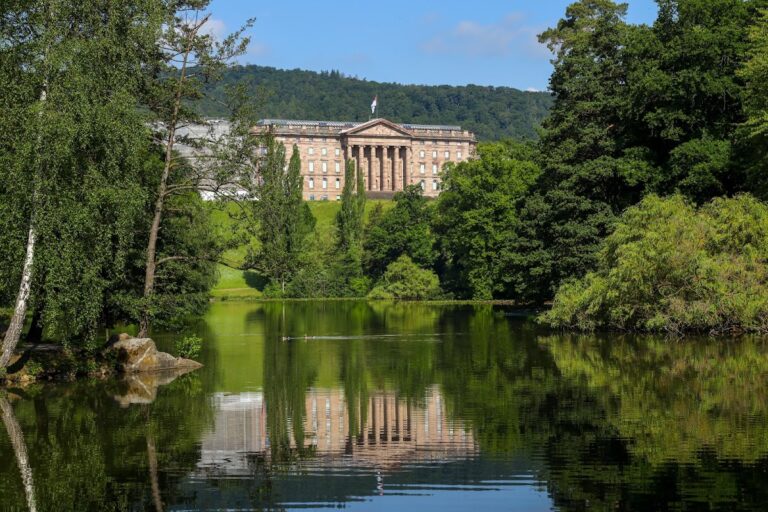
Schloss Wilhelmshöhe
Schloss Wilhelmshöhe stands at the eastern and lowest end of the Hercules-palace axis. Developed between 1786 and 1798 as a Neoclassical replacement for the Weißenstein hunting palace, it originally consisted of three wings that were later connected by intermediate buildings. The palace houses the Gallery of Old Masters, the Antikensammlung, a collection of prints and drawings, and other museum holdings, including Greek and Roman antiquities, seventeenth-century European paintings, and a major collection of works by Rembrandt.
The Lac and Roseninsel
Jussow developed the Lac, also called the Schlossteich, below the palace between 1785 and 1791. The Roseninsel, completed in 1795 within the lake, contains a rose collection. The rose variety Perle vom Weissenstein was bred there in 1795 and is regarded as Germany’s first rose breeding.
Löwenburg
Löwenburg stands south of the main axis at approximately 350 metres above sea level. Heinrich Christoph Jussow designed and built it between 1793 and 1800 as an imitation of a medieval English castle. It was deliberately made as a romantic, historically evocative partial ruin. Its interiors continue the medieval theme with armour, shields, bronze and glass objects, and coloured stained glass.
One tower was destroyed by bombing during the Second World War and rebuilt during restoration between 2005 and 2022. Another tower was intentionally designed and built as a ruin.
Park buildings and service areas
The Ballhaus
The Ballhaus stands directly north of Schloss Wilhelmshöhe. Leo von Klenze designed it as a court theatre in 1809 and 1810 under Jérôme Bonaparte. Johann Conrad Bromeis converted it into a ballroom between 1828 and 1830 for Elector Wilhelm II. The free-standing Neoclassical building now serves as an exhibition and event venue.
The Great Greenhouse
The Great Greenhouse lies slightly west-northwest of the Ballhaus. J. C. Bromeis designed it for Elector Wilhelm II, and it was built in 1822 as an early steel-and-glass construction. Its originally round central section was replaced by a cubic palm house in 1887.
The Kaskadenaufseherhaus
The Kaskadenaufseherhaus stands immediately below the Hercules at the Neptunbassin. Built between 1803 and 1809 to designs by Jussow, it is a single-storey exposed-stone building with restrained references to Revolutionary architecture. It first housed park supervisors and later became a refreshment establishment.
The former economic quarter
The former economic quarter north of Schloss Wilhelmshöhe, beyond the Tulpenallee and Wilhelmshöher Allee, contained court-supply facilities, service buildings, stables, and gardeners’ grounds. The former Marstall now contains the park’s operating depot, while its western wing includes the Gärtnerhaus, used by the garden administration. Several simpler greenhouses west of the former stables survive mainly from the twentieth century and are used by the Wilhelmshöhe horticultural nursery.
Decorative structures and planting
Numerous small Staffage structures, meaning landscape features used to animate views or create historical associations, stand at viewpoints, near the edge of the designed landscape, or slightly away from the main axis. Many were built between 1760 and 1785 under Landgrave Friedrich II and incorporated into the later English landscape-garden redesign.
On the southeastern edge of the park, on the slope above the Lac, are the surviving architectural remains of the Chinese-style village of Mou-lang. Construction began in 1781 under Landgrave Friedrich II, and Landgrave Wilhelm IX later renewed and developed the ensemble. It served both as a European Chinoiserie, an artistic style that adapted imagined Chinese motifs, and for agricultural purposes.
The surviving architecture combines Baroque, Neoclassical, Romantic, medieval-revival, Chinese-inspired, and deliberately ruinous forms. Trees and shrubs dominate the planting. By 1777, the park contained 329 tree species, including 128 from North America, and a plant register listed 431 species in 1785. Later introductions increasingly came from the Pacific coast of North America and, from the mid-nineteenth century, Asia.
The dendrological collection includes trees and shrubs from Europe, North America, and Asia. Approximately 700 woody plants are numbered in a dendrological guide, and about 50 specimens were replanted during its revision. A European larch was designated a National Heritage Tree in October 2021. Its trunk circumference at a height of 1.5 metres was 4.77 metres in October 2021, and its age was estimated at 220 to 250 years.
Nearby sites