Sasso da Pigna: A Swiss Artillery Fortification on the Gotthard Pass


Site at a Glance
- Rating
- 4.6
- Popularity
- Medium
- Country
- Switzerland
- Primary era
- Modern
- External website
- Open
- Eras represented
- Modern
- Civilizations
- Swiss
- Site type
- Military
- Remains
- Fort
On this page8 sections
History
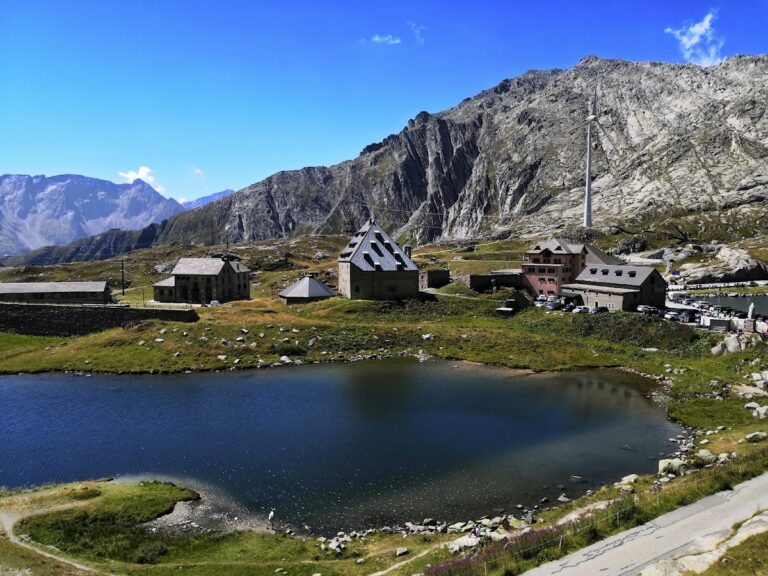
Sasso da Pigna is a Swiss artillery fortification on the Gotthard Pass in Airolo, Switzerland. Built during the Second World War and completed in 1945, it was a modern artillery work within the Swiss National Redoubt, a defensive strategy that concentrated major military positions in the Alpine interior to preserve a defensible core of Switzerland during a foreign invasion.
Strategic origins
The opening in 1929 of the Italian road from the Toce Falls to San Giacomo Pass led to a new phase of fortification construction in Ticino. An attacker advancing from San Giacomo could descend into the Bedretto Valley and strike the Airolo defenses from the flank. The south portal of the Gotthard railway tunnel and the Gotthard Pass were about 14 kilometres away, within the effective range of heavy artillery.
In 1931, the chief engineer of the Gotthard garrison presented a plan to fortify San Giacomo. From 1935, an infantry fortification was built on the Swiss side of the pass. During the Second World War, it expanded into a barrier position with 30 separate installations and a military cableway. Earlier artillery works at Fort Hospiz, Forte Airolo, and Motto Bartola no longer met modern standards because they had not been built into the rock. Sasso da Pigna therefore became the second modern artillery work after the San Carlo prototype and was intended to support the infantry defenses of the National Redoubt.
Construction and armament
Planning lasted one year, and the construction contract was signed on 28 August 1941. Work began soon afterward. The original design called for two 10.5-centimetre bunker guns, later supplemented by two 7.5-centimetre guns to block the Gotthard Pass road. In November 1941, the plan changed to four 15-centimetre bunker guns, but delivery difficulties led to the initial installation of four 10.5-centimetre guns.
The first two 10.5-centimetre guns were ready to fire in July 1943, and the other two followed in October. In 1942, the design had been substantially revised. Accommodation facilities were moved to the northern side behind the pass lake, while the complex was divided into a logistics and accommodation section and an upper combat section. A tunnel about one kilometre long and more than 400 steps connected the two parts. A small funicular, a rail-based transport system running on a slope, carried materials between them.
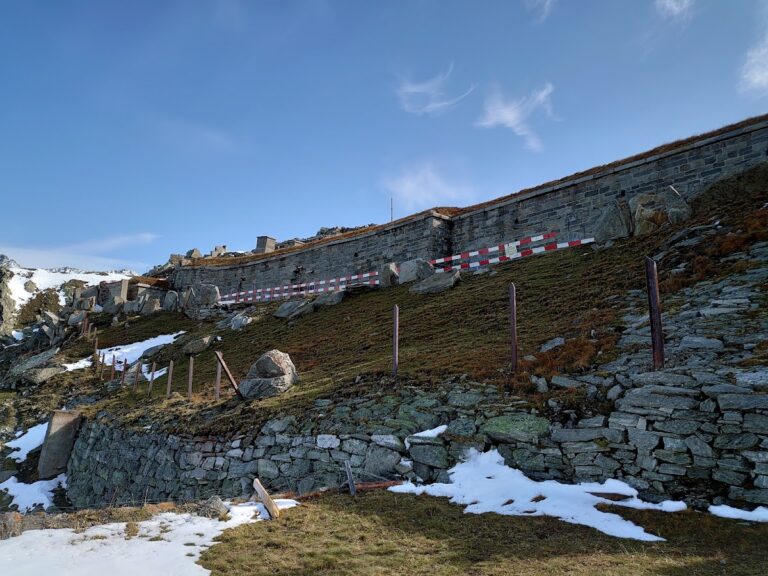
In 1944, the four 10.5-centimetre guns were replaced by the planned 15-centimetre weapons. All four were ready for firing by September of that year. Their practical range was 23.5 kilometres, covering the western sector as far as a line from Ulrichen to Formazza in Italy and the eastern sector from Scopi in the Lukmanier region to Pizzo Campo Tencia. The external-defense infantry installation A 8386, Forte J, was built south of Sasso da Pigna to protect the gun openings, and most of the anti-aircraft defenses were placed there.
Decommissioning and museum use
Construction was completed in 1945 at a cost of approximately 10 million Swiss francs. The installation contained 2.4 kilometres of tunnels and more than 8,000 square metres of usable floor area, making it one of the largest fortifications of its type in the Gotthard region. Sasso da Pigna ceased to serve as a combat installation in 1998.
The former secret fortification opened as the Museum Sasso San Gottardo on 25 August 2012. The museum name comes from the rocky terrace called Sasso di San Gottardo. Its displays interpret the underground fortification alongside the Gotthard myth, the journeys of Johann Wolfgang von Goethe, the Tell tradition, the National Redoubt, quartz crystals, and the installation’s energy system. A permanent exhibition on Goethe’s journeys across the Gotthard was added in summer 2022.
Remains
Underground layout
Sasso da Pigna lies deep inside the mountain and is arranged in two physically distinct sections. Section A, behind the main entrance, contains the gas-lock door, filter room, command area, food stores, machine room, medical facilities, accommodation, dining facilities, water reservoir, fire-control station, troop washroom, and an engine room for generating power. Section B forms the upper combat area and contains the East 1, East 2, West 1, and West 2 gun positions, ammunition magazines, machine-gun positions, accommodation, a water source, and an eastern secondary entrance.
The two main levels are separated by more than 400 steps. Troops originally used a staircase of 475 steps, while a small underground funicular carried materials. In 2012, an inclined lift called Metro del Sasso was installed for the museum route. It follows the former track of the ammunition-transport platform and crosses an elevation difference of 80 metres. Section B’s East 1 and East 2 positions are reached by a second inclined lift and are not open to the public.
Gun positions and defenses
The combat section contains four 15-centimetre guns. One position retains its gun, while another 15-centimetre weapon is displayed in firing position. An interior view of an ammunition magazine illustrates how the artillery section was supplied. The fortification also included 12 permanently bunkered machine guns, six mobile machine guns, and two bunkered 8.1-centimetre fortress mortars of the 1956/60 type, designated installation A 8389.
Machine-gun bunkers formed part of the external defense. Their weapons were positioned to flank the openings through which the 15-centimetre guns fired. This arrangement joined the concealed artillery positions inside the mountain with the infantry defenses protecting the gun openings from the south.
Exhibition caverns
The exhibition sector includes the Caverna Grande, the Myth of the Gotthard exhibition, the Goethe at the Gotthard exhibition, the Wunderkammer, or cabinet of curiosities, and the former energy cavern. The energy cavern remains in its original condition and shows how diesel generators supplied electricity for the installation’s internal needs.
The Myth of the Gotthard exhibition follows the development of the Gotthard myth from traditions about the name through Goethe’s interpretation and the Tell tradition, the legends surrounding William Tell as a hero of resistance to foreign rule and Swiss formation. It also connects these ideas with the National Redoubt, whose central element was the Gotthard fortification. A large visual and mechanical installation by the Zurich painter Tullio Zanovello combines painted images, a statue of Helvetia, music, and choral text. During a performance of about 30 minutes, moving paintings present Gotthard legends and myths.
The Wunderkammer displayed approximately 1.5 tonnes of mountain crystals, with some specimens reaching one metre in height. Franz von Arx and Elio Müller found the crystals in 2008. The exhibition also presents contemporary Swiss jewellery made from quartz crystals originating in the mountain cantons.
Nearby sites