Burg Pontaningen: A Medieval Hilltop Castle in Switzerland


Site at a Glance
- Rating
- 3.8
- Popularity
- Very Low
- Country
- Switzerland
- Primary era
- Medieval
- External website
- Open
- Eras represented
- Medieval
- Civilizations
- Holy Roman Empire
- Site type
- Military
- Remains
- Castle
On this page6 sections
History
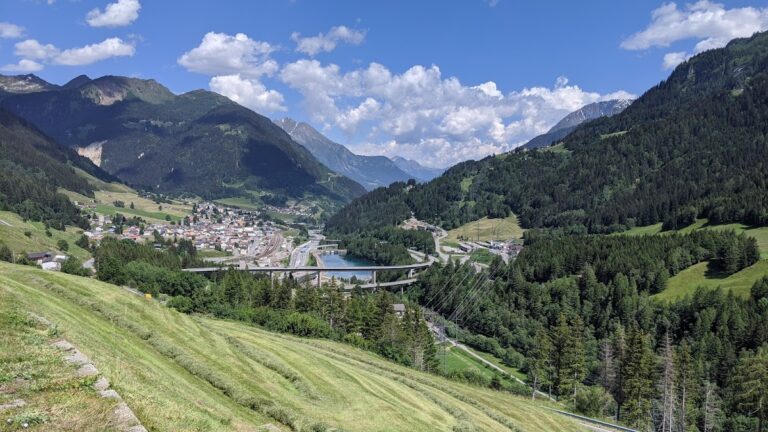
Burg Pontaningen is a hilltop castle in Switzerland, in the territory of Tujetsch in the Vorderrhein valley. It is generally assigned to the thirteenth century, although its building style points to a date around 1200. The castle was associated with the Pontaningen family, medieval service nobles who held land or office in return for administrative, military, or other duties performed for a higher-ranking lord or institution.
The Pontaningen family and Disentis Abbey
The family first appears in the surviving record in 1252 through the knight Wilhelm of Pontaningen, whose recorded activity continued until 1278. Members of the family regularly served Disentis Abbey, a medieval monastic institution that exercised territorial authority in parts of Graubünden. They acted as witnesses, guarantors, mediators, and envoys in the abbey’s affairs.
In 1278, Wilhelm and his son Hugo joined Walter of Vaz among the abbey’s opponents, encroaching on possessions belonging to Disentis Abbey. The castle itself appears in a document from 1300, when Abbot Nicholas of Disentis transferred serfs to Wettingen Abbey in front of Burg Pontaningen.
Administrative roles and later history
The family continued to hold offices connected with the abbey and its territories. Hugo of Pontaningen served as reeve in the monastic territory of the Urseren Valley in 1339, and Ulrich held the same office there in 1363 across the Oberalp Pass. Heinrich of Pontaningen was the abbey’s bailiff in 1391, while Wilhelm became a reeve of Disentis at the beginning of the fifteenth century. A reeve was a local official who exercised authority on behalf of a lord or institution.
The most prominent family member was Peter of Pontaningen, who served as abbot of Disentis from 1402 to 1438. He participated in forming the Upper League, a political alliance of communities and powers in the medieval Alpine region of Graubünden. The Grey League emerged from political developments associated with that alliance in 1424. The Pontaningen family remained traceable until the middle of the sixteenth century.
Securing work at the ruins took place in 2007, 2012, 2014, and 2015, helping preserve the surviving masonry and clarify the condition of the remains.
Remains
The ruins stand at about 1,403 metres above sea level southwest of Rueras near Sedrun, below the cantonal road. The castle occupies a rocky ridge that drops steeply to the east. Its surviving layout is centered on a masonry tower, with defensive features extending around the ridge and approach.
The tower
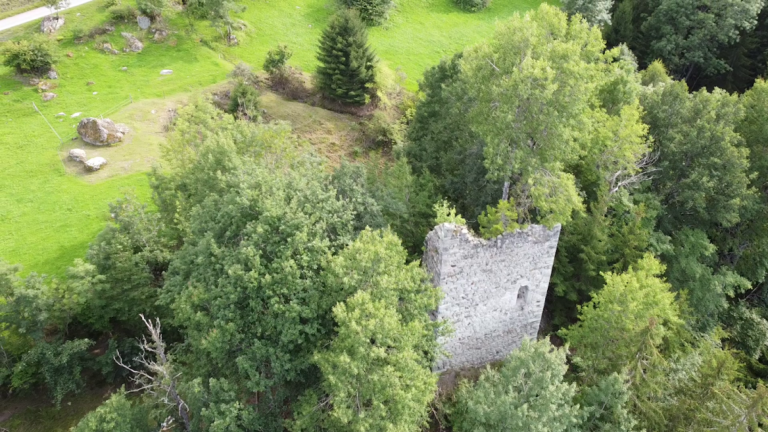
The principal surviving structure is a rubble-masonry tower, probably the castle’s keep. It forms an irregular quadrilateral with sides measuring approximately 6 metres. The east and south walls have collapsed heavily, while the north wall remains about 7 metres high. Beam holes in the outer face of this wall show that a low building was once attached to the tower. The northwestern corner has been substantially reduced, probably after large corner stones were removed and reused in later construction.
Approach and outer defenses
A ditch cut into the rock separates the tower from the approach side. It is approximately 2.5 metres wide and about 3 metres deep. Scarcely visible remains represent a western outer bailey, a subsidiary fortified area beyond the principal stronghold, while an enceinte, or surrounding defensive enclosure, occupied the eastern side.
Nearby sites