Forte Ospizio San Gottardo: A Swiss National-Defense Fortification


Site at a Glance
- Rating
- 4.8
- Popularity
- Very Low
- Country
- Switzerland
- Primary era
- Modern
- External website
- Open
- Eras represented
- Modern
- Civilizations
- Swiss
- Site type
- Military
- Remains
- Fort
On this page8 sections
History
Forte Ospizio San Gottardo is a Swiss defensive fortification on the Gotthard Pass, near Airolo, built in 1893–1894 as part of the late nineteenth-century Gotthard military system. Together with Forte Airolo, it protected the north-south route over the pass, supported Switzerland’s southern front, and was intended to block an advance through this important alpine crossing.
Creation of the Gotthard defenses
Preparatory defenses appeared on the Gotthard in 1886–1887, when protective trenches were cut into the rock. The pass barrier later developed into a network of about fifty installations, including infantry positions, underground chambers, and shelters. Forte Ospizio San Gottardo was constructed with open trenches and continued to grow until 1918. Its army designation was Hospizwerk San Gottardo B 9477.
From 1894 to 1947, a mixed and reinforced fortress-artillery company operated the fort. This was a military unit responsible for artillery in fixed defensive positions. During the First World War, the armament included two 12-centimeter armored howitzers, four 5.3-centimeter rapid-fire guns on mobile armored mounts, seven Maxim machine guns, and two 10.5-centimeter pneumatic mortars. A Maxim was an early water-cooled, belt-fed automatic machine gun, while a mortar fired projectiles on a high trajectory.
Interwar and Second World War changes
In 1939, the Maxim guns were replaced by Model 1911 machine guns. The two mobile armored mounts gave way to 4.7-centimeter Model 1935/41 infantry guns, and the pneumatic mortars were withdrawn. A further defensive expansion of the pass took place from 1937 to 1946 as part of the Swiss Reduit, a fortified fallback area designed for defense in mountainous terrain. The nearby artillery works at San Carlo and Sasso da Pigna were built in 1938 and 1941.
End of combat use and museum history
Forte Ospizio San Gottardo ceased to serve as a combat installation in 1947 after becoming obsolete. It continued as troop accommodation, and it remains partly a military installation. Deterioration caused by limited maintenance later led to renovation. The fort opened as a museum in 1989, and rooms no longer needed by the troops were opened to visitors on 25 July 1998. Its collections and displays present the weapons, equipment, and uniforms associated with its military use, along with videos and historical images of daily work and the 1914–1918 war. The fort’s cultural-historical importance lies in its role as a defensive work guarding the central Gotthard Pass.
Remains
Fort layout and artillery positions
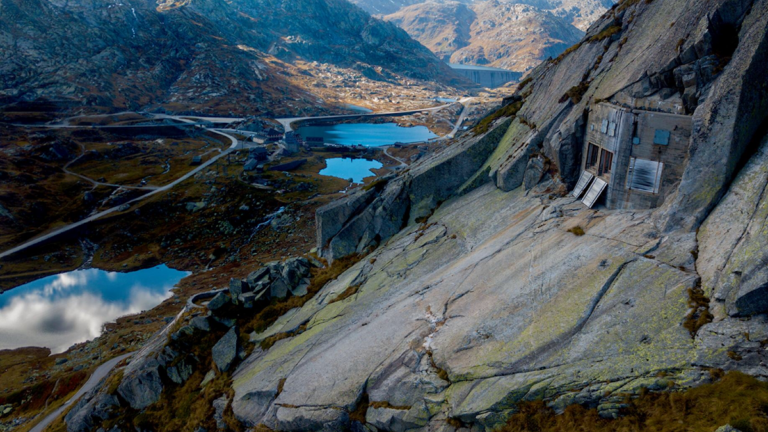
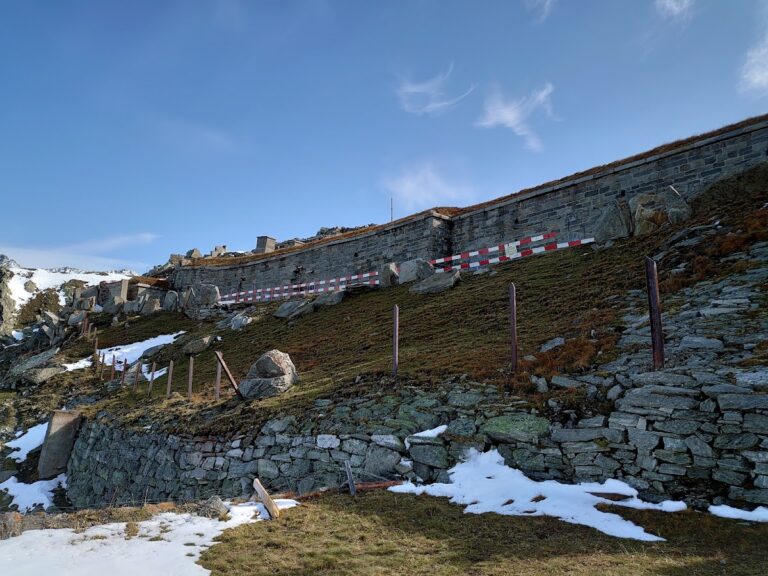
Forte Ospizio San Gottardo stands on the Gotthard Pass plateau near the Gotthard Hospice, a historic mountain shelter for travelers. It lies at the meeting point of the old Gotthard road and the road leading to the Lake Sella dam, within the municipality of Airolo in Ticino. The surviving work comprises two barracks placed side by side. The higher barracks contains the military museum, while the lower section remains in use as troop accommodation.
Between 1891 and 1894, a position was prepared for a 12-centimeter armored howitzer, and a second gun was added soon afterward. The ammunition magazine and gunnery office occupied bombproof vaulted chambers, heavily protected spaces designed to resist explosive attack. The barracks were surrounded by firing trenches and shelters. An observation armored cupola, a protected metal turret for observation, was installed in 1900, and mobile armored positions for 5.3-centimeter guns followed after 1902.
Outer defensive installations
The wider defensive layout included the right and left Tremola infantry bunkers, the Sellabrücke infantry bunker, and demolition installations at the Tremola Bridge and Viadukt. An 8.1-centimeter fortress mortar position stood at the summit of the Gotthard Pass. These positions formed the outer elements associated with the main barracks and artillery work.
Museum collections
The museum’s displayed material includes 12-centimeter armored howitzers, 5.3-centimeter guns, Maxim machine guns, 4.7-centimeter infantry guns, mortars, military equipment, and uniforms. Videos and historical images show the fort’s daily operations and wartime activities. The exterior installations survive for examination, while the interior areas open to visitors are limited to rooms not required for troop accommodation.
Nearby sites