Saraç Mosque: An Ottoman Mosque in Prizren, Kosovo


Site at a Glance
- Rating
- 4.9
- Popularity
- Very Low
- Country
- Kosovo
- Primary era
- Early Modern
- Eras represented
- Early Modern
- Civilizations
- Ottoman
- Site type
- Religious
- Remains
- Mosque
On this page6 sections
History
Saraç Mosque, also known as Kukli Mehmet Bey Mosque, is an Islamic mosque in Prizren, Kosovo, built during the Ottoman period in 1531 by Mehmet Kukli Bey of Opoja. It is regarded as one of the oldest mosques in Prizren and Kosovo and is protected as a cultural-heritage monument.
Foundation and urban setting
Mehmet Kukli Bey was an Albanian nobleman and governor of a region extending from Thessalonica to Bosnia. He established the mosque near the centre of Prizren, in the Saraçhane Quarter, an area historically associated with tanning and gristmill trades. The building stands near the Halveti Teqe, a lodge of the Halveti Sufi tradition, and the Gazi Mehmet Pasha Hammam, a traditional Islamic bathhouse.
Alterations and damage
The mosque’s southwestern-facing porch was demolished in 1963 during road widening. Renovations in 1977 and 1994 plastered the interior walls, removed the murals, and replaced the original stone roof with clay tiles. Further work took place from 2000 to 2003. The porch was rebuilt in 2008, but an electrical fire damaged the interior in 2009.
Remains
Prayer hall and entrance
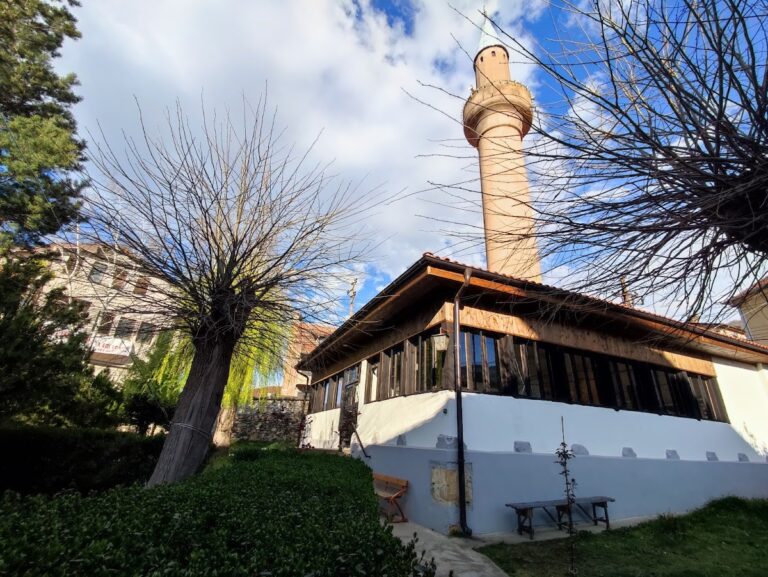
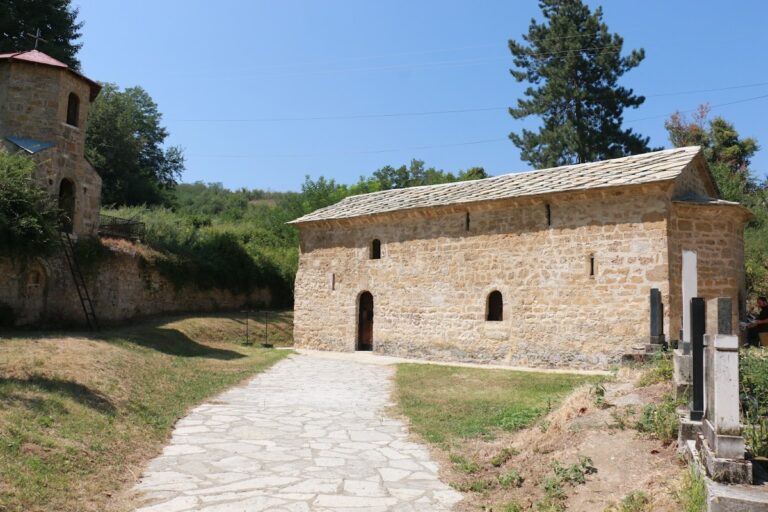
The mosque is a square structure measuring 9 by 9 metres, constructed from irregular river stones bonded with lime mortar. The façade plaster allows this masonry to be seen, along with wooden openings or hatches connecting the façade to the central structure. Above the building is an externally hexagonal roof, originally made from stone slabs, which covers an octagonal interior dome. The roof was later finished with clay tiles. The entrance is on the southwestern side, where a wooden door is set within a semi-arched frame of carved stone. A nearby sign identifies the mihrab, the recessed or marked feature indicating the direction of prayer toward Mecca.
Minaret and courtyard
A stone minaret stands beside the door at the southern corner. Its form combines a hexagonal base, a rounded shaft, and a conical dome above the şerefe, the balcony surrounding a minaret. The balcony surface carries rich geometric ornament. Tombstones remain in the mosque courtyard, adding a funerary element to the surviving complex.