Fortress of Prizren: A Hilltop Stronghold in Kosovo
Site at a Glance
- Rating
- 4.7
- Popularity
- Medium
- Country
- Kosovo
- Primary era
- Early Modern
- Eras represented
- Medieval, Early Modern
- Civilizations
- Byzantine, Ottoman, Serbian
- Site type
- Military
- Remains
- Citadel
On this page10 sections
History
Fortress of Prizren is a hilltop fortification in Kosovo, developed through prehistoric, Eastern Roman, Serbian medieval, and Ottoman phases above the city of Prizren. The site was inhabited from approximately 2000 BC, during the Bronze Age, and was rebuilt as part of a late-antique defensive system under the Eastern Roman emperor Justinian in the 6th century. Its position made it important to successive powers controlling routes through the Drin valley and the central Balkans.
Prehistoric and Eastern Roman phases
The hill was occupied through several prehistoric phases, continuing from the Bronze Age into the late Iron Age around the 1st century AD. In late antiquity, the period of the later Roman and early medieval worlds, the fortress formed part of the defenses of western Dardania, an ancient region broadly covering parts of present-day Kosovo and neighboring areas. Justinian, whose reign included the strengthening of many frontier fortifications, ordered its reconstruction as one of a series of strongholds along the White Drin and on routes connecting the coastal regions with the Kosovo valley.
The fortress probably corresponds to Petrizen, a 6th-century fortification in Dardania mentioned by the historian Procopius, although this identification remains uncertain. Prizren itself first appears in written records in 1019, during the reign of Basil II, under the name Prisdriana. The settlement developed around the fortress and later became associated with the commercial route known as the Via de Zenta, which connected the Adriatic coast with inland Balkan regions through the Drin valley.
Serbian medieval rule
In 1072, the area became involved in the Bulgarian uprising against Byzantine rule led by Georgi Voiteh. Constantine Bodin, a Serbian prince, arrived with 300 soldiers after his father, Mihailo Vojislavljević of Duklja, sent assistance. Following the defeat of the Byzantine commander Dalassenos Doukas near Prizren, the Serbian army extensively plundered the town. Bodin was proclaimed “Emperor of the Bulgarians,” but Nikephoros Bryennios defeated the rebels later that year.
Stefan Nemanja took control of the surrounding White Drin region between 1185 and 1195. Byzantine authority ended definitively in 1219–1220, when the Nemanjić dynasty, the medieval Serbian ruling house, established control over Prizren and its fortress. Until 1371, the site belonged to the Serbian medieval state and served as the administrative and economic center of the župa of Podrimlje, a medieval territorial district.
During the 14th century, the Serbian Empire expanded the fortress. Under Stefan Dušan, Prizren served for a time as an imperial capital, and the stronghold formed part of the defensive setting of his court before the court moved to Skopje. About 3 km southeast, Dušan commissioned the Monastery of the Holy Archangels and Višegrad Fortress, also called Dušan’s Fortress. Together with the Prizren stronghold, these sites served for a period in the defense of his court.
The weakening of the Serbian Empire brought a succession of regional rulers, including the Balšić, Dukagjini, Hrebeljanović, and Branković dynasties, often with Ottoman support. Prizren’s commercial importance declined, and in 1433 the town was described as an abandoned market. The settlement below the fortress, later known as Nënkalaja, or “below the fortress,” developed into the old town. Ragusan merchants established themselves there, and Prizren later became a commercial center and a gateway for Ragusan trade toward eastern Kosovo and beyond.
Ottoman transformation
The fortress entered the Ottoman Empire after the middle of the 15th century. Its conquest is most probably dated to 21 June 1455, although Ottoman records provide an alternative date of 1459. Ottoman administration retained the stronghold until the First Balkan War in 1912 and gradually transformed it into a central fortress of the Eyalet of Rumelia, a major Ottoman provincial administration covering much of the empire’s European territories.
Military additions continued for several centuries as firearms changed defensive requirements. Much of the surviving fortress belongs to an Ottoman expansion and reconstruction phase in the 18th century. During the Ottoman occupation, Serbs held social gatherings at monumental places including the fortress, where they danced the Kolo, a communal circle dance performed at South Slavic social and ceremonial gatherings.
Abandonment and archaeological work
Prizren was liberated during the First Balkan War in 1912, after which the fortress was abandoned. Excavations in 1969, 2004, and 2009–2011 exposed infrastructure and internal spaces that had previously been covered or incorporated into the fort. In 1948, the fortress was declared a Monument of Culture of Exceptional Importance. Later restoration sought to recover its former appearance using historical records as a guide.
Remains
Hilltop layout
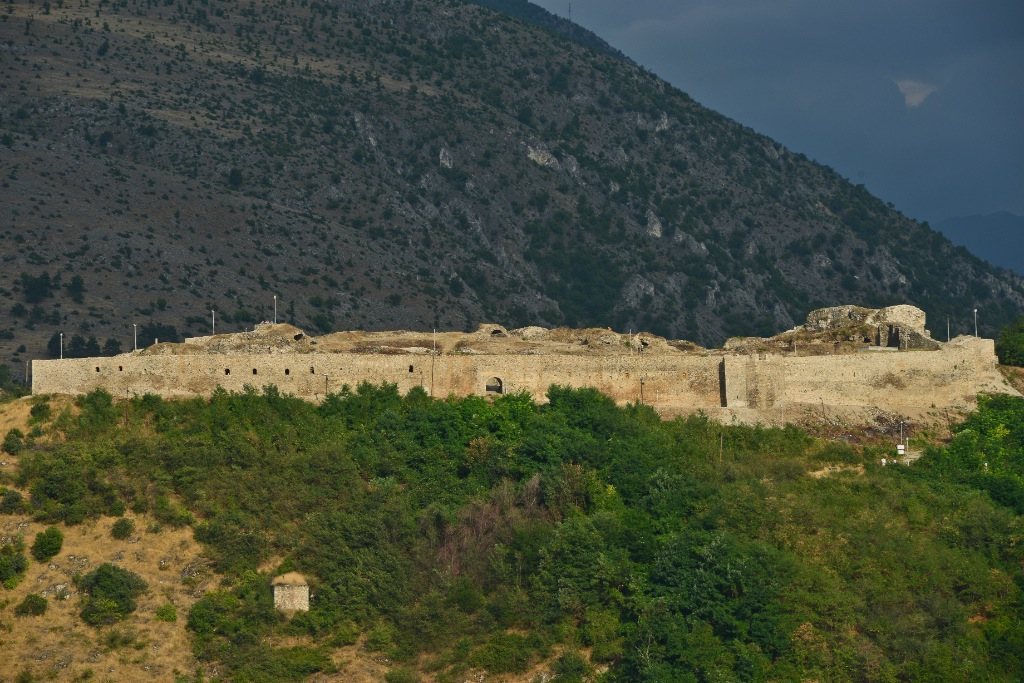
The fortress occupies a dominant hill in eastern Prizren above the river that flows through the town. Its irregular outline follows the hill’s natural form and plateau. The complex is divided into a Great City and an Upper City in its southwestern section, while a separate eastern sector, probably medieval in origin, forms another recognizable part of the site.
Defensive structures
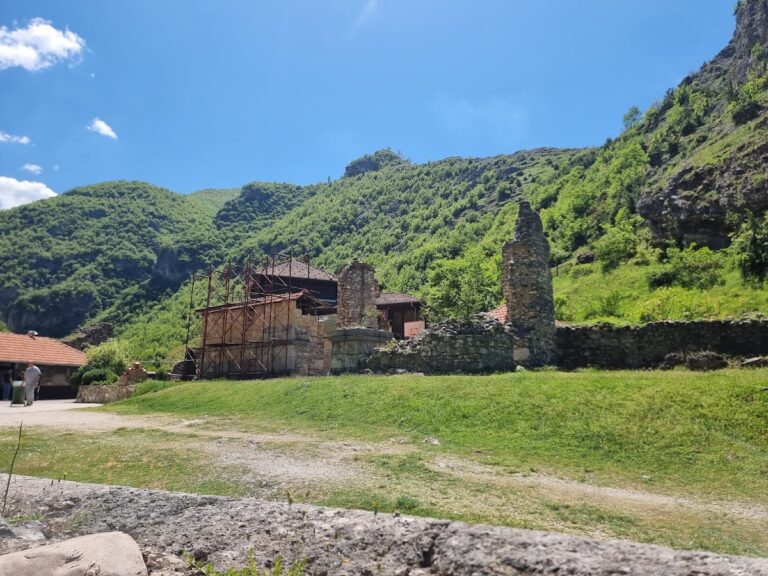
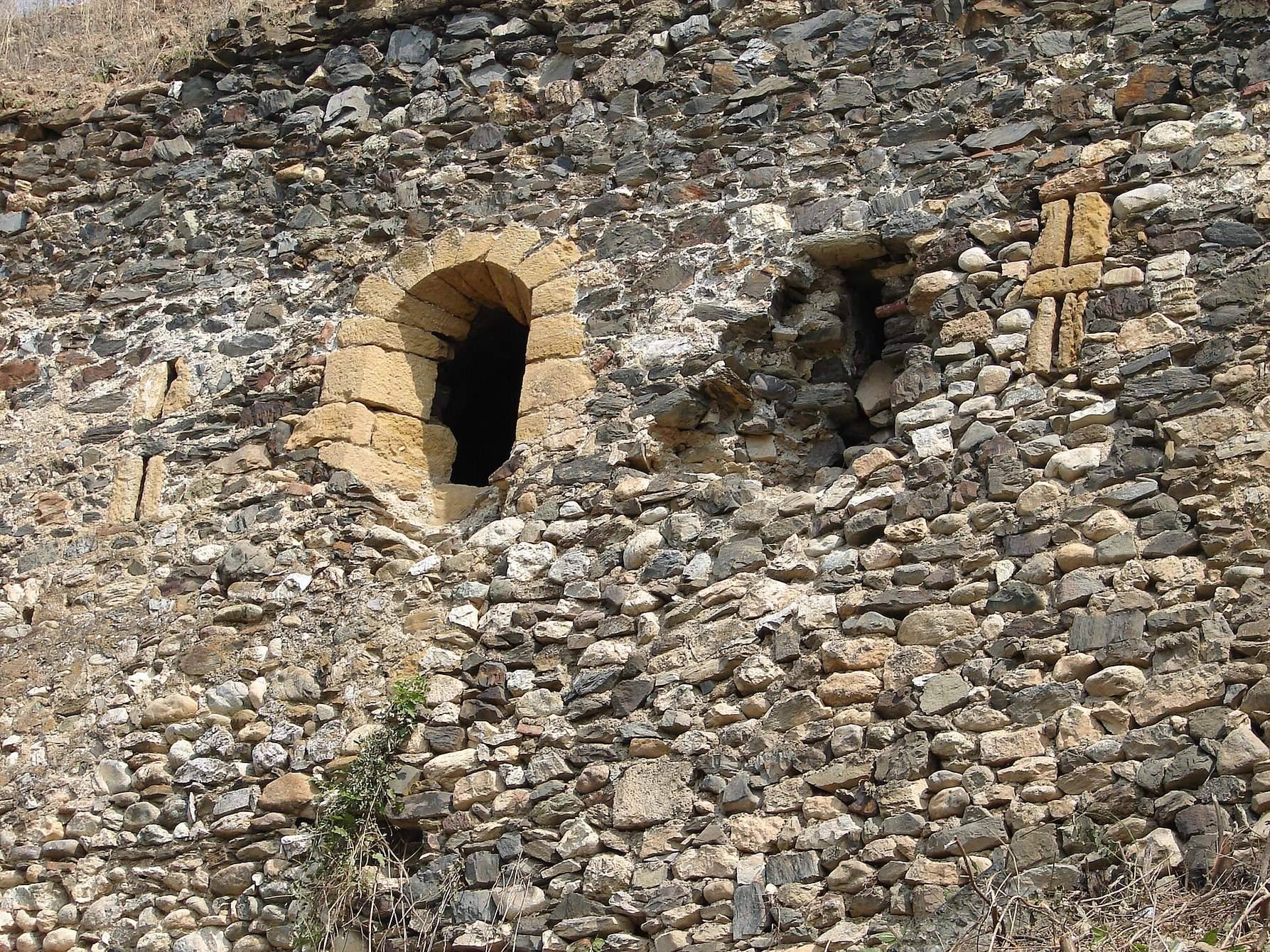
Excavated remains include rampart walls strengthened with towers, casemates, labyrinthine corridors, depots, and associated rooms and dwellings. A main gate survives, together with the remains of at least one tower and a reconstructed upper section. These features reflect the fortress’s successive defensive uses, while the substantial Ottoman additions continued to shape its present form.
Archaeological layers
Material from the upper part of the hill accumulated in the lower section over many centuries. The recovered material ranges from approximately 2000 BC to around the 1st century AD and is comparable with material from the nearby prehistoric site at Vlashnjë. These layers preserve evidence for the prehistoric occupation that preceded the later fortified complex.
Settlement and related fortifications
Nënkalaja developed around the fortress and constituted Prizren’s old town. The Monastery of the Holy Archangels and Višegrad Fortress lie approximately 3 km southeast, forming part of the wider defensive landscape associated for a time with Stefan Dušan’s court. The fortress’s upper section has been reconstructed, and the complex is illuminated at night, making it visible from throughout Prizren.