Santuario della Madonna dei Miracoli: A Renaissance Marian Sanctuary in Saronno


Site at a Glance
- Rating
- 4.7
- Popularity
- Low
- Country
- Italy
- Primary era
- Early Modern
- External website
- Open
- Eras represented
- Early Modern
- Civilizations
- Duchy of Milan, Habsburg, Spanish
- Site type
- Religious
- Remains
- Sanctuary
On this page17 sections
History
The Santuario della Madonna dei Miracoli is a Catholic Marian sanctuary in Saronno, Italy, established in the Lombard Renaissance on 8 May 1498. It belongs to the Ambrosian rite, the liturgical tradition associated principally with the Archdiocese of Milan, and became a parish church in 1986. The sanctuary grew around a statue of the Madonna del miracolo, a fourteenth-century image believed to bring miraculous cures, and became an important center of Marian devotion.
From Chapel to Sanctuary
The sanctuary was founded beside the Strada Varesina on the site of an earlier chapel. That chapel had collapsed three times before the community of Saronno began the new building. Popular belief connected the older site with the miraculous healing of a young man, variously dated to 1447, 1460, or 1497. Further cures were associated with the place. The suggestion that the chapel represented a Christian reinterpretation of an earlier pagan place of worship remains uncertain.
The new sanctuary was intended to house the Madonna del miracolo, a statue made during the second half of the fourteenth century. Devotion to the image helped attract increasing numbers of worshippers, while the sanctuary accumulated an extensive program of painting, sculpture, stucco, and metalwork. The designer of the initial building is not known. Its plan and proportions refer to the golden section, a proportional relationship traditionally associated with harmonious composition, and show connections with architectural models already established in Lombardy. Giovanni Antonio Amadeo has been proposed as the architect, but the attribution is not certain.
Early Construction and Expansion
Giovanni Antonio Amadeo is securely associated with the sanctuary through the design of its tiburio, the structure rising above the central part of a church to enclose or support a dome. Completed in 1508, it gave the building a distinctive Lombard Renaissance character. By 1507, the sanctuary administration had also built the casa dei deputati beside the church. The elected deputati supervised the property and directed the administration of construction works.
Paolo della Porta designed the campanile, which was erected between 1511 and 1516. Its reputation led it to be regarded as one of the finest bell towers in Lombardy and as a model for other churches. The sanctuary’s interior decoration developed during the sixteenth century through the work of Lombard artists including Bernardino Luini, Cesare Magni, Gaudenzio Ferrari, Bernardino Lanino, Andrea da Milano, and Giulio Oggioni, along with specialists in several other crafts.
Growing attendance prompted the deputati to enlarge the sanctuary with a three-aisled building of five bays. Work began in 1556, but by 1566 only three bays had been completed and the facade remained provisional. Carlo Borromeo, the sixteenth-century archbishop of Milan associated with Catholic reform, encouraged the resumption of the building campaign. Completing the enlarged church required the demolition of the surviving Cappella del Miracolo. In September 1581, Borromeo personally celebrated the solemn translation of the fourteenth-century Madonna statue into the sanctuary.
Facade and Completion
In the 1580s, the sanctuary and its surrounding buildings appeared as “S. Maria” on a map of the Duchy of Milan in the Gallery of Maps at the Vatican Palace. Pellegrino Tibaldi, also known as Pellegrini, was commissioned to design the facade. Construction continued from 1596 to 1613. Some deputati criticized the finished facade as too massive in comparison with the elegance of the tiburio.
In 1630, Carlo Buzzi designed the raising of the curving balustrade that supports the statue of the Assumption and four trumpet-playing angels. The design was not carried out until 1666, when the principal building campaign was completed. Franciscan spirituality shaped much of the sanctuary’s decoration. The deputati had entrusted religious services to the Friars Minor, the Franciscan order, and the sculptural groups were intended to encourage worshippers to identify with episodes from the life of Christ.
Later Status and Ecclesiastical Changes
The sanctuary’s bells were repeatedly altered. Bells were recast in 1555, 1568, and 1585. Nicola Bonavilla cast a larger bell and a smaller summons bell in 1617; the larger bell was recast in 1619 and again in Milan in 1640 by Lorenzo and Pietro Paolo Mirri. In 1903, wooden bell supports were replaced by cast-iron supports, and the bell frame was rebuilt during restoration of the tower in 1922.
A small clock tower with a clock bell was built in 1594. It was enlarged in 1650, and its bell chamber was rebuilt in 1668. The tower was demolished in 1757 when a new clock was installed on the campanile, but another clock tower was built on the same site in 1769. Pope Pius XI elevated the sanctuary to the rank of minor basilica, a special papal title recognizing a church’s religious and historical importance, on 2 January 1923. The sanctuary was consecrated on 6 September 1931.
Remains
Plan and Central Structure
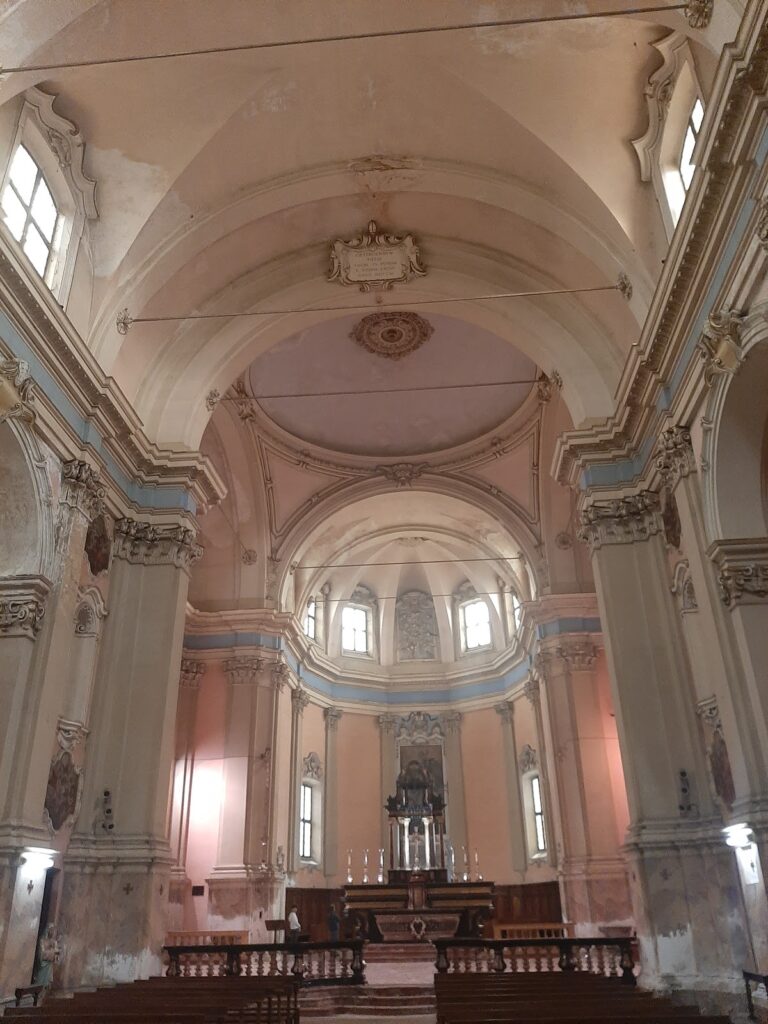
The original sanctuary followed a Latin-cross plan with an apse, presbytery, antipresbytery, central space, and two lateral chapels. The central space was covered by a circular vault beneath the tiburio and dome. Its intended use reversed the emphasis of traditional medieval Latin-cross churches by placing the gathering of the ecclesial community beneath the central vault at the heart of the building. The later enlargement produced the present three-aisled arrangement of five bays.
Tiburio and Dome
The tiburio has 24 exterior windows arranged as 12 bifora openings, each a two-light window divided by a central column. These openings correspond to a dodecagonal drum, the polygonal stage between the supporting structure and the dome, which carries an octagonal dome. Four corner sections were inserted above a structure founded on four corner piers.
The geometry follows the traditional ad quadratum method, which organizes a building from a square-based system. The progression from four corner piers to an eight-sided dome and a twelve-sided drum is expressed as 4 + 8 + 12 = 24. This arrangement symbolically moves from the square of the central space toward the circular heavens.
Facade
The facade follows late Renaissance classical principles. Its composition includes columns, pilasters, a frieze, balustrades, high lateral niches containing statues, paired columns, a projecting entablature, and obelisks. Two large caryatid-like telamons stand beside the entrance portal. Together, these elements give the facade a solemn and monumental appearance.
Bell Tower and Clocks
Campanile
The campanile rises 47 metres and is the tallest structure in Saronno. It contains a three-bell Ambrosian system tuned approximately to E-flat major, although the bells have noticeable tonal discrepancies. The smaller bell, sounding G3, was cast locally in 1585, measures 987 millimetres across, and is associated with protection of the population from harm. The middle bell, also cast locally in 1585, sounds F3, measures 1,097 millimetres, and is dedicated to praise of the Madonna dei Miracoli. The large bell bears the date 1640, sounds E-flat3, measures 1,257 millimetres, and is dedicated to Christ Resurrected.
Another bell cast in 1617 with the former Bonavilla great bell was removed from the campanile in October 2010 and placed in the cloister. It is mounted in a half-Ambrosian system, sounds F-sharp4, and measures 513 millimetres in diameter.
Clock Tower
The clock tower rebuilt on its earlier site in 1769 contains two bells cast that year by Francesco and Innocenzo Bonavilla of Milan. The half-hour bell sounds an ascending E-flat4 and measures 551.5 millimetres across. The hour bell sounds D-flat4 and measures 639 millimetres.
Painted Decoration
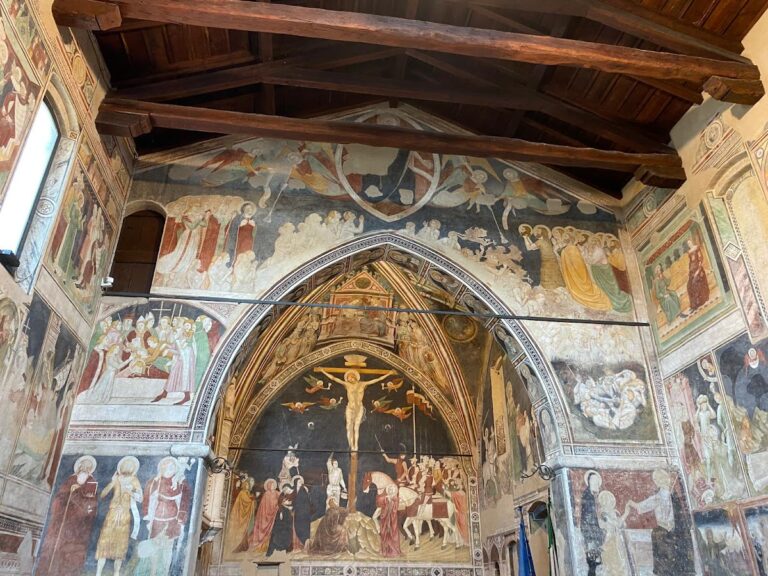
Bernardino Luini’s Frescoes
Bernardino Luini painted frescoes on the walls of the apse, presbytery, antipresbytery, and the area beneath the dome. He also painted figures on the vault of the Chapel of the Cenacle and a Nativity in the cloister. His principal cycles show the Marriage of the Virgin and Jesus among the Doctors in the antipresbytery, together with the Adoration of the Magi and the Presentation of Jesus at the Temple in the presbytery, also called the Main Chapel.
The frescoes combine numerous figures placed on different planes, brightly coloured clothing, expressive faces, and perspectival illusion. In the Marriage of the Virgin, the disappointed suitors wear restrained smiles shaped through sfumato, a technique using soft transitions between tones and contours and associated with Leonardo. The Adoration of the Magi and the Presentation are framed by projecting pilasters with grey-blue stone capitals supporting terracotta arches. Four airborne Sibyls, prophetic female figures in classical and Christian traditions, hold scrolls on the arches.
Pairs of the Four Evangelists and the Four Doctors of the Church occupy the lunettes between the windows of the barrel vault. The Doctors of the Church are authoritative Christian theologians recognized for their teaching. Eight monochrome, or sepia, figures on the chapel pilasters represent the theological and cardinal virtues, together with an allegory of Peace.
Dome Decoration
Gaudenzio Ferrari directed the decoration of the dome. His contract was signed on 15 June 1534, work began in July 1535, and his coordinating role continued until the completion of the Concerto degli Angeli in 1545. The decoration officially represents the Assumption of the Blessed Virgin and combines painting with wooden sculpture. A carved figure of the Assumption stands at the level of the drum, while the face of God the Father occupies the center of the dome.
The angels are arranged in four concentric circles. The highest circle contains luminous nude angels looking toward God the Father. Below them are singing angels reading choirbooks and scrolls, together with instrumentalists. The painted orchestra includes 56 different instruments, covering string, wind, and percussion types. It combines recognizable historical instruments with inventions attributed to Ferrari, including hybrid or impossible forms.
Wooden Figures
Andrea da Milano, also called Andrea da Saronno because of his extensive work at the sanctuary, carved the wooden figure of God the Father and began the figure of the Assumption. Battista da Milano completed the latter in 1537. In 1539, Guido Oggioni, a pupil of Andrea da Milano, made 22 wooden statues of Prophets and Sibyls for niches in the drum of the dome.
Andrea da Milano also made two major polychrome wooden groups in the lateral chapels. The groups have been heavily repainted. The left chapel contains the Cenacle, dated 1531, showing the apostles as Jesus announces his impending betrayal. Their gestures and arrangement emphasize discussion and disbelief. Luini painted Angels with the Symbols of the Passion on the chapel vault. Three large canvases by Camillo Procaccini, dated 1598, stand behind the group, showing the Agony in the Garden, the Kiss of Judas, and servants with tableware.
The right chapel contains Andrea da Milano’s group of the Lamentation over the Dead Christ, also called the Descent from the Cross. The group has undergone several rearrangements, and some parts, including the smaller angels carrying the Symbols of the Passion, are internally inconsistent. It originally included more statues and represented further Passion scenes, including the Calvary with the thieves on the cross and the Descent into Limbo. Surviving statues of a grieving male figure and a female figure identified as a Gitana are preserved in the Sanctuary Museum.
Apse Sculpture
Andrea da Milano produced statues of Saints Lucy, Agatha, Mary Magdalene, Liberata, and Martha, together with Saint John, for the apse. The apse also contains busts of King David, Solomon, Habakkuk, and Isaiah. Two frescoes in the sanctuary are attributed to Stefano Maria Legnani, while works by Cesare Magni and Bernardino Lanino are also associated with the interior decoration.
Nearby sites