Farfa Abbey: A Benedictine Territorial Abbey in Italy


Site at a Glance
- Rating
- 4.6
- Popularity
- Medium
- Country
- Italy
- Primary era
- Medieval
- External website
- Open
- Eras represented
- Classical, Medieval, Early Modern
- Civilizations
- Carolingian, Holy Roman Empire, Roman
- Site type
- Religious
- Remains
- Monastery
On this page17 sections
History
Farfa Abbey is a Benedictine territorial abbey in Italy, located at Farfa within Fara in Sabina, Lazio, whose monastic origins emerged between 560 and 592 and whose present architecture incorporates Carolingian, Romanesque, Gothic, Renaissance, and Baroque elements. The abbey stands above the Farfa stream, a tributary of the Tiber, and remains an active monastery belonging to the Cassinese Benedictine Congregation.
Origins and Early Restoration
The foundation tradition preserved in the twelfth-century Chronicon Farfense attributes the first monastery to Laurence the Illuminator, a Syrian monk who came to Italy with his sister Susannah and other companions. According to this tradition, Laurence chose a wooded hillside above the Farfa stream during the reign of either Emperor Julian or Emperor Gratian. Historical research identifies him with Laurence, bishop of Forum Novum, and places the formation of a monastic center at Farfa between 560 and 592.
Archaeological investigations begun in 1888 revealed a Roman sanctuary on the terraced hillside and the foundations of a possible sixth-century oratory associated with an early monastic community. The first monastery was destroyed after its foundation, probably around 592, during a Lombard raid led by Ariulf, duke of Spoleto. Farfa then remained abandoned for more than a century.
Monastic life was restored in the late seventh century, with another tradition dating the renewed foundation to about 681. Thomas of Maurienne, a pilgrim who had spent three years in Jerusalem, is traditionally credited with rebuilding the community after receiving a vision of the Virgin Mary at the Holy Sepulchre. Duke Faroald II of Spoleto was also said to have received a vision commanding him to help Thomas. Thomas became the first abbot of the renewed monastery and died in 720. Frankish abbots governed Farfa for more than a century afterward.
The restoration formed part of a wider revival of Benedictine monasticism in Italy. Lombard rulers and Carolingian emperors granted Farfa protection, privileges, immunities, and land. The abbey was also removed from the jurisdiction of the bishops of Rieti, a position that helped establish its territorial and institutional independence.
Imperial Protection and Expansion
In 775 Charlemagne granted Farfa the defensio imperialis, an imperial protection that freed the monastery from interference by secular and ecclesiastical authorities. It is described as the first privilege of this kind granted in Italy. Charlemagne visited Farfa shortly before his coronation in Saint Peter’s Basilica on 25 December 800.
During the Carolingian period, Farfa became a major spiritual, political, and economic center of central Italy. At its height, its possessions included 683 churches and monasteries, 132 castles, 16 strongholds, seven ports, eight salt mines, 14 villages, 82 mills, and 315 hamlets. Its territory also included the towns of Centumcellae, now Civitavecchia, and Alatri. In the third decade of the ninth century, under Abbot Ingoald, the monastery possessed a commercial ship exempt from customs duties in Carolingian imperial ports.
Farfa’s military and political influence arose from its imperial status and its position between the Papal States and the Duchy of Spoleto. Its abbot acted as an imperial representative and was associated with the defense of Lazio and the representation of imperial interests before the Holy See. As a territorial abbey, Farfa’s abbot historically exercised jurisdiction over a defined territory in a manner comparable to that of a bishop.
Destruction and Eleventh-Century Reform
In 898 Saracen forces sacked and burned the abbey after a period of resistance organized by the monastery’s chapter. Abbot Peter I abandoned Farfa, and the monks dispersed. One group sought refuge in Rome, where a cemetery associated with Farfa’s abbots was later found beneath Palazzo Madama.
Abbot Ratfred rebuilt Farfa between 930 and 936. He was later poisoned by the monks Campo and Hildebrand, who seized the monastery’s wealth and ruled it until Alberic II of Spoleto, Prince of the Romans, summoned Odo of Cluny to reform Farfa and other monasteries in the Duchy of Rome. Campo was exiled and replaced by Dagibert, who also died by poisoning five years later. The monastery then entered a period of severe moral and material decline. Monks stripped altar ornaments and misused monastic wealth, while political ambitions further disrupted institutional life.
With the protection of Emperor Otto I, Abbot John III, consecrated by the pope around 967, restored a measure of order. The principal reformer was Hugh of Farfa, who served as abbot from the late tenth to the early eleventh century. Although his appointment involved simony, Hugh reorganized monastic life, encouraged piety and study, and invited Odilo of Cluny and William of Dijon to Farfa.
Hugh’s successor Guido oversaw the compilation of the Consuetudines Farfenses around 1010. This work recorded the organization of monastic life at Farfa. Hugh also wrote the Destructio Monasterii, Diminutio Monasterii, and Querimonium, which described the earlier crisis and the material difficulties caused by the ambitions of minor Roman lords.
Learning, Imperial Politics, and Decline
Under Berard I, abbot from approximately 1049 to 1089, Farfa became an important intellectual center. The Benedictine monk Gregory of Catino organized the abbey’s archives and compiled the Regesto di Farfa, also called the Liber Gemniagraphus sive Cleronomialis Ecclesiae Farfensis. This collection contains 1,324 documents that preserve extensive evidence for eleventh-century Italian society.
In 1103 Gregory wrote the Largitorium, or Liber Notarius sive emphiteuticus, a register of grants made by the monastery to its tenants. He also began the Chronicon Farfense and later compiled the Liber Floriger Chartarum cenobii Farfensis as an index to his works.
Growing wealth increasingly impeded Farfa’s religious life. Rivalry between Abbot Guido and the monk Berard troubled the monastery from 1119 to 1125. During the Investiture Conflict, the wider struggle between imperial authority and the papacy over control of church offices, Farfa generally supported the Ghibelline, or imperial, side. Its monks issued the Orthodoxa defensio imperialis in support of that position.
Pope Eugene III was enthroned at Farfa on 18 December 1145. The abbey’s imperial political orientation weakened after the defeat of the Hohenstaufen and the end of German imperial rule in Italy. In 1262, Farfa sought the protection of Pope Urban IV.
Commendatory Administration and Modern Revival
In 1399 Boniface IX made Farfa a commendatory abbey. This arrangement placed the monastery under an abbot who often did not reside there and could hold the office chiefly as an administrative benefice. In 1494 Alexander VI united Farfa’s commendatory administration with that of San Salvatore Maggiore.
The Orsini family controlled the abbey until the early sixteenth century. The Della Rovere family succeeded them briefly, and the Orsini returned until 1542, when administration passed to the Farnese family. During the Farnese period Farfa entered the Cassinese Congregation in the mid-sixteenth century. Restorations and new construction continued, but the abbey lost much of its independent importance over the following two centuries because non-resident commendatory abbots governed it.
Farfa was suppressed in 1798 and again in 1861, after the creation of the Kingdom of Italy. Part of its property was sold to private owners. The heirs of Count Volpi later donated part of the monastic buildings and surrounding land to monks, allowing the community to revive. In 1920, monks sent by Alfredo Ildefonso Schuster, then abbot of Saint Paul Outside the Walls in Rome, re-established a monastic community at Farfa.
Farfa was declared a national monument in 1928, although substantial reconstruction and repair began only later. In 2016 it was placed on Italy’s tentative list for UNESCO World Heritage status as part of the proposed cultural landscape of Benedictine settlements in medieval Italy. The abbey continues to function as an active monastery.
Remains
Site and Monastic Layout
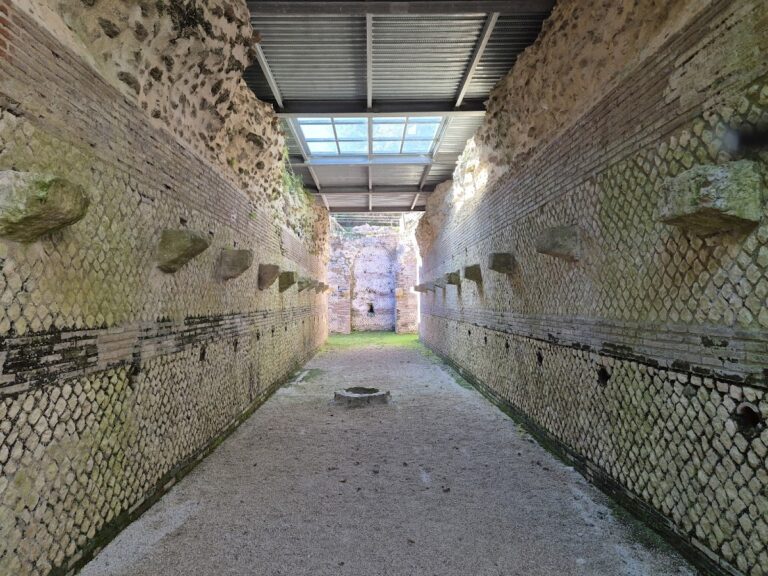
The abbey occupies a slope of Monte Acuziano, now called Monte San Martino, above the Farfa stream. The terraced hillside contains the remains of a Roman sanctuary and foundations attributed to a possible sixth-century oratory. The present complex also incorporates ruins of a ninth-century church, altered by later construction, while medieval structural fragments survive within the monastic buildings.
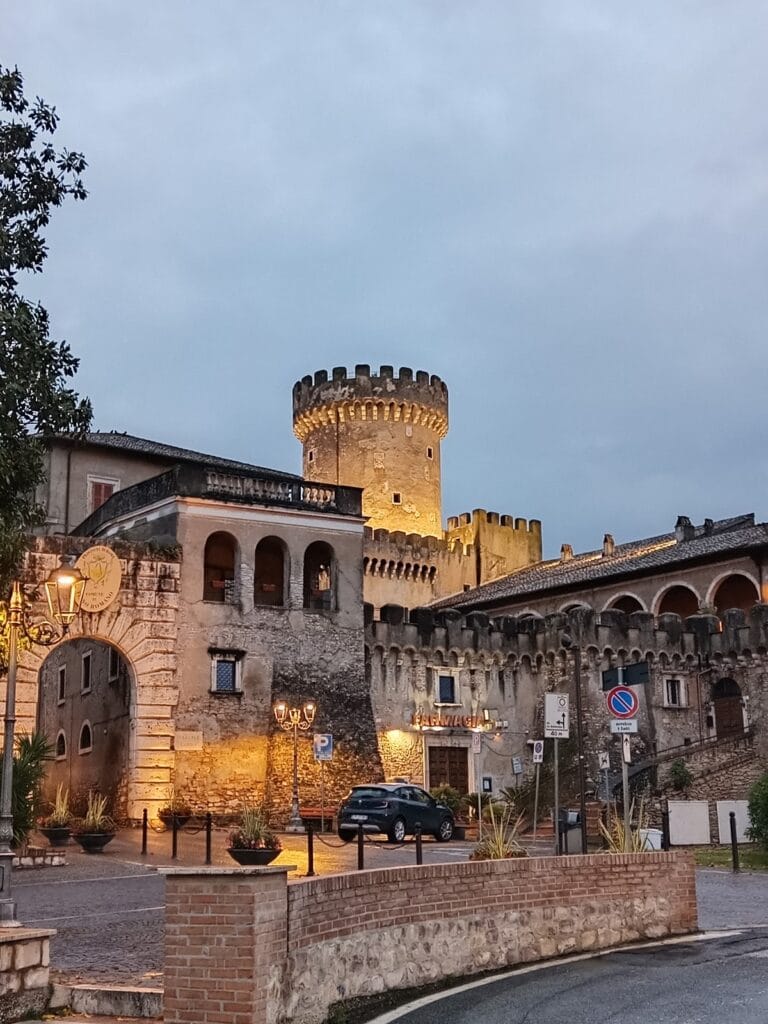
The monastery developed around a large cloister, which forms the organizing center of the complex. The medieval village of Farfa surrounds the abbey and forms part of the settlement associated with the monastic foundation. A state library attached to the abbey preserves books, manuscripts, and codices that remained at Farfa during periods when other collections were moved elsewhere.
Abbey Church
Facade and Exterior
The abbey church stands at the center of the complex. It is a basilica with a Latin-cross plan and three naves, reflecting a building history that extends from the Carolingian period through the Romanesque, Gothic, Renaissance, and Baroque eras. Its Romanesque facade has a stepped roofline and a central marble-framed portal decorated with floral friezes.
Above the portal, a painted lunette, the semicircular area over an opening, shows the Virgin and Child crowned by two angels between Saints Benedict and Scholastica. The facade ends in a simple triangular pediment and contains three rose windows, one for each nave. The central rose window is the largest.
Interior and Furnishings
The interior retains its basilical organization but is largely Baroque in appearance. Two rows of round arches rest on Ionic marble columns, and the Renaissance hall contains several chapels. The Crucifix Chapel houses Farfa’s most venerated image. The first chapel on the left contains the Triumph of Saint Ursula, an altarpiece painted by Orazio Gentileschi between 1597 and 1599 during the commendatory administration of Cardinal Alessandro Peretti.
The deep polygonal apse contains Baroque wooden choir stalls. Above the high altar stands a ciborium, a canopy over an altar, whose pinnacle bears a relief of the Assumption of Mary. A lunette depicting the Virgin and Child surmounts the central nave, while the interior wall of the facade carries a large Flemish Last Judgment canvas dated 1571 and painted by Hendrick van den Broeck.
Behind the triple window in the rear wall of the apse is the church organ, built by the Pedrini organ workshop in 1947. It has electro-pneumatic transmission, 12 stops divided between two keyboards of 58 notes each, and a concave-radial pedalboard of 30 notes. The console can be moved independently within the presbytery.
Bell Tower and Archaeological Finds
Bell Tower
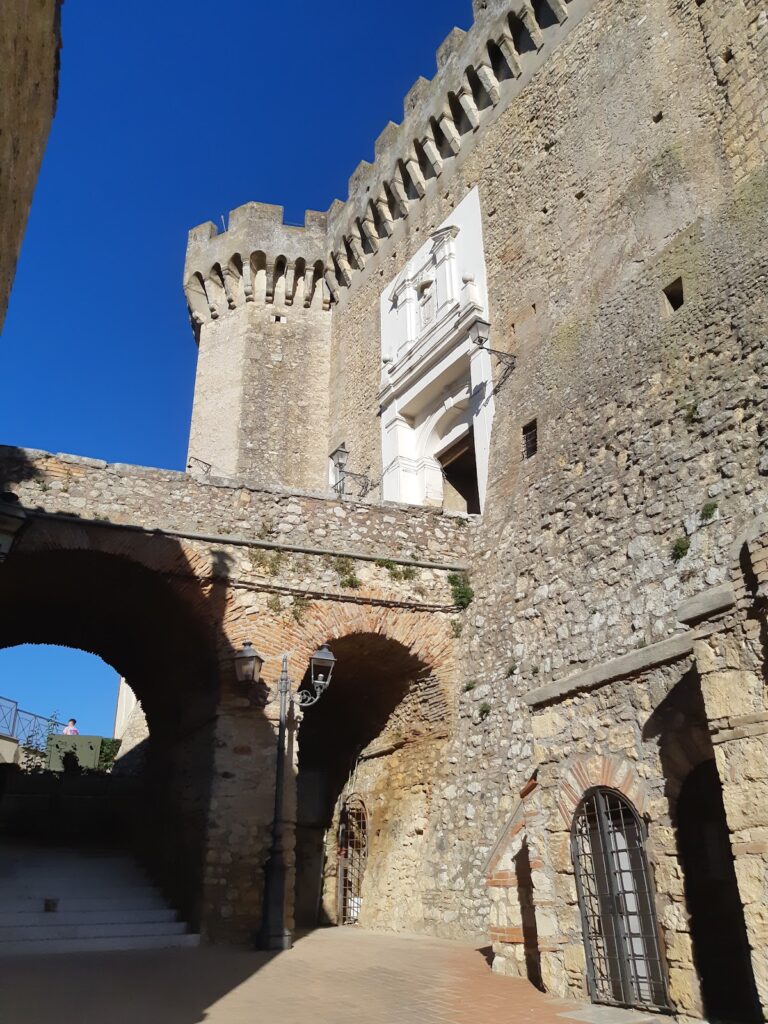
The surviving bell tower preserves elements of the original Carolingian architecture. Its lower section and the surrounding wall retain well-preserved pilasters, while the upper portion, including the triple-arched openings, belongs to a later period. Structural traces indicate that the church formerly possessed a westwork, a monumental western section that could contain entrances, chapels, galleries, or towers.
An oratory was built in the lower part of the tower on the orders of Abbot Sichard. Medieval frescoes were found at the base of the tower, and a ninth-century stone inscription associated with Sichard was discovered reused in the church in 1959.
Recovered Remains
A Roman sarcophagus dating from the first or second century AD was discovered in the church apse in 1961. Together with the Roman sanctuary on the hillside and the possible early oratory, it forms part of the archaeological evidence for the long occupation of the site before and during the emergence of the monastery.
Later Features and Collections
Fountain and Mill
A fountain and a mill were constructed in 1568 by Jacopo Barozzi da Vignola at the initiative of Alessandro Farnese. Giacomo Della Porta later completed the work, adding Renaissance-period features to the abbey’s wider architectural fabric.
Library and Museum
The abbey’s state library preserves books, manuscripts, and codices retained at Farfa through periods when other collections were transferred elsewhere. The monastic museum contains an installation by Emanuele Luzzati consisting of 12 scenes with references to the writings of Gregory of Catino.