Santa Maria Maggiore, Alatri: A Romanesque-Gothic Church in Italy


Site at a Glance
- Rating
- 4.6
- Popularity
- Low
- Country
- Italy
- Primary era
- Medieval
- Eras represented
- Classical, Medieval, Early Modern
- Civilizations
- Papal States, Roman
- Site type
- Religious
- Remains
- Church
On this page12 sections
History
Santa Maria Maggiore, Alatri, is a Roman Catholic church in Italy, founded in the fifth century over the ruins of an ancient Roman temple dedicated to Venus. Consecrated during that century and originally dedicated to the Virgin and the Savior, it developed into a Romanesque-Gothic church through repeated medieval enlargement and rebuilding. The church belongs to the Roman rite and the Diocese of Anagni-Alatri, and its existence is first documented in 1137.
Early Foundation and Medieval Expansion
The church replaced a pagan sanctuary dedicated to Venus, a major Roman goddess associated with love, beauty, fertility, and prosperity. Its foundation therefore belongs to the Christian transformation of an earlier Roman religious setting. During the Romanesque period, the building was enlarged several times, before Burgundian craftsmen radically reshaped it in the thirteenth century. That intervention established the Romanesque-Gothic character that still defines the church.
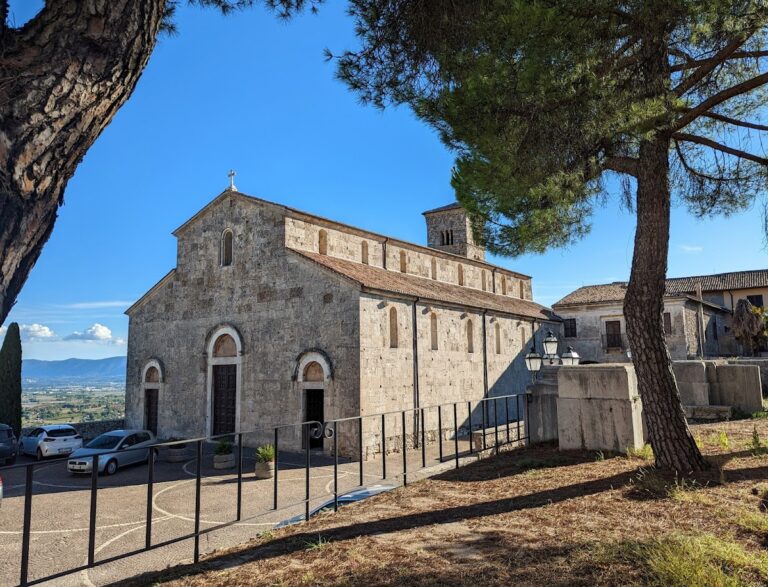
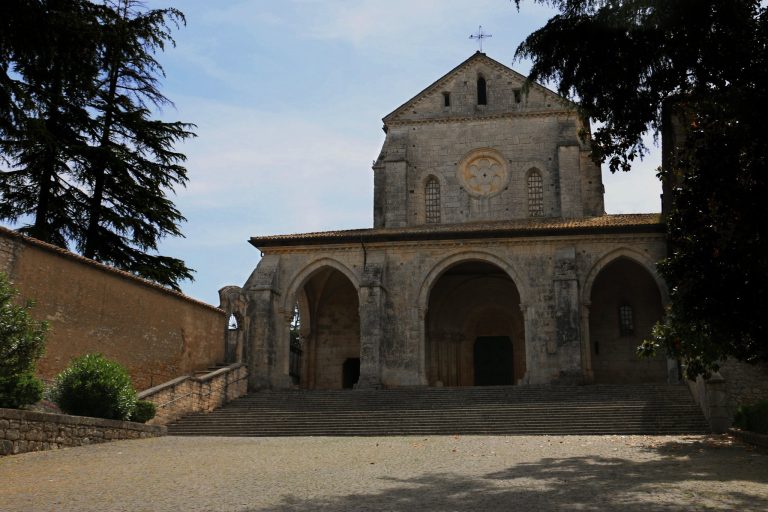
A further rebuilding in the fourteenth century moved the facade forward and created the entrance narthex, or hall before the main body of the church. A portico supported by four columns once sheltered the facade, but it was demolished during the second half of the nineteenth century. The same medieval phase gave the church its gabled front and much of its present external arrangement.
The Bell Tower and Later Changes
The bell tower was added in 1394. An inscription associated with the work bears the coat of arms of Boniface IX, a pope of the late fourteenth and early fifteenth centuries. An earthquake in 1654 destroyed the tower’s original cusp-like covering and caused an older statue of John the Baptist above the rose window to collapse. In 1739, the tower was lowered because it was considered at risk of collapse, and it was restored in 1938 and 1939.
The chapels opening from the left aisle were added in the seventeenth century and later became the setting for many of the church’s artworks. In 1852, the fresco of the Madonna della Libera was moved from the first left half-column of the central nave to the chapel at the end of the left aisle, which was refurbished for the transfer. The Madonna of Constantinople was restored in 2019, while the organ was expanded from an earlier instrument in preparation for the 2000 Jubilee.
The prominence of Saint Sebastian in the church’s wooden artwork has been interpreted as evidence that he was especially venerated in Alatri before the arrival of the relics of Saint Sixtus I and the extraordinary events later associated with them.
Remains
The surviving church has a gabled facade, a medieval bell tower, and a sober interior organized around a central nave and two side aisles. The facade leads into an entrance narthex, while the nave terminates in a deep quadrangular apse. Massive composite piers alternate with simpler supports beneath round arches, and cup-shaped capitals carry floral friezes.
Facade and Exterior
Gabled Facade
The fourteenth-century facade contains three portals with frescoed lunettes. The central lunette preserves a late-fourteenth-century Madonna and Child, while the frescoes that once occupied the lateral lunettes have been lost. Earlier paintings between the portals included Saint Christopher and an Annunciation. The portals were formerly protected by the four-column portico removed in the nineteenth century.
Above the central entrance is a large rose window divided into quadrilateral sections and enriched with trilobed motifs. Its design closely resembles patterns preserved in Villard de Honnecourt’s Livre de Portraiture, a thirteenth-century sketchbook containing architectural drawings. The same arrangement was reproduced at a larger scale in the rose window of the nearby church of San Francesco. A trilobed-arched niche at the top of the gable contains a modern copy of the statue of John the Baptist.
Bell Tower and North Wall
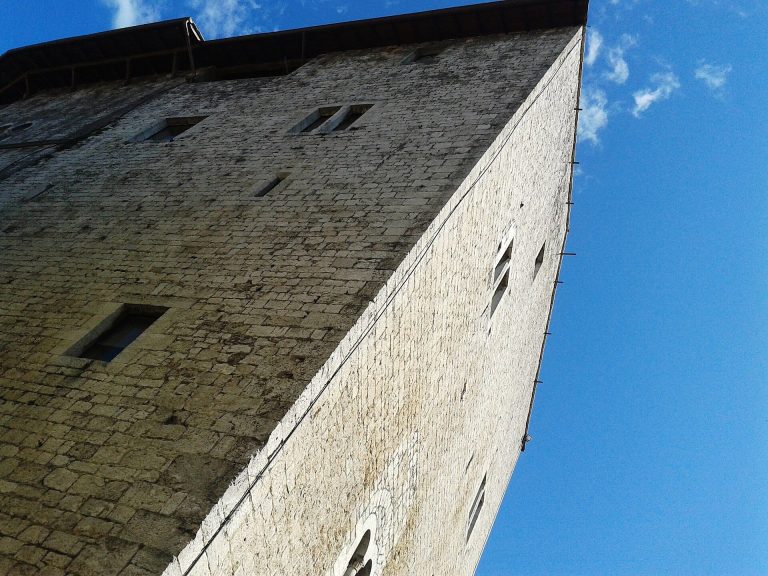
The bell tower has two levels of two-light windows, with paired columns and capitals that differ from one window to another. Its summit is marked by projecting stone spurs resembling battlements, a form resulting from the tower’s reduction in 1739 and restoration in 1938 and 1939. At its base, an archivolt, or decorative band following an arch, surrounds a lunette containing a late-fifteenth-century fresco of the Madonna and Child.
The north side is articulated by five stone buttresses alternating with single-light windows. These external supports and openings form a clear rhythm along the wall and express the church’s medieval construction. The bell tower remains physically integrated with this side of the building.
Interior Structure and Chapels
Nave, Aisles, and Apse
The entrance narthex precedes the central nave and two side aisles. The nave ends in a deep quadrangular apse, with massive composite piers alternating with simpler piers to support round arches. Their cup-shaped capitals are decorated with floral friezes. The right aisle is narrower, divided into six bays, and ends in a small apse whose semi-dome is covered with a gold mosaic. The wider left aisle has four asymmetrical sections and concludes in the large chapel of the Madonna della Libera.
Madonna of Constantinople Chapel
The first chapel of the left aisle contains the polychrome wooden Madonna of Constantinople, made by an anonymous artist from Latium between the twelfth and thirteenth centuries. The sculpture reflects Byzantine influence while using pronounced three-dimensional modeling. The Virgin holds an egg, a symbol of life and resurrection, and the Child holds a scroll of the Law, evoking divine authority.
A large carved narrative polyptych, an altarpiece made from several adjoining or hinged panels, completes the work. Its two side panels originally closed over the niche containing the statue. Twelve low-relief scenes portray the Annunciation, Visitation, Nativity, Annunciation to the Shepherds, the story of the Magi in three panels, Presentation in the Temple, Baptism of Christ, Flight into Egypt, Massacre of the Innocents, and Dormition of the Virgin.
Paintings and Liturgical Furnishings
The same chapel contains the Triptych of the Redeemer, the only signed work by Antonio da Alatri. Painted in the first half of the fifteenth century, it retains features of the late Gothic style associated with Gentile da Fabriano, a leading painter of the International Gothic tradition. Its central panel presents the Salvator Mundi, or blessing Christ, while the hinged side panels show the Virgin and Child and Saint Sebastian.
At the end of the left aisle, the chapel of the Madonna della Libera preserves the fourteenth-century fresco transferred there in 1852 with the semicircular block supporting it. Its composition follows the model of the Madonna of Constantinople, but the figures have a gentler appearance. The chapel also contains a fifteenth-century Renaissance marble tabernacle, formed as an apsidal niche beneath a pediment and decorated with stiacciato, a very shallow relief technique that creates an illusion of depth.
The third chapel contains a canvas painted by Filippo Balbi in 1869, showing Saint Francis of Paola and Blessed Andrea Conti. Near the bell-tower staircase are remains of a late-Gothic fresco of the Madonna Enthroned with Saint Leonard. The baptismal font stands to the right of the presbytery, the area reserved for clergy and liturgical ministers around the main altar. Its basin rests on three telamons, sculpted human supports that originally formed the base of a column-shaped candelabrum for the Paschal candle.
Organ
The pipe organ is housed in a niche to the right of the high altar, while its body occupies the chapel of the Madonna della Libera. It has three manuals and a pedalboard and incorporates the expansion of an earlier instrument.