Castrum Porciani: A Medieval Fortified Stronghold near Ferentino


Site at a Glance
- Rating
- 4
- Popularity
- Very Low
- Country
- Italy
- Primary era
- Medieval
- Eras represented
- Medieval
- Civilizations
- Papal States
- Site type
- Military
- Remains
- Castle
On this page5 sections
History
Castrum Porciani, also known as Castello di Porciano, is a medieval fortified settlement near Ferentino in Italy. Built in the ninth century as a local military garrison or defensive stronghold, it is first mentioned in a document from 926. Its position later supported both military and political importance within the surrounding community.
Foundation and Medieval Expansion
The castle was originally under the direct control of the Roman Church, the medieval institution centered on the papacy that administered religious jurisdictions and revenues in the region. It owed an annual tax of six pounds of silver. In 1085, Trasmondo di Amato donated the castle to a monastery at Subiaco.
In 1203, after visiting the Monastery of Saint Benedict at Subiaco, Pope Innocent III ordered the inhabitants to pay the same annual tax directly to the monastery’s prior, the senior officer responsible for administering the monastic community. The order reflected the monks’ serious economic difficulties.
By the thirteenth century, the local population exceeded 1,000 inhabitants. As the settlement grew, it acquired greater political as well as military importance, and the castle was progressively enlarged until its territory covered about five hectares.
Conflict, Restoration, and Transfer
During conflicts involving the pope, the King of Naples, and several Roman aristocratic families, the castle was looted and burned around the fifteenth century. In 1438, Pietro De Viviani acquired the fortress and all its possessions. Porciano was restored during the papacy of Eugene IV, who was related to De Viviani, and the castle was later repaired and fortified again.
Shortly before Pietro De Viviani died, his heirs took control of the fortress. They came into conflict with the local population and were poorly regarded by it. In 1477, the castle passed to Antonio Rovere, who undertook to pay its annual income to the Cathedral of Saints John and Paul in Ferentino.
Abandonment
The site was abandoned from 1640. Local inhabitants first used the ruins as a quarry for building material, after which the area was converted into pasture. The remains now lie in the Porciano area of Ferentino, within the natural-reserve area of Lake Canterno in Lazio.
Remains
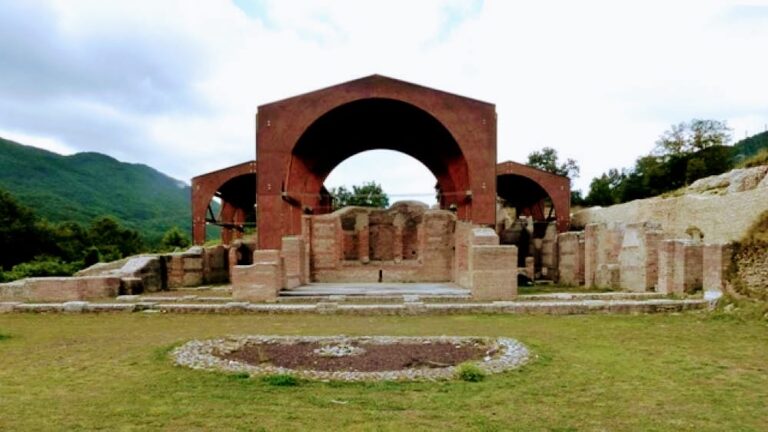
Castrum Porciani occupies a hill overlooking Lake Canterno. After successive expansion, the fortified settlement covered about five hectares. The site survives in ruinous form, including part of a tower, while dense vegetation and woodland cover much of the former castle area. This vegetation also makes the remains difficult to access.