Casamari Abbey: A Cistercian Monastery in Italy
Site at a Glance
- Rating
- 4.7
- Popularity
- Medium
- Country
- Italy
- Primary era
- Medieval
- External website
- Open
- Eras represented
- Classical, Medieval, Modern
- Civilizations
- Papal States, Roman
- Site type
- Religious
- Remains
- Monastery
On this page16 sections
History
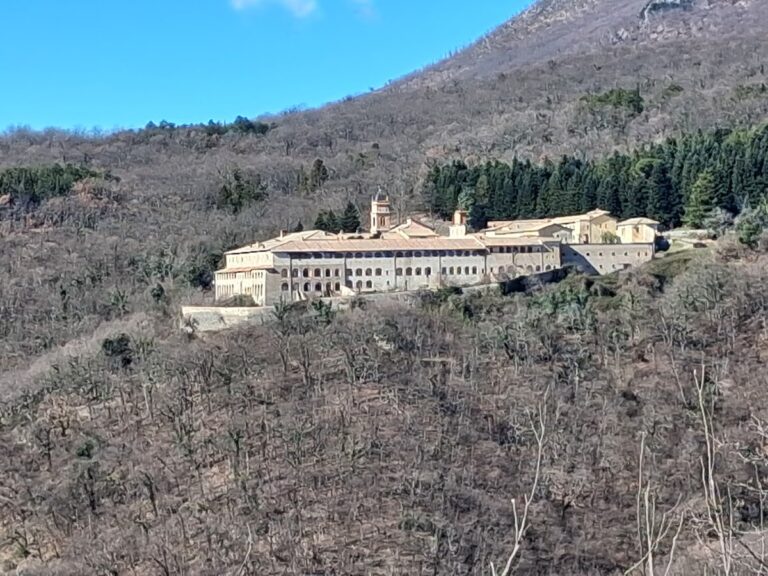
Casamari Abbey is a Cistercian monastery in Casamari, Italy, rebuilt between 1203 and 1217 in an early Italian Gothic style influenced by Burgundian architecture. It stands on the site of the ancient Roman municipium of Cereatae, a town incorporated into the Roman state while retaining a degree of local self-government and civic organization. The settlement, also known as Cereatae Marianae, declined during the later Roman Empire amid economic and social crisis and barbarian invasions.
Roman site and Benedictine origins
The beginnings of the monastery are uncertain. A thirteenth-century chronicle places its origin in the ninth century, while another tradition describes the gathering of monks and the foundation of a church dedicated to Saints John and Paul in 1005, followed by the construction of a monastery around 1036. Other historical summaries date the Benedictine foundation to 1053.
The first community was Benedictine. It began as a small monastery with a modest church and expanded in the mid-eleventh century under Abbot Giovanni. Its influence grew through donations, the acquisition of chapels, and the revenues and pastoral work connected with them. The abbey’s library is traditionally associated with this period, having been founded in 1036.
Cistercian reform and medieval expansion
Casamari entered a new phase during the schism between Antipope Anacletus II and Pope Innocent II. Bernard of Clairvaux promoted the monastery’s incorporation into the Cistercian Order, a Catholic movement that emphasized strict communal prayer, work, discipline, and separation from worldly wealth. Innocent II approved the change, generally dated to around 1140, although the transition is also placed between 1140 and 1152. Casamari became a foundation of Clairvaux and was listed in the Cistercian directory as the twenty-ninth foundation of Citeaux.
The Cistercian abbey developed through donations and purchases, including chapels that supported pastoral, social, and political activity. Its monks helped establish affiliated monasteries in southern Italy, including Sambucina, Matina, San Galgano, Sagittario, and Agrigento. Casamari itself received substantial princely donations.
Between 1182 and 1184, Joachim of Fiore stayed at Casamari. He was a twelfth-century Italian abbot and religious thinker who founded the Florensian Order and wrote influential works of biblical interpretation. Abbot Giraldo received him at the abbey, where he also met Pope Lucius III. The pope granted Joachim permission to write, and he began composing the Concordia of the Old and New Testaments and the Exposition of the Apocalypse at Casamari.
The present church and abbey were completely rebuilt for the Cistercians between 1203 and 1217. The church was consecrated in 1217, establishing the medieval complex whose architecture remains central to Casamari’s identity.
War, commendatory rule, and reform
At the beginning of the fifteenth century, Ladislaus of Anjou plundered the abbey. In 1417, fighting between the forces of Queen Joanna II of Naples and those of Braccio da Montone, who had occupied the monastic complex, caused major damage and destroyed the western wing.
In 1430, Pope Martin V appointed his nephew, Cardinal Prospero Colonna, commendatory abbot of Casamari. A commendatory abbot received an abbey’s revenues and exercised authority without necessarily living with or directly governing its community. At Casamari, this system placed finances under outside control and contributed to decline. By 1623, the community had been reduced to eight monks. The abbey joined eight other monasteries in the Roman Congregation for mutual support, an arrangement that lasted until 1650.
In 1717, commendatory abbot Annibale Albani introduced the Trappist reform by bringing monks from the Trappist monastery of Buonsollazzo in Tuscany. This strict reform of Cistercian observance brought a period of renewed prosperity and religious discipline.
Suppression, restoration, and modern religious life
On 13 May 1799, French soldiers returning from the assault on Naples sacked the abbey and its church. After desecrating the tabernacle and scattering the consecrated hosts, they killed Prior Simon Cardon and five fellow monks as the group attempted to recover them. The six monks became known as the martyrs of Casamari. Their martyrdom received official recognition in 2020, and they were beatified in 2021.
Napoleon’s forces suppressed the abbey in 1811. Surviving monks returned by 1814 and resumed monastic life under the direct authority of the Holy See. Pope Pius IX ended the office of commendatory abbot in 1825. Casamari assumed jurisdiction over the Monastery of San Domenico near Sora in 1833 and Valvisciolo Abbey near Sermoneta in 1864. With these dependencies, it developed into an autonomous congregation subject directly to the Holy See.
Casamari was declared a national monument in 1874. The San Bernardo Institute was founded within the complex in 1898, and the abbey supported prayer, teaching, pharmaceutical production, liqueur production, book restoration, library work, and archaeological and art-museum activities.
In 1929, the Holy See formally recognized the Congregation of Casamari and united it with the other congregations of the Cistercian Order. The Cistercian monks returned to Casamari in the same year after the modern interruption of their presence. The abbey became the congregation’s mother house and the residence of its abbot.
At the invitation of Pope Pius XI, the community promoted Catholic monasticism in Eritrea and Ethiopia. Its first overseas foundation was established in Ethiopia in 1940, followed by foundations in Eritrea, Brazil, and the United States. The congregation comprises roughly 130 to 200 monks in about 11 to 12 monasteries.
Among those connected with this expansion was Father Felix Mary Ghebreamlak, an Ethiopian Catholic priest who entered the community with twelve other Ethiopian men in preparation for Catholic monastic life in Ethiopia. He died at Casamari in 1934 after being allowed to profess his vows while terminally ill and was buried at the abbey. A cause for his possible canonization was later opened. In 1957, Pope Pius XII elevated the abbey church to the status of a minor basilica, an honorary papal title for a church of particular historical, religious, or pastoral importance.
Remains
Monastic complex
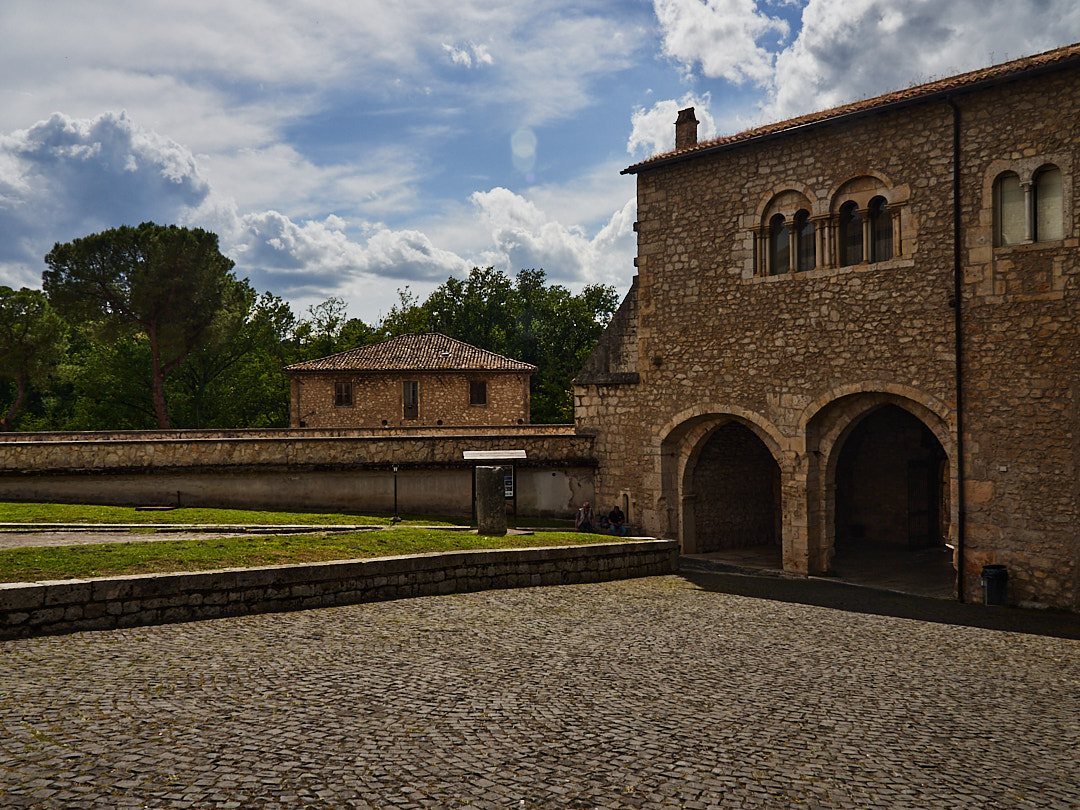
The surviving complex is arranged around a quadrangular cloister set within a garden. Its buildings are entered through a double-arched gate, and the cloister’s four galleries have semi-cylindrical ceilings. The arrangement preserves the principal relationship between the communal spaces and the church, while the surviving buildings also include the chapter house, library, museum rooms, and other monastic facilities.
Gate and cloister
The double-arched entrance forms the approach to the conventual buildings. Inside, the cloister provides the organizing centre of the complex, with four covered galleries surrounding the quadrangular garden. The galleries have semi-cylindrical ceilings and connect the principal monastic spaces.
Chapter house
The chapter house has nine bays supported by four pillars. A chapter house is the room where a monastery’s community meets for official business, discipline, and readings from its rule. At Casamari, the room continues to serve for meetings.
Abbey church
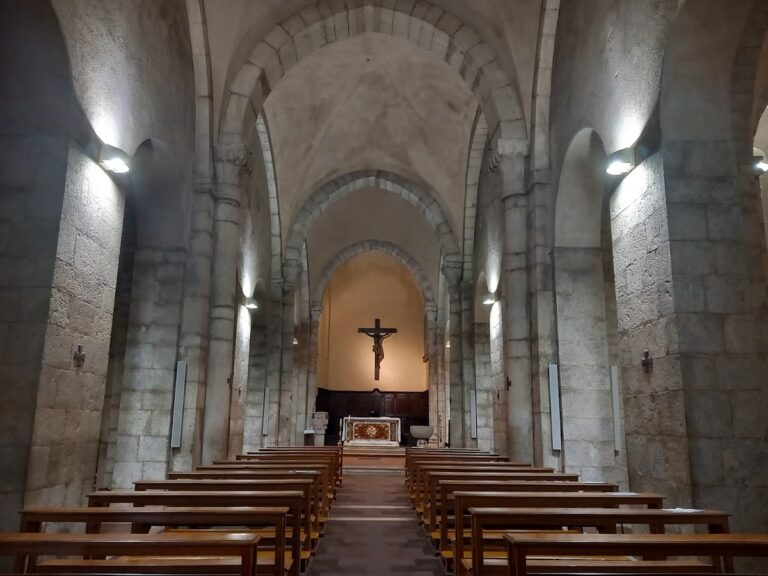
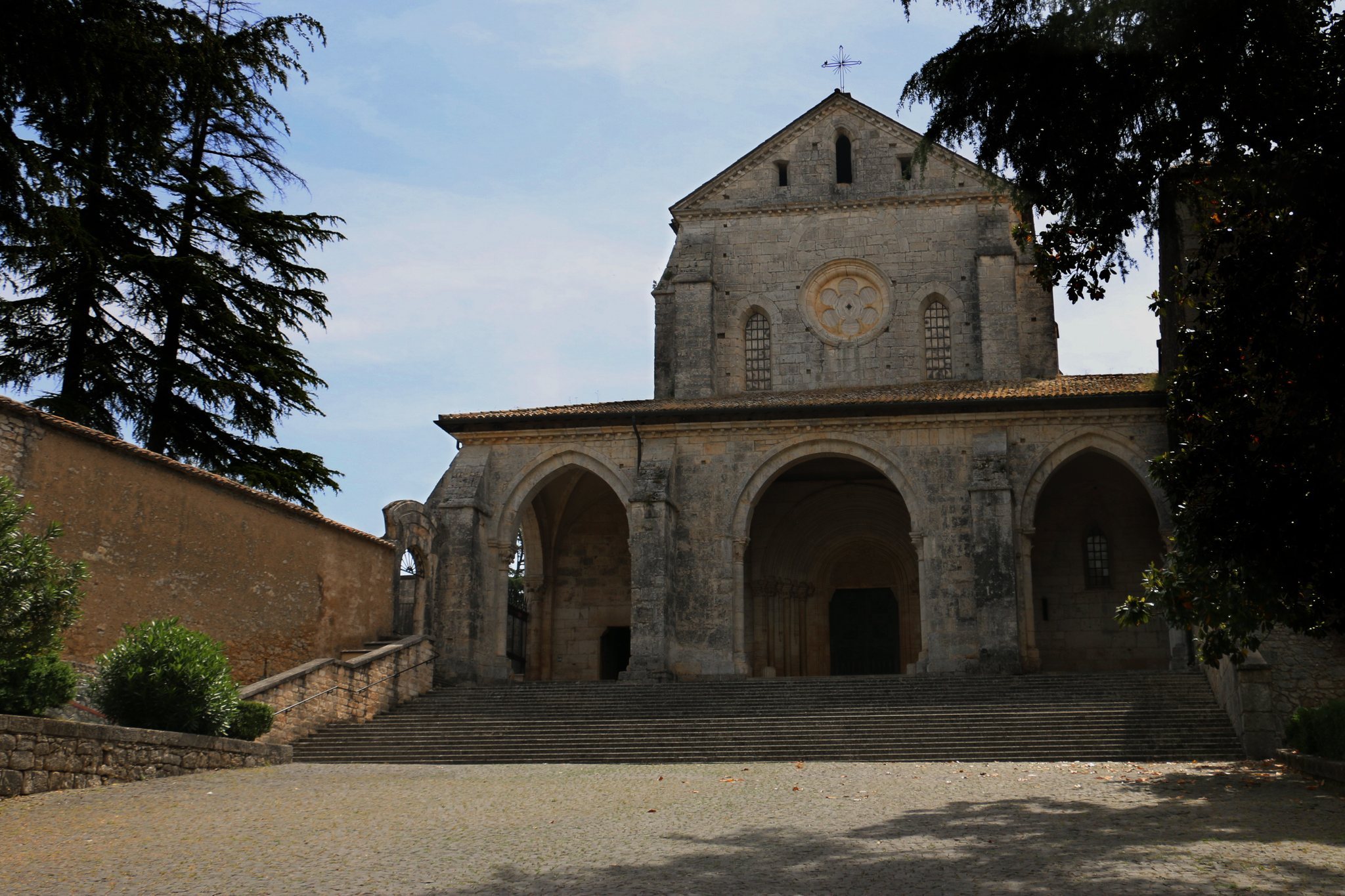
The church is a basilica with a nave and two aisles, reached from the cloister. A large external portico stands on the façade, while alabaster sheets take the place of glass in the windows. Its plan follows contemporary French monastic models and is comparable with the Cistercian architecture of Fossanova.
Cistercian interior
The church has a flat-ended east end, ventilation openings beneath the nave’s upper windows for the roof spaces over the aisles, and paired lateral chapels opening onto both sides of the transept. Rib vaults are supported at the angles of the responds. The builders probably also worked at Fossanova, where construction took place between 1186 and 1208, but at Casamari they used rib vaulting rather than the earlier groin-vaulting approach.
Choir and baldachin
A large baldachin stands in the choir. This type of canopy emphasizes the ceremonial space beneath it, and the Casamari baldachin was presented to the monks by Pope Clement XI. The choir behind the altar was added in the mid-twentieth century by Vincenzo Domenico De Donatis of Sora and his sons. The contemporary pipe organ is Mascioni opus 542.
Archaeological and monastic collections
The complex incorporates remains of the ancient site of Cereatae, associated with the alternative name Cereatae Marianae. The site is linked with Caius Marius, a Roman general and statesman who held the consulship seven times and opposed Sulla during the Roman civil war of 88 BC. One tradition identifies it as his birthplace, while another places a temple of Mars beneath the later abbey. The name Casamari has likewise been explained as either Casa Marii, “House of Mary,” referring to the abbey’s dedication to the Virgin, or “House of Marius,” an interpretation also associated with the nearby Via Maria.
Museum and picture gallery
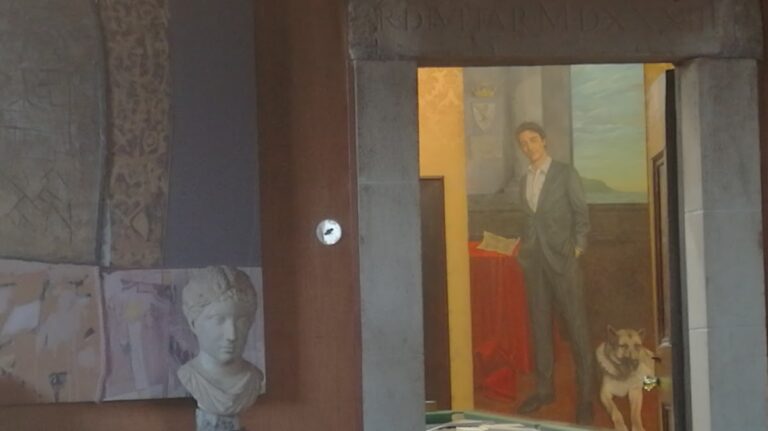
The museum and picture gallery occupy the side of the complex opposite the church and extend from the cloister. Their thirteenth-century rooms contain Roman archaeological material and part of a tusk attributed to Elephas or Mammuthus meridionalis, possibly a dwarf mammoth.
Pharmacy and liqueur workshop
The internal pharmacy includes a botanical herbarium or garden and a cabinet for pigments. Its foundation date is uncertain but has been placed around 1760. The internal liqueur workshop developed between the eighteenth and nineteenth centuries, when the monks also made bottles.
Library and printing press
The library, founded in 1036, now contains approximately 80,000 volumes. Its holdings include the Italian Documentation Centre on the Order of the Temple and the Padre Goffredo Viti collection. The abbey’s printing press began operating in 1954 and also produced school texts.