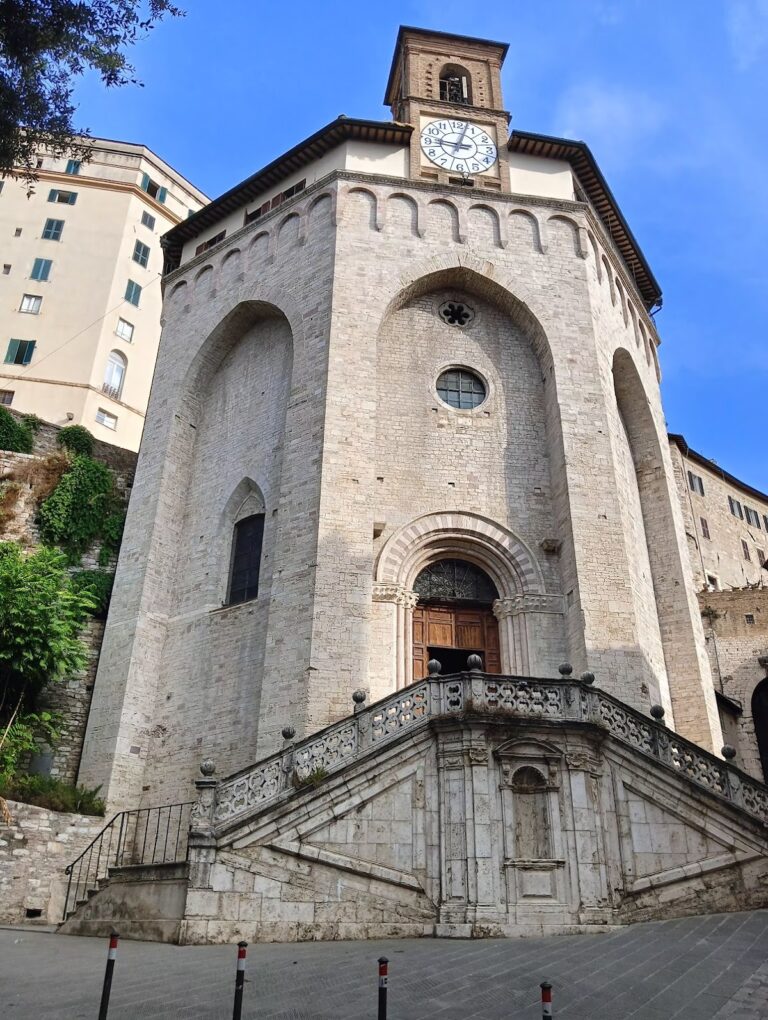
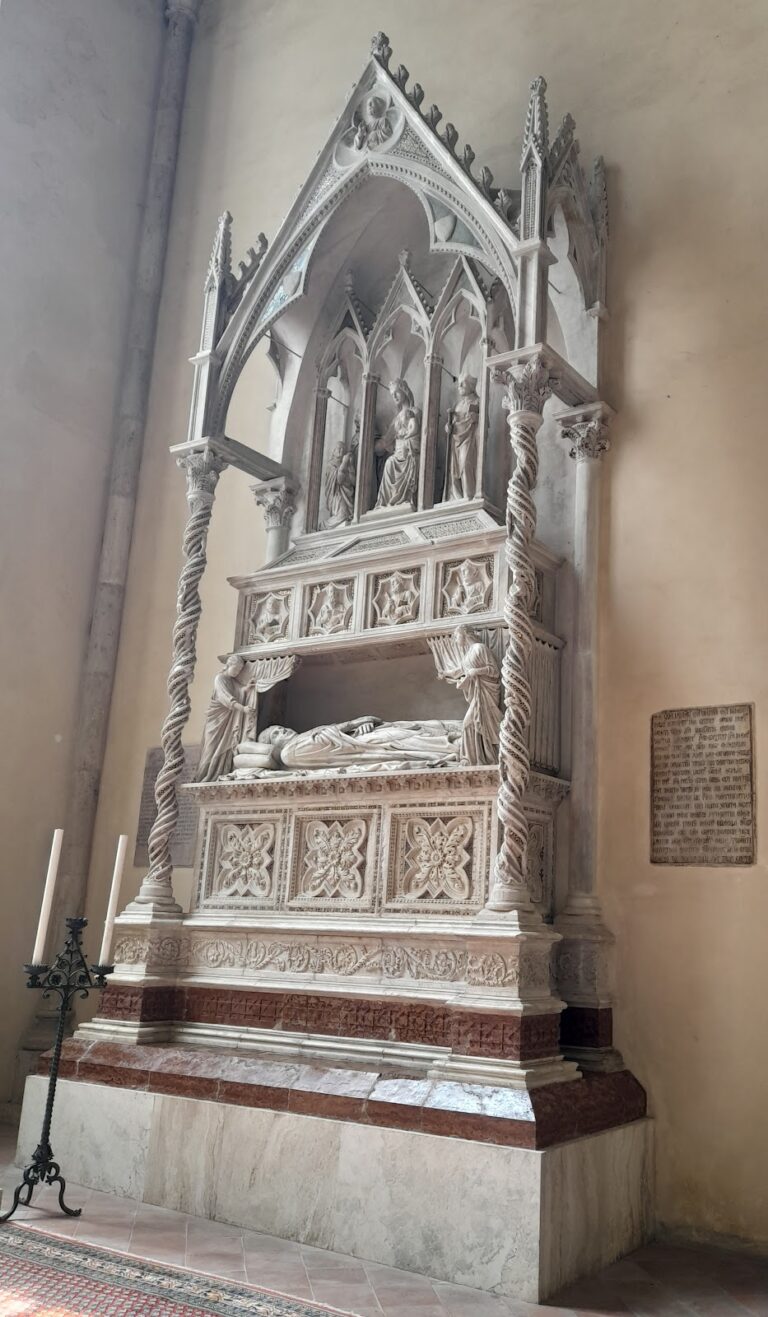
Santa Maria di Monteluce: A Franciscan Church and Former Poor Clare Monastery in Perugia
Site at a Glance
- Rating
- 4.6
- Popularity
- Very Low
- Country
- Italy
- Primary era
- Medieval
- External website
- Open
- Eras represented
- Medieval, Early Modern, Modern
- Civilizations
- Papal States
- Site type
- Religious
- Remains
- Church
On this page14 sections
History
Santa Maria di Monteluce, also called Santa Maria Assunta di Monteluce, is a Roman Catholic church in Perugia, Italy, founded in the thirteenth century for women drawn to the Franciscan ideal. It became the home of the city’s oldest community of Poor Clares, the contemplative Franciscan order founded by Clare of Assisi, and remains a parish church of the Archdiocese of Perugia-Città della Pieve.
Foundation of the Damianite monastery
The history of Santa Maria di Monteluce began in 1218, when the Perugian nobleman Count Glotto Monaldo donated land to the Church for women wishing to follow the Franciscan way of life. Giovanni, Bishop of Perugia, authorized construction of the church and monastery that same year. In 1219, Cardinal Ugolino of Anagni, who later became Pope Gregory IX, confirmed the monastery’s construction and approved the Order of San Damiano.
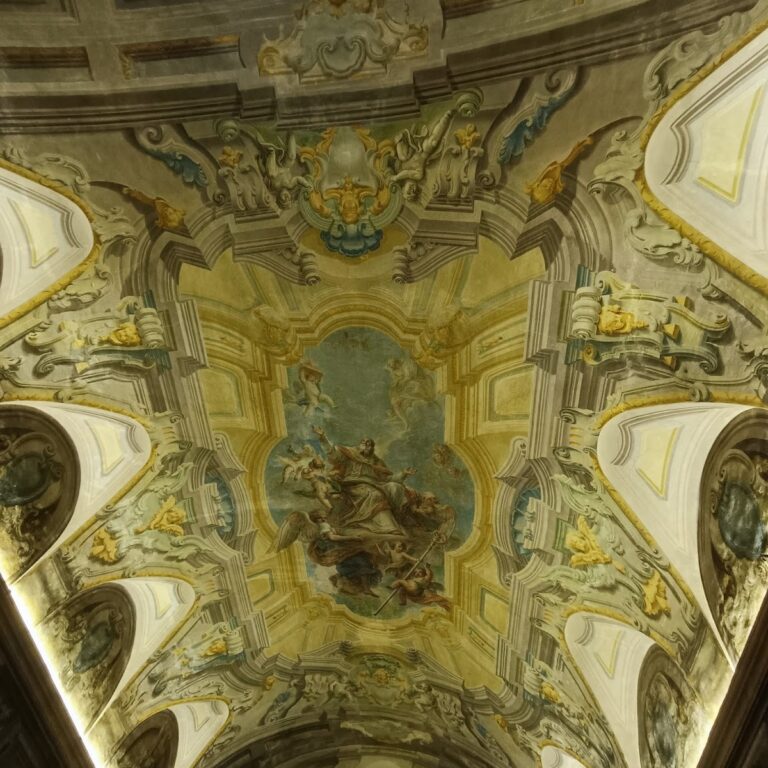
The women associated with the new foundation were known as Damianites, an early name for the Poor Clares connected with the monastery of San Damiano. Santa Maria di Monteluce consequently became an important center of female Franciscan religious life in Perugia. Donations later made the monastery the city’s wealthiest and most prestigious women’s monastery during the sixteenth, seventeenth, and eighteenth centuries. The church’s extensive painted decoration reflects this long period of prosperity.
From monastery to parish church
After the unification of Italy, confiscations of ecclesiastical property altered the institution’s history. The monastery ceased to function in 1910, when construction began on the new Santa Maria della Misericordia Hospital. The hospital was transferred to the site from Via Oberdan, while the Poor Clares moved to Sant’Erminio. Santa Maria di Monteluce then continued as a parish church.
The former monastery was almost entirely demolished for the hospital. Between the early 2000s and 2009, the hospital was gradually transferred to the unified medical center at San Sisto on the outskirts of Perugia. The former hospital area was later adapted for municipal offices and residential use. Construction work revealed the bases of the old cloister columns, preserving physical evidence of the monastic complex. The square that once occupied the monastery’s site was named for Cecilia Coppoli, its last abbess.
The church remains in use for worship. The Feast of the Assumption, celebrated on 15 August, has traditionally been linked with the centuries-old Fiera di Monteluce and other local celebrations, which have been revived in recent years.
Remains
Santa Maria di Monteluce has a rectangular, single-nave plan. Its present interior is covered by a round vault carried on twelve supports, while the vault conceals an earlier arrangement of large Gothic arches. The surviving decoration brings together medieval, Renaissance, eighteenth-century, and Perugian Mannerist elements, a local form of Mannerism known for deliberately unusual forms and complex expressive effects.
Facade and chapels
Facade and entrance
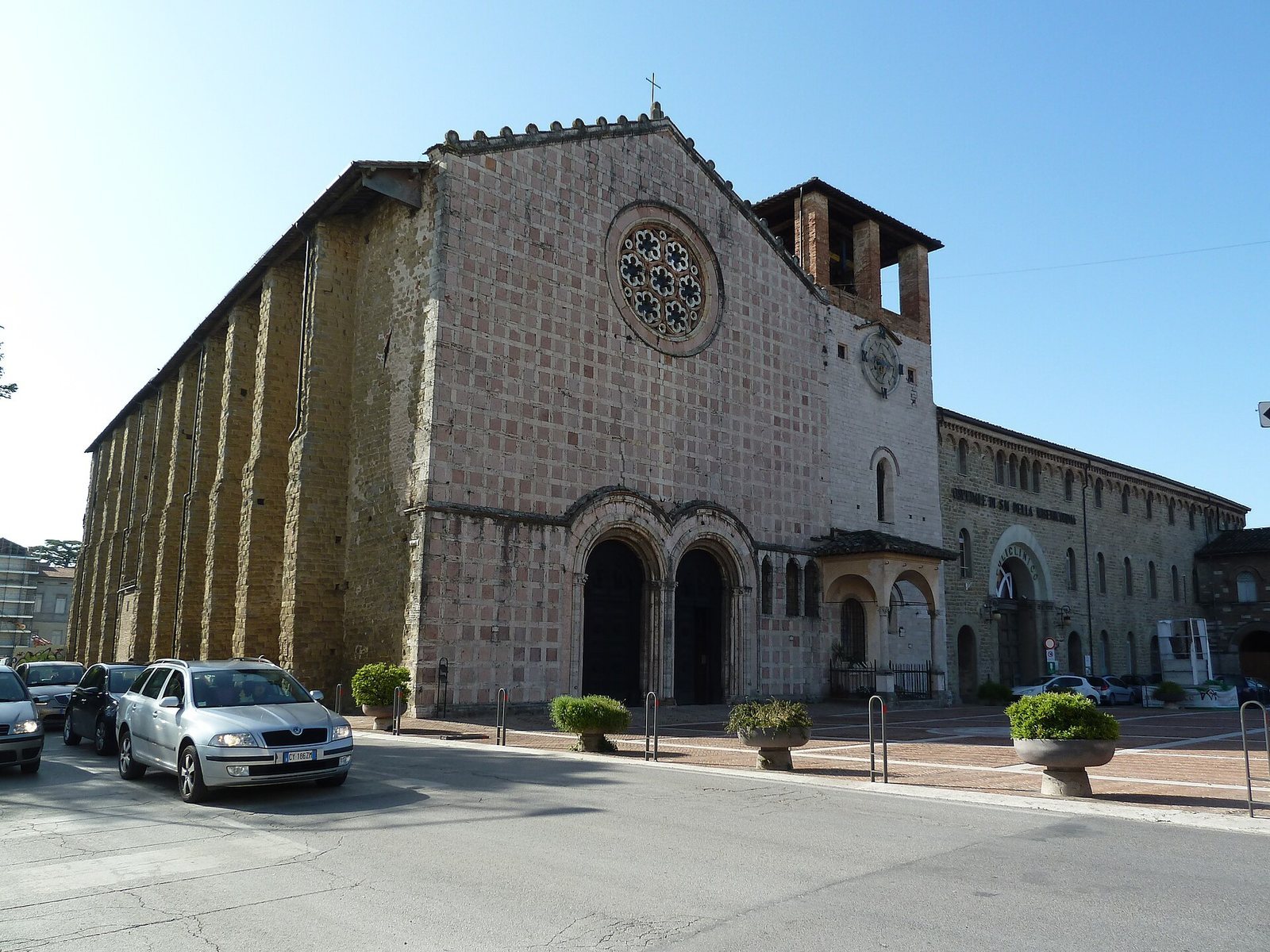
The facade was restored in 1451 and is faced with pink marble panels set within white frames. Its medieval portal has two round arches and wooden shutters decorated with late-Mannerist carved reliefs of Saints Francis, Clare, and Bernardino. Projecting sandstone buttresses flank the facade. Their form has been compared with the buttresses of San Bevignate and Santa Maria di Valdiponte, also known as Montelabbate.
Renaissance chapel
To the right of the portal, beside the bell tower, stands a Renaissance chapel. It was formerly decorated with frescoes by Anton Maria Fabrizi, an eighteenth-century artist. The chapel now contains a modern painting by Nello Palloni, copied from a fourteenth-century work preserved in the sacristy.
Side-chapel frescoes
The side chapels contain a major cycle of Perugian Mannerist frescoes. The paintings include Christological and Marian subjects, together with scenes associated with evangelization, Marian devotion, and penitential practice. Saints Francis and Clare appear among the figures, as do promoters of the Franciscan Observance, a reform movement that emphasized stricter discipline, poverty, and an eremitical way of life.
Parts of the cycle have been attributed to the seventeenth-century painter Matteuccio Salvucci because of their caricatural expressiveness. Other proposals have named Francesco Vanni and Giovanni Maria Bisconti, but the strong stylistic differences among the frescoes prevent a secure attribution for the entire group. Some of the paintings date from around 1607.
The first chapel on the right contains a detached fresco of the Crucifixion. A detached fresco is a wall painting removed from its original plaster support. This work is attributed to Fiorenzo di Lorenzo and dates from the end of the fifteenth century.
Apse and movable artworks
Apse decoration
The rear wall of the apse is enclosed by a gilded-stucco framework made by Valentino Carattoli, an eighteenth-century artist. Within it is Giovanni Silvagni’s 1831 copy of the Coronation of the Virgin. The copy replaced an earlier altarpiece painted by Giulio Romano and Giovan Francesco Penni in Rome in 1523 and 1524 from designs by Raphael.
French forces confiscated the original altarpiece in 1797. It was returned in 1815 but retained in the Vatican Pinacoteca, where it remains. Its predella, the lower section of an altarpiece that usually contains smaller scenes or figures, is attributed to Berto di Giovanni and is held by the National Gallery of Umbria.
Marble tabernacle and former altarpiece
A marble tabernacle by Francesco di Simone Ferrucci stands in the lower right part of the church. Dated 1487, it depicts the Eternal Father surrounded by angels. Another work formerly kept in the church, Fiorenzo di Lorenzo’s Adoration of the Shepherds, was confiscated by French forces in 1812 and returned in 1817. It is now in the National Gallery of Umbria.
Former nuns’ choir
Behind the presbytery is the former nuns’ choir, a Gothic room with ribbed vaults. A ribbed vault is a ceiling reinforced by projecting structural ribs. The room retains frescoes from the Umbrian-Sienese school, a group of artistic traditions associated with Umbria and Siena, dating from the fourteenth and seventeenth centuries.
Short wall and central crucifix
The short wall facing the church carries late-seventeenth-century frescoes of the Flagellation and the Mocking of Christ. A small carved wooden Crucifix stands in a niche at the center. The lower register contains images of saints and a fourteenth-century Coronation of the Virgin.
Long wall frescoes
The long wall is covered by a series of apparently votive fourteenth-century frescoes. Their subjects include the Stigmata of Saint Francis, Saint Onuphrius the Hermit, the Archangel Michael, and the Baptism of Christ, as well as four episodes from the life of Saint Catherine. Traces of further paintings remain in the upper register.
An initial restoration recovered figures of Saint Catherine of Alexandria, Saint Euphemia, and Saint Eustace. Other figures beside these three panels remain visible and require restoration.