Perugia Cathedral: The Metropolitan Cathedral of Perugia, Italy


Site at a Glance
- Rating
- 4.6
- Popularity
- Medium
- Country
- Italy
- Primary era
- Medieval
- External website
- Open
- Eras represented
- Classical, Medieval, Early Modern, Modern
- Civilizations
- Italian, Papal States, Roman
- Site type
- Religious
- Remains
- Cathedral
On this page25 sections
History
Perugia Cathedral is a medieval Christian cathedral in Perugia, Italy, whose present Gothic design derives from a project prepared by the religious builder and architect Fra Bevignate in 1300. Construction began on 20 August 1345, when Bishop Giovanni Andrea Baglioni commissioned the rebuilding, and the work resumed in 1437 before reaching completion in 1490. The church became the principal Catholic place of worship in Perugia and the metropolitan cathedral of the Archdiocese of Perugia-Citta della Pieve, the Roman Catholic ecclesiastical province centred on Perugia.
Earlier cathedrals and medieval rebuilding
Perugia had cathedrals in several locations from the establishment of its bishopric. An earlier cathedral was built between the tenth and eleventh centuries over the ancient Etruscan-Roman forum. Its remains lay along the transept of the present church, linking the medieval cathedral to the city’s much earlier civic and religious centre.
The rebuilding associated with Fra Bevignate created the basis of the present cathedral. Work continued over successive generations, with the long interruption between the initial campaign and its resumption in 1437 forming part of the building’s extended medieval development. The church was officially consecrated in 1569, although later alterations continued to shape both its exterior and interior.
Cathedral, commune, and religious life
The cathedral has long been closely connected with Perugia’s civic institutions and public memory. Saint Bernardino of Siena preached from the external pulpit in 1425 and 1427. During the Salt War of 1540, when Perugia resisted the policies of Pope Paul III, Perugians placed a wooden Crucifix on the pulpit as a public protest. The Crucifix, made by Polidoro Ciburri, remains associated with that episode.
Perugia later expressed gratitude to Pope Julius III after he restored the city’s local magistracies, which Pope Paul III had suppressed. Vincenzo Danti created a bronze statue of Julius III in 1555. By the end of the nineteenth century, the statue had been moved from Piazza Danti to the side of the cathedral, allowing space for the electric tram inaugurated in 1899.
The cathedral’s relationship with the surrounding civic buildings also changed over time. Braccio da Montone commissioned the Loggia di Braccio in 1423. The structure had previously formed part of the Palazzo del Podesta, which was burned in 1534. The original campanile, or bell tower, was destroyed in 1371 by the abbot of Monmaggiore when he connected the fortress of Porta Sole with the palaces on the square. A replacement tower was built between 1606 and 1612.
Consecration, decoration, and later history
During the seventeenth century, the brick upper sections of the cathedral were raised above the external walls. The interior received its completed decorative scheme in the eighteenth century, when paintings, stucco, gilding, and marble transformed the appearance of the medieval Gothic structure. The polychrome marble floor belongs to the nineteenth century.
The Chapel of the Holy Ring preserves the tradition of the Virgin Mary’s wedding ring. In 1473, the German friar Winter of Mainz secretly took the relic from Chiusi and presented it to the bishop of Perugia. The sacred object is publicly displayed twice each year, in July and September, when fourteen locks are opened. The chapel’s history also reflects the disruptions of the Napoleonic occupation. In 1797, French troops requisitioned Perugino’s Marriage of the Virgin from the chapel. The painting reached Paris in 1798 and was sent to the Museum of Caen in 1802. A work by Jean-Baptiste Wicar replaced it in the chapel in 1825.
The cathedral and its associated collections preserve evidence of the building’s changing artistic and religious functions. Fragments of Agostino di Duccio’s Altar of the Pieta, made in 1473 and demolished during the seventeenth century, were restored and transferred to the adjacent Capitular Museum. The Cathedral Museum also preserves Luca Signorelli’s Saint Onofrio Altarpiece, which was removed from the Chapel of Saint Onofrio, together with manuscripts, archaeological excavations beneath the cathedral, and other works formerly connected with the church.
A fire in 1985 damaged the wooden choir and altar. The organ underwent major maintenance and tonal expansion in 2014 and 2015. The first major restoration of the external facades took place between 12 July 2021 and 17 June 2022, covering more than 9,000 square metres and including cleaning, structural consolidation, and improvements to the lighting system. In 2023, a raised pavement running parallel to the main facade enlarged the pedestrian area beside the church.
Remains
Exterior and civic setting
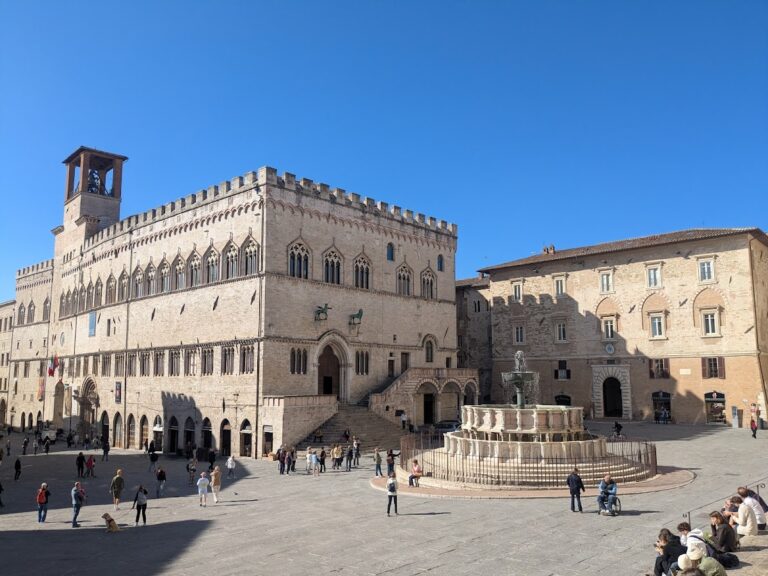
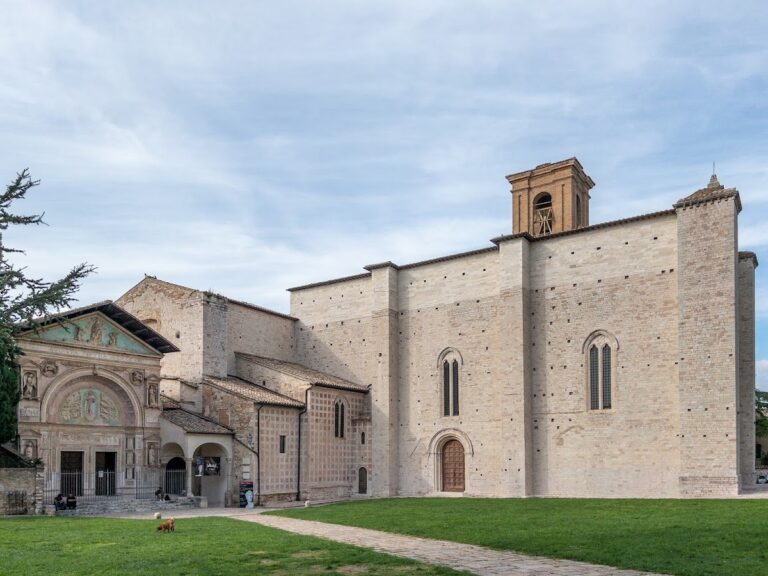
Perugia Cathedral occupies the urban space between Piazza Danti and Piazza IV Novembre. Its principal facade faces Piazza Danti, while its lateral flank faces the city’s main square, opposite the Fontana Maggiore and the Palazzo dei Priori. The exterior remains unfinished and carries a geometric pattern of pink and white marble quatrefoils in its lower sections. The marble was adapted from material taken from Arezzo Cathedral. Hooks for a marble facing remain visible on the facade, showing the point at which the planned external finish was prepared.
The lateral elevation has large Gothic windows and a Renaissance portal designed by Galeazzo Alessi in 1568 and executed in travertine by Ippolito Scalza. An external pulpit incorporates ancient fragments and Cosmatesque mosaics, intricate medieval geometric inlays of coloured stone and glass associated with Roman and central Italian workshops. The wooden Crucifix made by Polidoro Ciburri in 1540 stands nearby.
Loggia and entrance structures
Loggia di Braccio
The Loggia di Braccio is an early Renaissance structure attributed to Fioravante Fioravanti of Bologna. Beneath it are part of a Roman wall and the foundations of the former campanile. The area also preserves Perugian measures for the foot and half-canna, as well as a cast of the Pietra della Giustizia. The original stone is kept in the Palazzo dei Priori, and its inscription of 1234 records the commune’s announcement that all public debt had been repaid.
Staircase, statue, and Holy Door
A staircase leads to the church and carries Vincenzo Danti’s bronze statue of Pope Julius III, made in 1555. On the north side, the Holy Door is decorated with bronze high reliefs made for the 2000 Jubilee by the Perugian sculptor Artemio Giovanni. The main facade has a Baroque portal designed by Pietro Carattoli in 1729.
Campanile
The replacement campanile was designed by Valentino Martelli and built between 1606 and 1612. It contains four old bells cast by different foundries in different centuries. The earlier tower had three tiers of windows and a bronze rooster at its summit. In 1880, Guglielmo Calderini designed an unrealized scheme to complete the facades in a unified Neoclassical manner. Archbishop Federico Foschi submitted the plan to Camillo Boito, but it was abandoned.
Medieval structure and interior decoration
The interior follows a Latin-cross plan with three aisles and an Italian hall-church arrangement, in which the nave and side aisles have approximately equal height and form a unified interior volume. Octagonal piers divide the space, and the cathedral measures 68 metres in length. The central nave is approximately two to two and a half times wider than the side aisles.
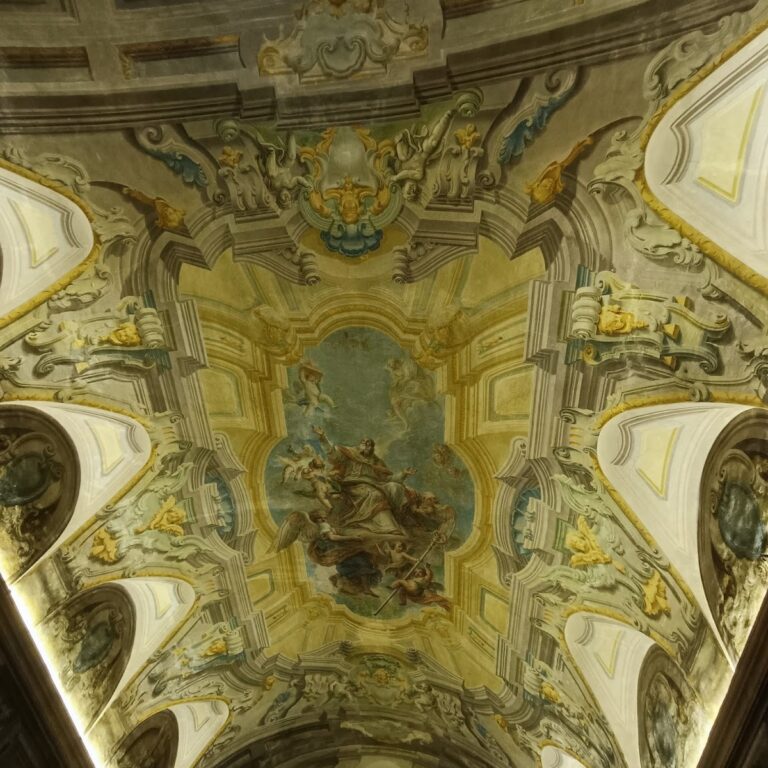
The Gothic structures were covered during the eighteenth century with marbled stucco and fine gilding. Francesco Appiani, Vincenzo Monotti, Valentino Carattoli, Carlo Spiridione Mariotti, Marcello Leopardi, and Domenico Sergardi decorated the ribbed vaults supported by the octagonal piers. On the counterfacade, Giovanni Antonio Scaramuccia’s large 1616 canvas shows the Virgin among Perugia’s patron saints and Saints Augustine, Dominic, and Francis. Their lay confraternities contributed to the painting. The same area contains the 1451 sarcophagus of Bishop Giovanni Andrea Baglioni, attributed to Urbano da Cortona.
Rose window and episcopal monument
The central rose window depicts the martyrdom of Saint Lawrence, the third-century Christian deacon and martyr traditionally associated with Rome. The present stained glass was made by the Moretti Caselli workshop and executed by Ludovico Caselli in 1919, replacing an earlier window by Guglielmo Marcillat. Nearby, Domenico Guidi of Carrara’s 1668 funerary monument to Bishop Marcantonio Oddi shows the bishop kneeling above allegories of Time and Fame.
Chapels and devotional works
Chapel of the Holy Ring
The Chapel of the Holy Ring is a reliquary chapel, a space designed to preserve and display a sacred relic. Its principal object is a presumed wedding ring of the Virgin Mary, a green stone identified as chalcedony or onyx. Bino di Pietro, Federico, and Cesarino del Roscetto made the Renaissance reliquary. Bernardino and Giacomo di Matteo produced the enclosing iron grille between 1496 and 1511. Its parapet bears a Latin inscription referring to the ring and its guardian.
The chapel’s present marble frame was made by Francesco Caselli between 1753 and 1761. Its fifteenth-century altar is by Benedetto Buglioni, and Francesco Moretti’s stained-glass Adoration of the Shepherds dates from 1873. The chapel formerly contained frescoes by Pinturicchio and Perugino’s Marriage of the Virgin, while Jean-Baptiste Wicar’s replacement painting was installed in 1825.
Chapel of Saint Bernardino
The Chapel of Saint Bernardino contains Federico Barocci’s Deposition from the Cross, painted in 1569 and regarded as a major work of sixteenth-century European painting. The Collegio della Mercanzia, a mercantile corporation or guild, commissioned the work and held the chapel from 1515. Other features include a stained-glass design of Saint Bernardino preaching by Hendrik van den Broeck, a walnut bench carved by Jacopo di Antonio Fiorentino and Ercole di Tommaso del Ricco between 1565 and 1567, and an altar designed by Giovanni Cerrini in 1796.
Right aisle and Baptistery Chapel
At the beginning of the right aisle stands a large canvas of the Nativity of the Virgin, attributed either to Vincenzo Pellegrini or Giulio Cesare Angeli. Its central bifora, or paired window, reveals a landscape that contributes to the painting’s perspective.
The Baptistery Chapel was built in 1855 to a design by Giovanni Santini. It contains a Renaissance marble architectural prospect by Pietro da Como, dated 1477 to 1479, and another by Pietro di Paolo di Andrea da Como. Domenico Bruschi’s Baptism of Jesus and stained glass showing the Eternal among Angels date from 1876. The chapel also has Giuseppe Luchetti’s baptismal font of 1876 and a wooden Crucifix carved by Christophe Fournier in 1656.
Chapel of the Sacrament
Galeazzo Alessi designed the Chapel of the Sacrament in 1576. Its works include Cesare Nebbia’s Pentecost of 1563, Orazio Alfani’s Martyrdom of Saint Sebastian of 1572, Neoclassical frescoes by Marcello Leopardi, and Tito Moretti’s Pieta stained glass of 1874. A marble sarcophagus contains the remains of Pope Martin IV, while relics associated with Popes Innocent III and Urban IV are also preserved there.
Chapel of Saint Stephen and eastern chapels
The right transept contains the Chapel of Saint Stephen, with Giovanni Baglione’s Martyrdom of Saint Stephen from the early seventeenth century. Giuseppe Luchetti’s 1892 monument to Pope Leo XIII, formerly Bishop Giovacchino Pecci of Perugia, stands there, together with a 1615 monument to Popes Innocent II, Urban IV, and Martin IV.
The Chapel of Saint Onofrio contains deteriorated frescoes and an altar painted to imitate inlay, both made by Domenico Bruschi in 1877. The adjacent Chapel of Saint Emidio has Francesco Appiani’s 1784 altarpiece, Saint Emidius Baptizes Polisia.
Apse, choir, and bishop’s throne
The apse walls carry eighteenth-century scenes from the life of Saint Lawrence by Baldassarre Orsini and Carlo Spiridione Mariotti. The wooden choir was made in a Florentine workshop by Giuliano da Maiano and Domenico del Tasso between 1486 and 1491. Its inlaid decoration survived the fire that damaged the choir in 1985. The bishop’s throne, with perspective architectural inlay, was made by Giacinto di Pierfrancesco to a design by Rocco da Vicenza between 1520 and 1524. Rosa and Cecilia Caselli painted the apse windows with local saints between 1932 and 1936.
Chapels of Saint Francis and the Crucifix
The Chapel of Saint Francis contains Ippolito Borghese’s Assumption of the Virgin, painted in 1620, and Bino Sozi’s tabernacle of 1579. The Chapel of the Crucifix has a fifteenth-century wooden Crucifix and an altar designed by Pietro Carattoli in 1735 for the Florenzi marquises. Nearby, Ludovico Caselli’s Holy Family of 1896 hangs above the tomb of the Perugian musician Francesco Morlacchi.
Organ, images, and sacristy
Cathedral organ
The cathedral organ was built by the Tamburini firm of Crema in 1967. It has four keyboards, a pedalboard, fully electric transmission, 87 stops, and 5,178 pipes. The Positive and Grand Organ are positioned behind the high altar in the apse, while the Expressive and Solo divisions occupy the left transept. The pedal pipes are divided between both bodies. Copper pipes arranged in cusp formations form the organ facades, and the independent movable console is generally placed in the left transept.
Chapel of the Gonfalone and column images
The Chapel of the Gonfalone houses Berto di Giovanni’s 1526 processional banner. A gonfalone is a banner used in religious or civic ceremonies, and this example depicts medieval Perugia with numerous towers. It was painted during a severe plague epidemic. The lunette contains a canvas by Giannicola di Paolo, while the adjacent area has Simone Ciburri’s Eternal Blessing Perugia of 1602.
Beside the third octagonal column, a venerated image of the Madonna delle Grazie by Giannicola di Paolo is installed in a wooden Neo-Gothic tabernacle of 1855. A portrait of Saint Bernardino of Siena from the school of Benedetto Bonfigli, dated about 1450, is painted on the first column on the left.
Sacristy
The sacristy contains Giovanni Antonio Pandolfi Mealli’s extensive fresco cycle, painted between 1573 and 1576. The scenes show episodes from the life of Saint Lawrence, biblical narratives, and Perugia’s patron bishops Saint Costanzo and Saint Ercolano, also called Herculanus. Saint Ercolano was traditionally regarded as a bishop, martyr, and patron of Perugia. The decoration also includes major figures of the universal Church, references to Michelangelo, and Roman grotesque ornament revived during the Renaissance.
Cloister, museum, and associated collections
The late Renaissance cloister has a second arcade level on three sides and an older wellhead set into its east wall. Its stairs lead to fifteenth-century San Lorenzo loggias with three superimposed orders. The cloister also provides access to the Cathedral Museum, the Dominici Library, and the Sala del Dottorato.
The Sala del Dottorato retains a memorial plaque recording five conclaves held there between 1216 and 1305, including the conclave that elected Celestine V. Until the nineteenth century, the room was used for conferring degrees in law and medicine. Its frescoes show Pope John XXII between the Emperors Charles IV and Sigismund. Established in the seventeenth century, the Dominici Library contains about 12,000 volumes.
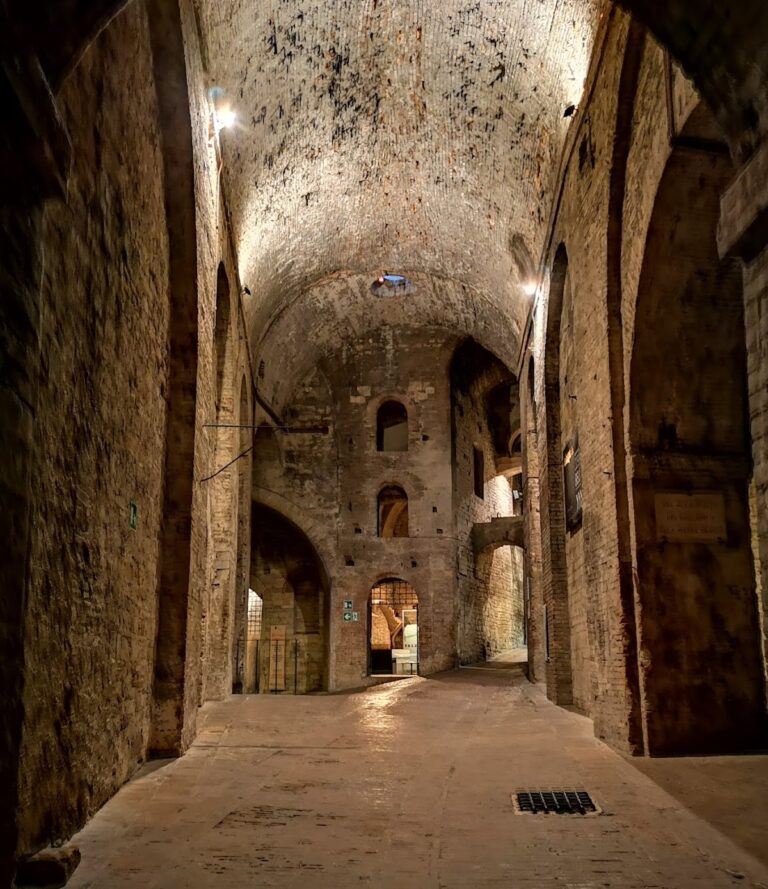
The Cathedral Museum contains a triptych by Meo da Siena, a Madonna by Andrea Vanni, a triptych by Agnolo Gaddi, and Luca Signorelli’s Saint Onofrio Altarpiece. Its collections also include Carlo Labruzzi’s Marriage of the Virgin of 1815, numerous valuable manuscripts including examples from the tenth century, an archaeological section, and excavations in the cathedral’s underground spaces. These collections preserve both the artistic history of the cathedral and material evidence of the earlier structures beneath it.
Nearby sites