Santa Maria della Sorresca: A Catholic Church in Gaeta
Site at a Glance
- Popularity
- Very Low
- Country
- Italy
- Primary era
- Early Modern
- Eras represented
- Early Modern, Modern
- Civilizations
- Kingdom of Naples, Kingdom of the Two Sicilies, Spanish
- Site type
- Religious
- Remains
- Church
On this page13 sections
History
Santa Maria della Sorresca is a Catholic church dedicated to the Virgin Mary in Gaeta, Italy. It belongs to the Archdiocese of Gaeta, the church district led by an archbishop, and developed around a local focus of Marian devotion.
Origins and devotion
On 16 April 1513, an image of the Virgin Mary beneath a portico near Gaeta Cathedral was said to perform miracles. The portico led to warehouses owned by the Albito family, where sorra, also called tonnina, a tuna product preserved in salt or oil, was stored. The image drew growing devotion under the title Madonna della Sorresca, a name associated with this stored product.
A church was erected at the site in 1515. As devotion increased, a new church replaced it, built between 1617 and 1635, probably to a design by Andrea Lazzari. The Albito family and Gaeta’s citizens paid for the work, and the city held patronage rights over the church.
Administration and furnishings
During the eighteenth century, the church was managed by its own governing body, which used offerings to appoint and pay chaplains. Baroque, a European artistic and architectural style prominent in the seventeenth and eighteenth centuries, shaped furnishings added during this period.
Street changes and later use
In the mid-nineteenth century, Ferdinand II, king of the Kingdom of the Two Sicilies from 1830 to 1859, ordered wider roads to improve access to the city’s military facilities, including Via Duomo. The church received its first façade in 1855, probably designed by Ferdinando Travaglini, and service rooms were built facing the new street.
Administration later passed to the Stabilimento della Santissima Annunziata, a historic charitable institution in Gaeta. The church remained in regular use for worship until it closed for religious services in 1966. Since then, it has been used occasionally for exhibitions and other cultural events.
Remains
Exterior and access
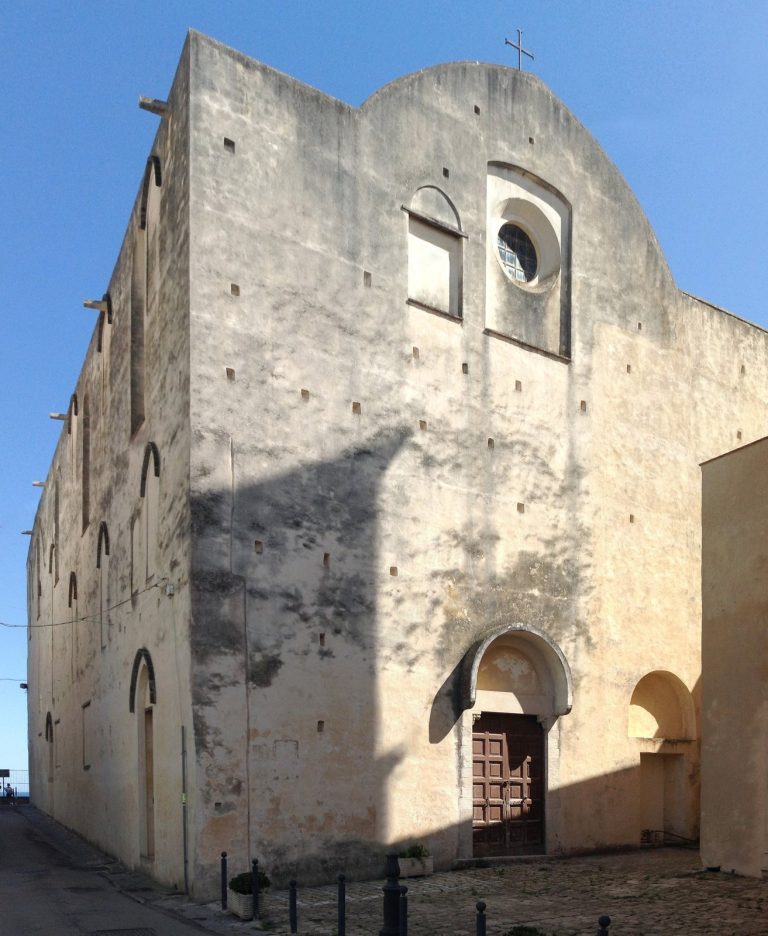
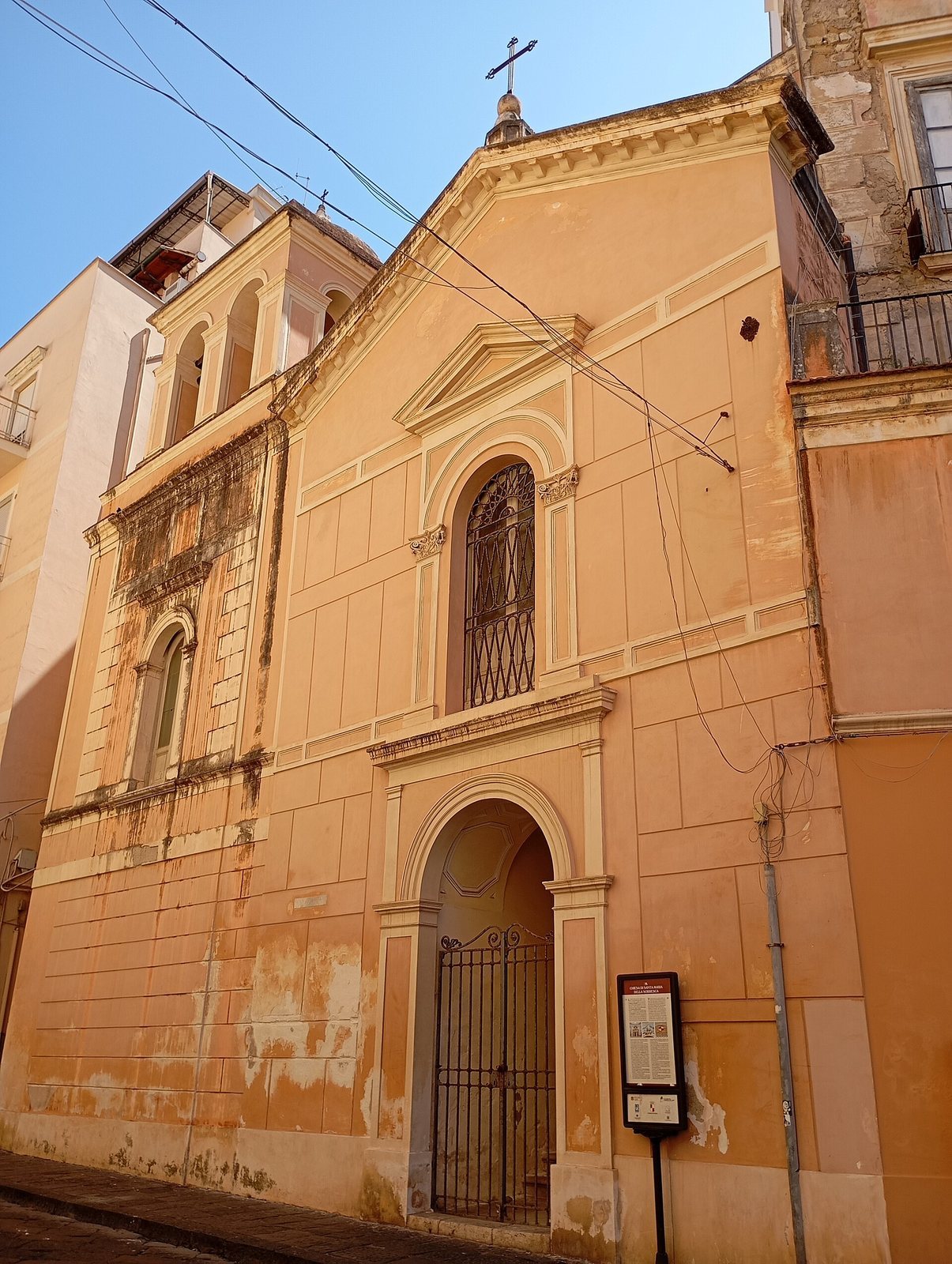
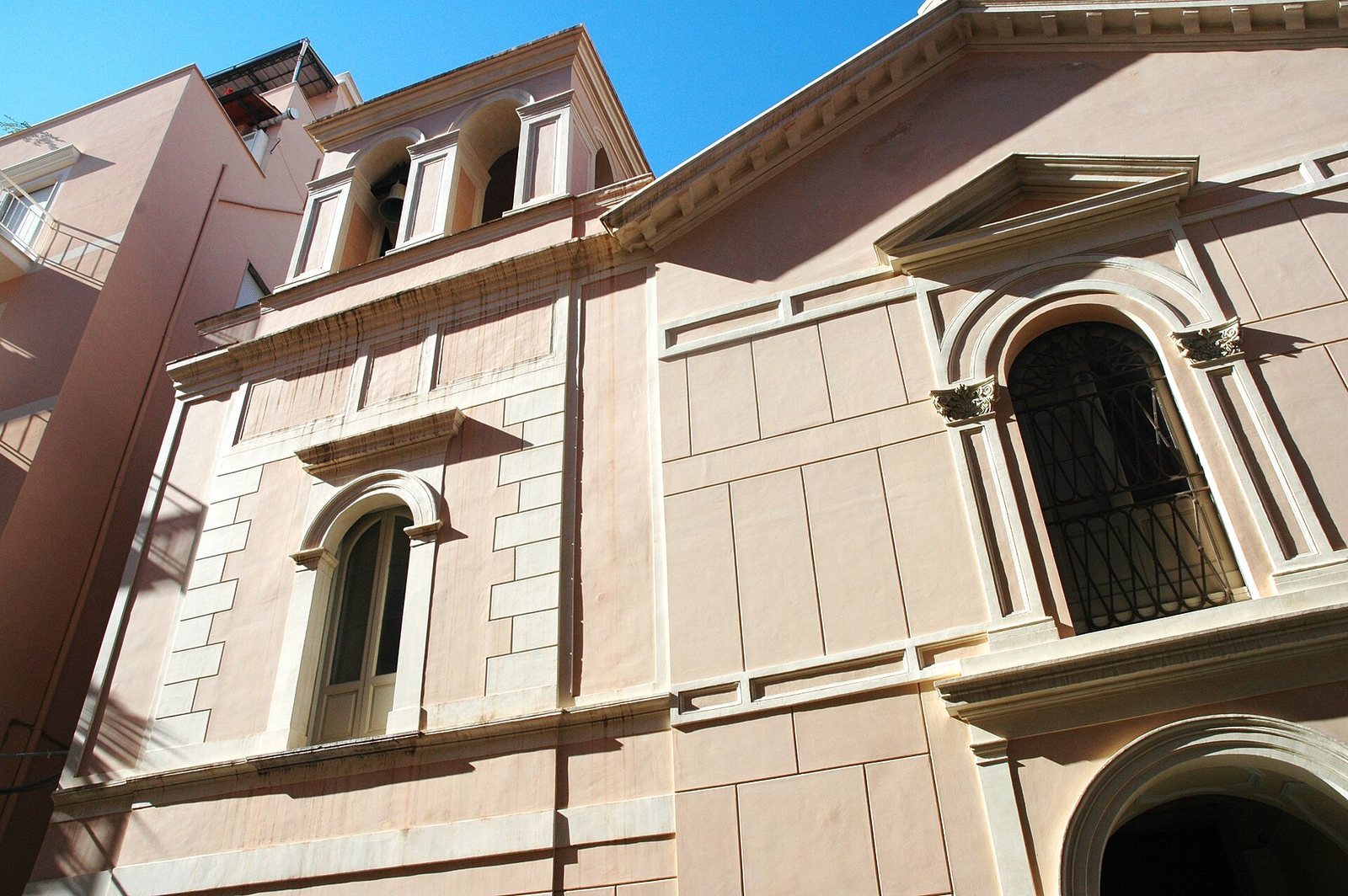
Buildings enclose the church on three sides, and its interior stands above Via Duomo. The façade meets the church at an angle rather than following the interior’s entrance-to-altar line. Its roof-shaped outline frames a round-headed arch, which opens onto stairs between the street and the church. A round-headed window sits above the arch, followed by a triangular top supported by two Corinthian pilasters, flat columns with ornate capitals. To the left is a low bell tower whose upper level opens through a series of arched windows.
Before the present façade was added, entry was probably through a door on the right side, opening onto an alley and not aligned with the altar. The current entrance from Via Duomo follows the altar axis. Two windows, one above the entrance and another to its left, probably help light the interior. Service rooms also face the street.
Interior layout and furnishings
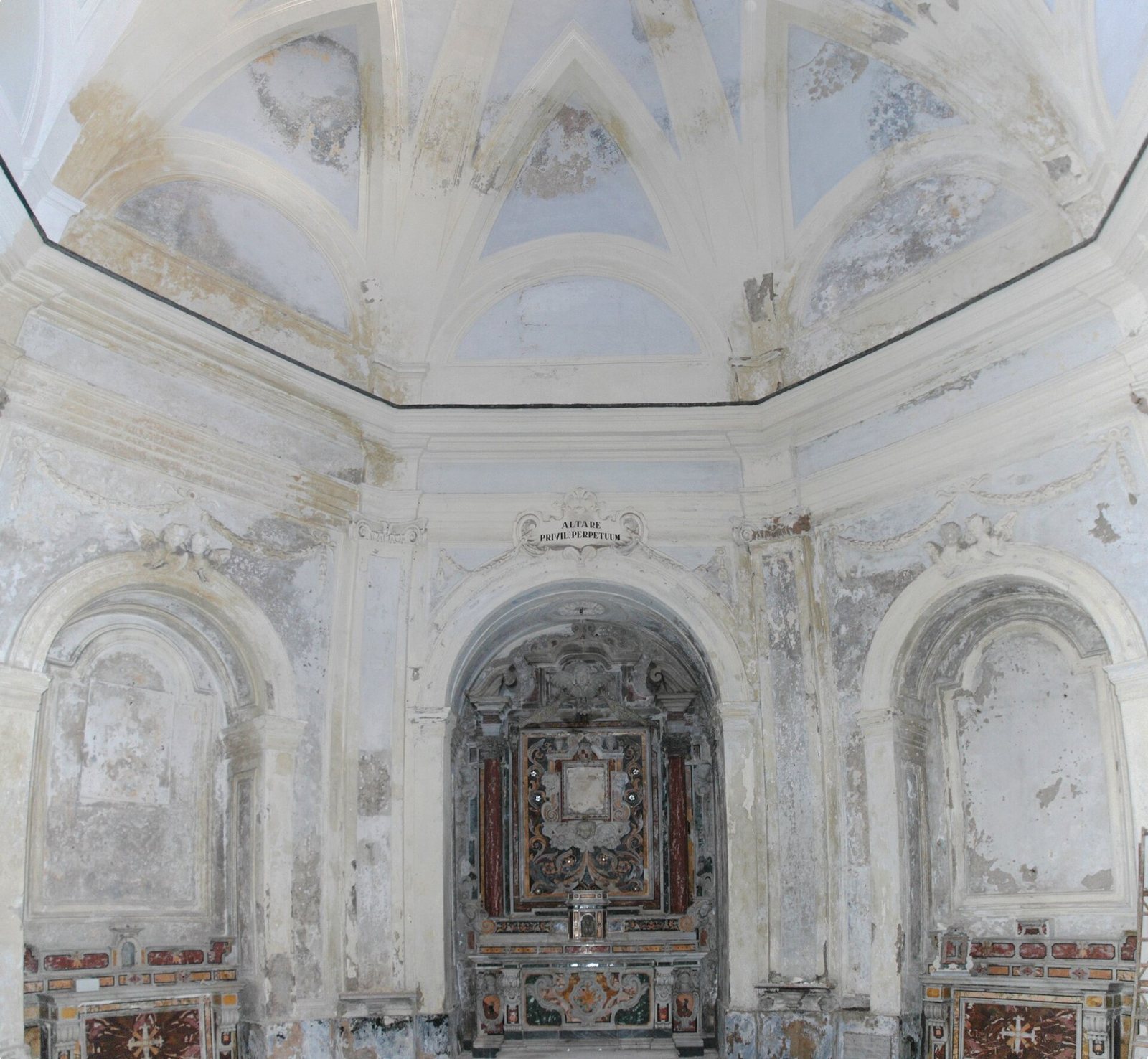
The interior largely preserves its seventeenth-century appearance. Its central space is an octagonal hall, with the main altar set against the rear wall in line with the entrance. Later changes include the axial entrance and side altars.
Dome and wall finish
A dome covers the hall. Curved sections at its base take the place of a supporting cylindrical wall, and a raised roof lantern, lit by eight round-headed windows, crowns it. Aquamarine-coloured plaster covers the walls and ceiling. White details include pilasters, the cornice at the dome’s base, ribs, and stucco decoration.
Choir loft, floor, and organ
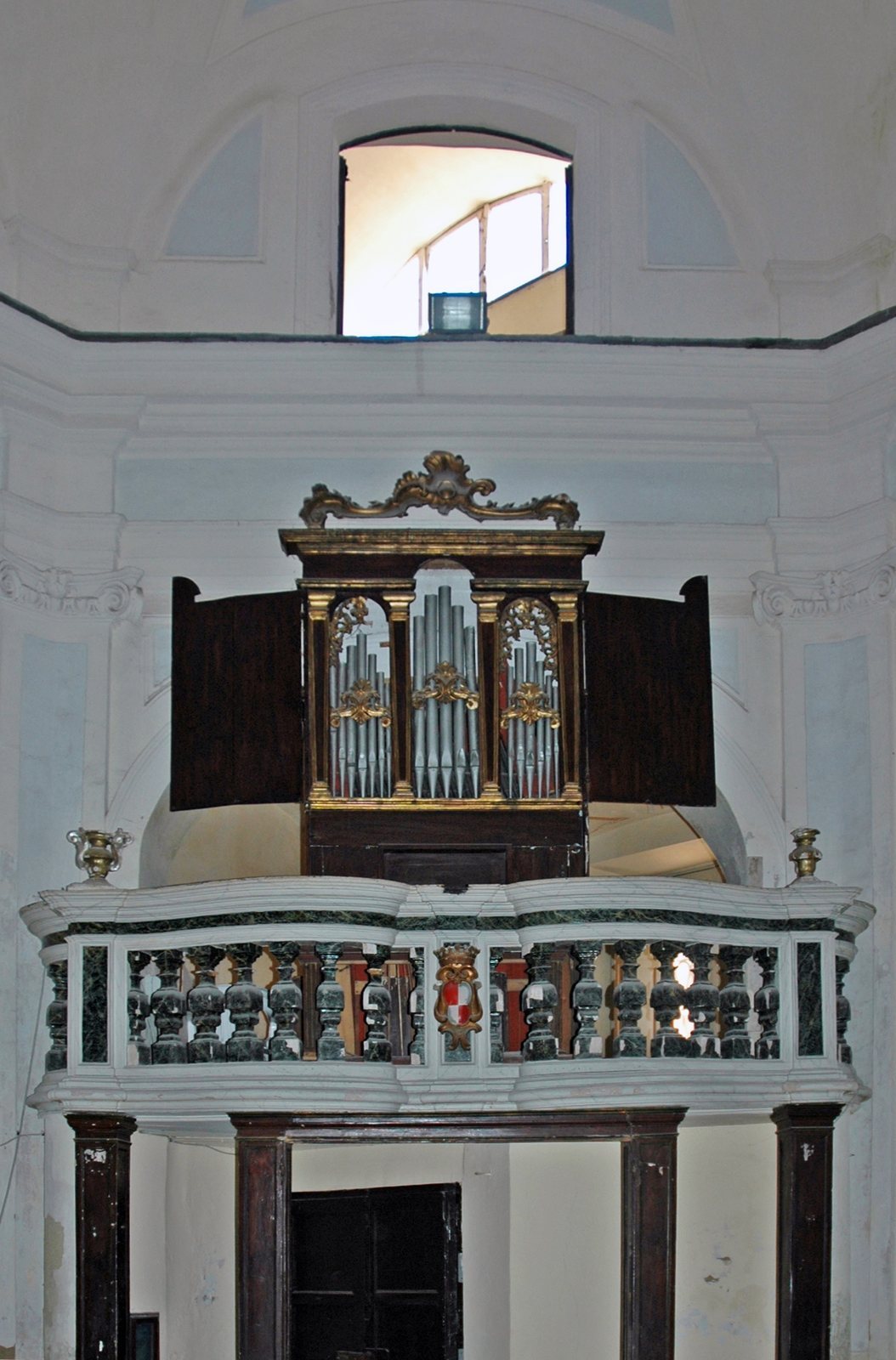
Above the entrance, a choir loft designed by Dionisio Lazzari has a railing painted to resemble white and green marble, with Gaeta’s coat of arms. The floor, also designed by Lazzari, is made of painted, tin-glazed tiles, with the city’s arms at its centre.
The loft contains a pipe organ built by Tomaso de Martino around 1730, in a case designed by Lazzari. It has nine stops, which select groups of pipes, on one manual keyboard. Its foot-operated pedalboard has no independent stops and is permanently linked to the keyboard. The organ is abandoned.
Wall niches
Each of the two walls perpendicular to the entrance-to-altar axis has an arched recess with a curved, tunnel-like ceiling. The left recess holds a twentieth-century harmonium made by A. Radice e Figli of Seveso. Its two stops are Flute 8′ and Clarion 8′; it also has an expression control and couplers that link notes an octave below or above. The 64-note keyboard has a transposer ranging from one semitone higher to two semitones lower.
The opposite recess contains a wooden confessional, an enclosure for sacramental confession. Dionisio Lazzari designed it in the first half of the eighteenth century.
Main altar and devotional image
Dionisio Lazzari made the main altar in the first half of the eighteenth century; Domenico Antonio Vaccaro later altered its front panel and tabernacle. The multicoloured marble altar has a projecting table flanked by the Albito family’s coats of arms. Two steps rise above it, with the upper step decorated in plant patterns in marble and ending in two angel heads. A tabernacle, the central Eucharistic container, stands between them.
Behind the altar, a decorative structure rises between Corinthian columns, with an interrupted triangular top and an elaborate crown. Its dense plant-patterned marble decoration includes mother-of-pearl inlays. It once held the Madonna della Sorresca image, a seventeenth-century replacement for the original, made by an unknown artist. Neapolitan silversmiths added an embossed, openwork silver covering to the image in 1694. The image is now in the permanent exhibition of the Stabilimento della Santissima Annunziata.
Side altars
Pietro Paolo Ferrara made the two matching multicoloured marble side altars in 1781. Ferrara, a pupil of the prominent Italian architect Luigi Vanvitelli, modelled them on the side altars in the Santissima Annunziata sanctuary.
Other works from the church
Other works formerly kept in the church are also in the permanent exhibition of the Stabilimento della Santissima Annunziata. They include Paolo de Matteis’s Madonna del Carmine (1727), a painting of the Virgin of Sorrows known as La Desolata by an unknown artist, and a small dressed statue of the Madonna with a gold-embroidered garment.